
Moto G57 Power vs. Moto G Stylus 5G (2023): Which Motorola Mid-Range Phone Reigns Supreme?
| Phones Images | |||||
|---|---|---|---|---|---|
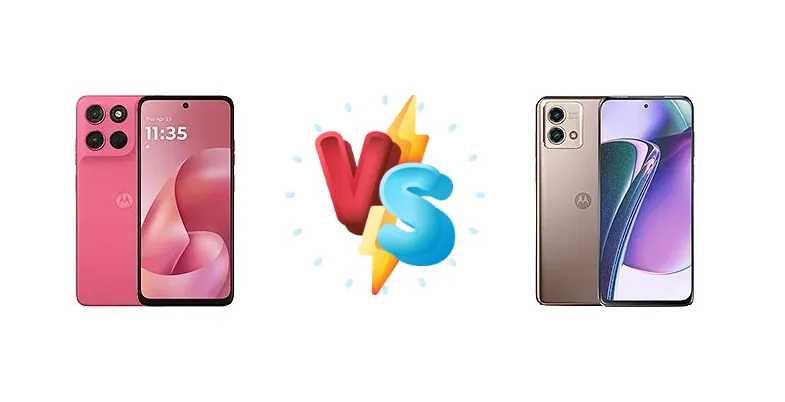
|
🏆 Quick Verdict
For the average user prioritizing all-day battery life and efficient performance, the Motorola Moto G57 Power emerges as the winner. Its Snapdragon 6s Gen 4 chipset, built on a 4nm process, offers a slight edge in efficiency, coupled with faster 33W charging, making it ideal for power users and those frequently on the go.
| PHONES | ||
|---|---|---|
| Phone Names | Motorola Moto G57 Power | Motorola Moto G Stylus 5G (2023) |
| Network | ||
|---|---|---|
| 2G bands | GSM 850 / 900 / 1800 / 1900 | GSM 850 / 900 / 1800 / 1900 |
| 3G bands | HSDPA 850 / 900 / 1900 / 2100 | HSDPA 850 / 900 / 1700(AWS) / 1900 / 2100 |
| 4G bands | 1, 2, 3, 5, 7, 8, 20, 26, 28, 32, 38, 40, 41, 42, 71 - International | 1, 2, 3, 4, 5, 7, 8, 12, 13, 14, 17, 18, 19, 20, 25, 26, 29, 30, 38, 39, 40, 41, 48, 66, 71 |
| 5G bands | 1, 3, 5, 7, 8, 20, 26, 28, 38, 40, 41, 71, 75, 77, 78 SA/NSA/Sub6 - International | 1, 2, 3, 5, 7, 12, 13, 14, 25, 26, 29, 30, 38, 41, 48, 66, 70, 71, 77, 78 SA/NSA |
| Speed | HSPA, LTE, 5G | HSPA, LTE, 5G |
| Technology | GSM / HSPA / LTE / 5G | GSM / HSPA / LTE / 5G |
| Launch | ||
|---|---|---|
| Announced | 2025, November 05 | 2023, May 30 |
| Status | Coming soon. Exp. release 2025, December 03 | Available. Released 2023, June 02 |
| Body | ||
|---|---|---|
| Build | Glass front (Gorilla Glass 7i), plastic frame, silicone polymer (eco leather) back | Glass front, plastic frame, plastic back |
| Dimensions | 166.2 x 76.5 x 8.6 mm (6.54 x 3.01 x 0.34 in) | 162.8 x 73.8 x 9.2 mm (6.41 x 2.91 x 0.36 in) |
| SIM | · Nano-SIM + eSIM - International· Nano-SIM + Nano-SIM - India; other regions | Nano-SIM |
| Weight | 210.6 g (7.44 oz) | 202 g (7.13 oz) |
| Display | ||
|---|---|---|
| Protection | Corning Gorilla Glass 7i | - |
| Resolution | 1080 x 2400 pixels, 20:9 ratio (~392 ppi density) | 1080 x 2400 pixels, 20:9 ratio (~399 ppi density) |
| Size | 6.72 inches, 109.0 cm2 (~85.8% screen-to-body ratio) | 6.6 inches, 105.2 cm2 (~87.5% screen-to-body ratio) |
| Type | IPS LCD, 120Hz, 1050 nits (peak) | IPS LCD, 120Hz |
| Platform | ||
|---|---|---|
| CPU | Octa-core (4x2.4 GHz Cortex-A78 & 4x1.8 GHz Cortex-A55) | Octa-core (4x2.2 GHz Cortex-A78 & 4x1.8 GHz Cortex-A55) |
| Chipset | Qualcomm SM6435-AA Snapdragon 6s Gen 4 (4 nm) | Qualcomm SM6450 Snapdragon 6 Gen 1 (4 nm) |
| GPU | Adreno | Adreno 710 |
| OS | Android 16, planned upgrade to Android 17 | Android 13, planned upgrade to Android 14 |
| Memory | ||
|---|---|---|
| Card slot | No | microSDXC (dedicated slot) |
| Internal | 128GB 8GB RAM, 256GB 8GB RAM, 256GB 12GB RAM | 64GB 4GB RAM, 128GB 4GB RAM, 128GB 6GB RAM, 256GB 6GB RAM |
| Main Camera | ||
|---|---|---|
| Dual | 50 MP, f/1.8 (wide), 1/1.95", 0.8µm, PDAF 8 MP, f/2.2, 120˚ (ultrawide), 1/4.0", 1.12µm | 50 MP, f/1.9, (wide), 1.0µm, PDAF 8 MP, f/2.2, (ultrawide), 1/4.0", 1.12µm, AF |
| Features | LED flash, HDR, panorama | LED flash, HDR, panorama |
| Video | 1440p@30fps, 1080p@30fps | 4K@30fps, 1080p@30/60fps |
| Selfie camera | ||
|---|---|---|
| Features | HDR | HDR |
| Single | 8 MP, f/2.2, (wide), 1/4.0", 1.12µm | 16 MP, f/2.5, (wide), 1.0µm |
| Video | 1440p@30fps, 1080p@30fps | 1080p@30fps |
| Sound | ||
|---|---|---|
| 35mm jack | Yes | Yes |
| Loudspeaker | Yes, with stereo speakers (with Dolby Atmos) | Yes, with stereo speakers |
| Comms | ||
|---|---|---|
| Bluetooth | 5.1, A2DP, LE | 5.1, A2DP, LE |
| NFC | Yes (market/region dependent) | Yes |
| Positioning | GPS, GALILEO, GLONASS, BDS, QZSS | GPS (L1+L5), GALILEO |
| Radio | FM radio | FM radio |
| USB | USB Type-C 2.0, OTG | USB Type-C 2.0 |
| WLAN | Wi-Fi 802.11 a/b/g/n/ac, dual-band | Wi-Fi 802.11 a/b/g/n/ac, dual-band |
| Features | ||
|---|---|---|
| Sensors | Fingerprint (side-mounted), accelerometer, gyro, proximity, compass | Fingerprint (side-mounted), accelerometer, gyro, proximity, compass, barometer |
| Battery | ||
|---|---|---|
| Charging | 30W/33W wired | 20W wired |
| Type | Si/C Li-Ion 7000 mAh | Li-Po 5000 mAh |
| Misc | ||
|---|---|---|
| Colors | Pantone: Fluidity, Pink Lemonade, Corsair, Meteorite, Regatta | Cosmic Black, Rose Champagne |
| Models | - | XT2315-1, XT2315-4 |
| Price | About 250 EUR | $ 93.43 |
Motorola Moto G57 Power
- Faster 33W charging for quicker top-ups
- More efficient Snapdragon 6s Gen 4 chipset for longer battery life
- Slightly higher CPU clock speeds for improved responsiveness
- Potentially slightly less GPU performance than the G Stylus 5G
- Camera performance may be similar to the G Stylus 5G
Motorola Moto G Stylus 5G (2023)
- Slightly more powerful processor for occasional gaming
- Potentially faster image processing due to the processor
- Similar overall feature set to the G57 Power
- Slower 20W charging
- Less efficient processor leading to shorter battery life
- May experience more thermal throttling under sustained load
Display Comparison
Neither device boasts a flagship-level display, but both likely utilize IPS LCD panels, typical for this price bracket. While specific display specs (resolution, brightness) are missing, the focus here is on the underlying processors. Display quality will likely be similar, with the user experience dictated more by software optimization than panel capabilities. Bezels are expected to be comparable, reflecting the budget-conscious design.
Camera Comparison
Without detailed camera specifications, a direct comparison is difficult. However, Motorola typically employs similar camera setups across its G series. The image processing algorithms will likely be the differentiating factor. Both phones will likely feature a primary camera, ultrawide, and potentially a macro lens. The G Stylus 5G's slightly more powerful processor *could* allow for faster image processing, but this is speculative. The presence of Optical Image Stabilization (OIS) would be a significant advantage, but is not confirmed for either device.
Performance
The core difference lies in the chipsets. The Moto G57 Power features the Qualcomm Snapdragon 6s Gen 4 (4nm), while the G Stylus 5G (2023) uses the Snapdragon 6 Gen 1 (4nm). Both are 4nm chips, but the 6s Gen 4 features a slightly higher peak CPU clock speed (2.4 GHz vs 2.2 GHz on the Cortex-A78 cores). This translates to a marginal performance advantage in CPU-intensive tasks for the G57 Power. However, the GPU performance is likely similar. The G Stylus 5G might show a slight edge in graphically demanding applications, but the difference will be minimal. Both devices likely utilize LPDDR4X RAM, limiting memory bandwidth, but the more efficient Snapdragon 6s Gen 4 in the G57 Power will likely result in better sustained performance under load.
Battery Life
The Moto G57 Power’s 30W/33W charging is a clear advantage over the G Stylus 5G’s 20W charging. This faster charging speed will significantly reduce the time required to replenish the battery. While the exact battery capacity of both devices is not provided, the G57 Power’s more efficient Snapdragon 6s Gen 4 chipset will likely deliver longer battery life, even with a similar capacity. The 4nm process node contributes to lower power consumption, extending usage between charges.
Buying Guide
Buy the Motorola Moto G57 Power if you need exceptional battery endurance and a chipset optimized for sustained performance during everyday tasks. It’s the better choice for users who prioritize longevity and don’t require the absolute highest processing power for demanding games. Buy the Motorola Moto G Stylus 5G (2023) if you prefer a slightly more powerful processor for occasional gaming or multitasking, and are willing to trade some battery life and charging speed for that extra performance boost.