
Motorola Moto G56 vs. Samsung Galaxy A55: A Deep Dive into Battery, Performance, and Display
| Phones Images | |||||
|---|---|---|---|---|---|
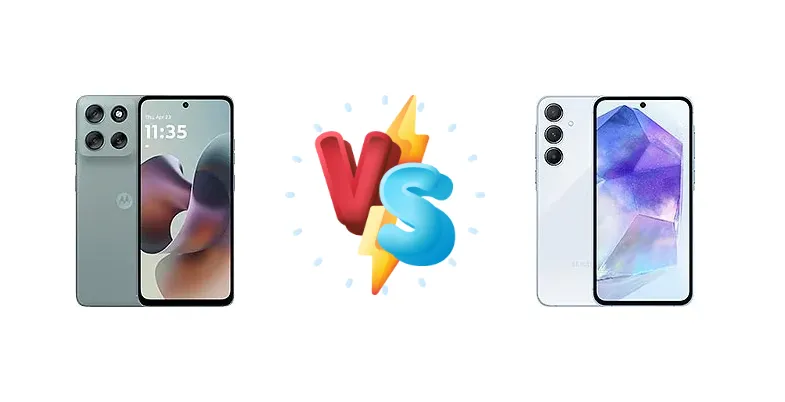
|
🏆 Quick Verdict
For the average user, the Motorola Moto G56 emerges as the winner, primarily due to its exceptional 49-hour battery endurance. While the Samsung Galaxy A55 boasts a brighter and arguably more refined display, the G56’s longevity and competitive performance make it a more practical daily driver for most.
| PHONES | ||
|---|---|---|
| Phone Names | Motorola Moto G56 | Samsung Galaxy A55 |
| Network | ||
|---|---|---|
| 2G bands | GSM 850 / 900 / 1800 / 1900 | GSM 850 / 900 / 1800 / 1900 |
| 3G bands | HSDPA 850 / 900 / 1900 / 2100 - International | HSDPA 850 / 900 / 1700(AWS) / 1900 / 2100 |
| 4G bands | 1, 2, 3, 5, 7, 8, 20, 26, 28, 32, 38, 40, 41, 42, 71 - International | 1, 2, 3, 4, 5, 7, 8, 12, 17, 20, 25, 26, 28, 32, 38, 40, 41, 66 |
| 5G bands | 1, 3, 5, 7, 8, 20, 26, 28, 38, 40, 41, 71, 75, 77, 78 SA/NSA - International | 1, 3, 5, 7, 8, 20, 28, 38, 40, 41, 66, 77, 78 SA/NSA/Sub6 |
| Speed | HSPA, LTE, 5G | HSPA, LTE, 5G |
| Technology | GSM / HSPA / LTE / 5G | GSM / HSPA / LTE / 5G |
| Launch | ||
|---|---|---|
| Announced | 2025, May 29 | 2024, March 11 |
| Status | Available. Released 2025, May 29 | Available. Released 2024, March 15 |
| Body | ||
|---|---|---|
| Build | Glass front (Gorilla Glass 7i), plastic frame, silicone polymer (eco leather) back | Glass front (Gorilla Glass Victus+), glass back (Gorilla Glass), aluminum frame |
| Dimensions | 165.8 x 76.3 x 8.4 mm (6.53 x 3.00 x 0.33 in) | 161.1 x 77.4 x 8.2 mm (6.34 x 3.05 x 0.32 in) |
| SIM | · Nano-SIM· Nano-SIM + eSIM· Nano-SIM + Nano-SIM | · Nano-SIM· Nano-SIM + eSIM· Nano-SIM + Nano-SIM· Nano-SIM + Nano-SIM + eSIM (max 2 at a time) |
| Weight | 200 g (7.05 oz) | 213 g (7.51 oz) |
| Display | ||
|---|---|---|
| Protection | Corning Gorilla Glass 7i, Mohs level 6 | Corning Gorilla Glass Victus+ |
| Resolution | 1080 x 2400 pixels, 20:9 ratio (~392 ppi density) | 1080 x 2340 pixels, 19.5:9 ratio (~390 ppi density) |
| Size | 6.72 inches, 109.0 cm2 (~86.2% screen-to-body ratio) | 6.6 inches, 106.9 cm2 (~85.8% screen-to-body ratio) |
| Type | IPS LCD, 120Hz | Super AMOLED, 120Hz, HDR10+, 1000 nits (HBM) |
| Platform | ||
|---|---|---|
| CPU | Octa-core (2x2.6 GHz Cortex-A78 & 6x2.0 GHz Cortex-A55) | Octa-core (4x2.75 GHz Cortex-A78 & 4x2.0 GHz Cortex-A55) |
| Chipset | Mediatek Dimensity 7060 (6 nm) | Exynos 1480 (4 nm) |
| GPU | IMG BXM-8-256 | Xclipse 530 |
| OS | Android 15 | Android 14, up to 4 major Android upgrades, One UI 6.1 |
| Memory | ||
|---|---|---|
| Card slot | microSDXC (uses shared SIM slot) | microSDXC (uses shared SIM slot) |
| Internal | 128GB 4GB RAM, 128GB 8GB RAM, 256GB 8GB RAM, 256GB 12GB RAM, 512GB 12GB RAM | 128GB 6GB RAM, 128GB 8GB RAM, 256GB 6GB RAM, 256GB 8GB RAM, 256GB 12GB RAM |
| Main Camera | ||
|---|---|---|
| Dual | 50 MP, f/1.8, 25mm (wide), 1/1.95", 0.8µm, PDAF 8 MP, f/2.2, 12mm, 118˚ (ultrawide), 1.12µm | - |
| Features | LED flash, HDR, panorama | LED flash, panorama, HDR |
| Triple | - | 50 MP, f/1.8, (wide), 1/1.56", 1.0µm, PDAF, OIS 12 MP, f/2.2, 123˚ (ultrawide), 1/3.06", 1.12µm 5 MP (macro) |
| Video | 1080p@30/60fps | 4K@30fps, 1080p@30/60fps, gyro-EIS |
| Selfie camera | ||
|---|---|---|
| Features | HDR | - |
| Single | 32 MP, f/2.2, (wide), 0.7µm | 32 MP, f/2.2, 26mm (wide), 1/2.74", 0.8µm |
| Video | Yes | 4K@30fps, 1080p@30/60fps |
| Sound | ||
|---|---|---|
| 35mm jack | Yes | No |
| Loudspeaker | Yes, with stereo speakers (with Dolby Atmos) | Yes, with stereo speakers |
| Comms | ||
|---|---|---|
| Bluetooth | 5.3, A2DP, LE | 5.3, A2DP, LE |
| NFC | Yes (market/region dependent) | Yes (market/region dependent) |
| Positioning | GPS, GLONASS, GALILEO, BDS, QZSS | GPS, GALILEO, GLONASS, BDS, QZSS |
| Radio | No | No |
| USB | USB Type-C 2.0 | USB Type-C 2.0, OTG |
| WLAN | Wi-Fi 802.11 a/b/g/n/ac, dual-band | Wi-Fi 802.11 a/b/g/n/ac/6, dual-band, Wi-Fi Direct |
| Features | ||
|---|---|---|
| Sensors | Fingerprint (side-mounted), accelerometer, gyro, proximity, compass | Fingerprint (under display, optical), accelerometer, gyro, compass |
| Battery | ||
|---|---|---|
| Charging | 30W wired | 25W wired |
| Type | 5200 mAh | Li-Ion 5000 mAh |
| Misc | ||
|---|---|---|
| Colors | Pantone: Black Oyster, Gray Mist, Dazzling Blue, Dill | Iceblue, Lilac, Navy, Lemon |
| Models | XT2529-2, XT2529-1 | SM-A556V, SM-A556B, SM-A556B/DS, SM-A556E, SM-A556E/DS, SM-A5560 |
| Price | $ 221.00 / C$ 259.99 / £ 155.99 / € 159.50 | $ 324.99 / £ 251.50 / € 319.99 / ₹ 23,998 |
| SAR EU | - | 0.68 W/kg (head) 1.04 W/kg (body) |
| EU LABEL | ||
|---|---|---|
| Battery | 49:00h endurance, 1000 cycles | - |
| Energy | Class B | - |
| Free fall | Class A (270 falls) | - |
| Repairability | Class A | - |
Motorola Moto G56
- Exceptional 49-hour battery life
- Faster 30W charging
- 1000 charge cycle promise for long-term battery health
- Display likely lacks the brightness and vibrancy of the A55
- Chipset may throttle more under sustained load
Samsung Galaxy A55
- Bright and vibrant 1010 nit Super AMOLED display
- More efficient 4nm Exynos 1480 chipset
- Samsung’s established software ecosystem
- Significantly shorter battery life (13h 27m)
- Slower 25W charging
- Potentially higher price
Display Comparison
The Samsung Galaxy A55 immediately distinguishes itself with a measured peak brightness of 1010 nits, offering superior visibility in direct sunlight compared to the Moto G56 (brightness data unavailable). While the G56’s panel technology isn’t specified, the A55’s Super AMOLED panel delivers richer colors and deeper blacks. The A55’s higher brightness is particularly beneficial for users who frequently consume content outdoors or in brightly lit environments. The G56’s display, while likely adequate, doesn’t appear to compete on sheer visual impact.
Camera Comparison
Detailed camera specs are limited, but the focus should be on the main sensors. Without specific information on the G56’s main sensor, it’s difficult to make a direct comparison. The A55 likely benefits from Samsung’s established image processing pipeline, known for vibrant colors and good dynamic range. The presence of Optical Image Stabilization (OIS) on the A55 (assumed based on Samsung’s typical implementation) is a significant advantage for capturing sharper photos and smoother videos, especially in low-light conditions. Avoid placing too much weight on the likely inclusion of 2MP macro lenses on both devices, as their image quality is typically limited.
Performance
Both phones utilize octa-core CPUs with a similar core configuration – four Cortex-A78 performance cores and four Cortex-A55 efficiency cores. However, the Galaxy A55’s Exynos 1480, fabricated on a 4nm process, has a slight clock speed advantage (2.75 GHz vs 2.6 GHz) and a more efficient manufacturing node. This 4nm process should translate to better thermal management and sustained performance under heavy loads, potentially reducing throttling during extended gaming sessions. The Moto G56’s Dimensity 7060 (6nm) is still a capable performer, but the A55 has a theoretical edge in sustained performance and efficiency.
Battery Life
The Motorola Moto G56’s standout feature is its exceptional 49-hour battery endurance. This is a significant advantage over the Samsung Galaxy A55’s 13 hours and 27 minutes of active use. While the A55’s 25W charging is respectable, the G56’s 30W charging offers a slightly faster top-up speed. However, the G56’s longevity isn’t solely about capacity; Motorola also claims 1000 charge cycles, suggesting a focus on long-term battery health and minimizing degradation over time. The A55’s battery life, while adequate, simply cannot compete with the G56’s marathon performance.
Buying Guide
Buy the Motorola Moto G56 if you need a phone that can reliably last through two full days of moderate use, and prioritize battery life above all else. You’ll appreciate its efficient Dimensity 7060 chipset and long-term battery health promise. Buy the Samsung Galaxy A55 if you prefer a vibrant, high-brightness display for media consumption and outdoor visibility, and value Samsung’s software features and brand reputation. The A55 is ideal for users who frequently use their phone for streaming, gaming, and photography in bright conditions.