
Motorola Moto G56 vs. Nothing Phone (2a) Plus: A Deep Dive Comparison
| Phones Images | |||||
|---|---|---|---|---|---|
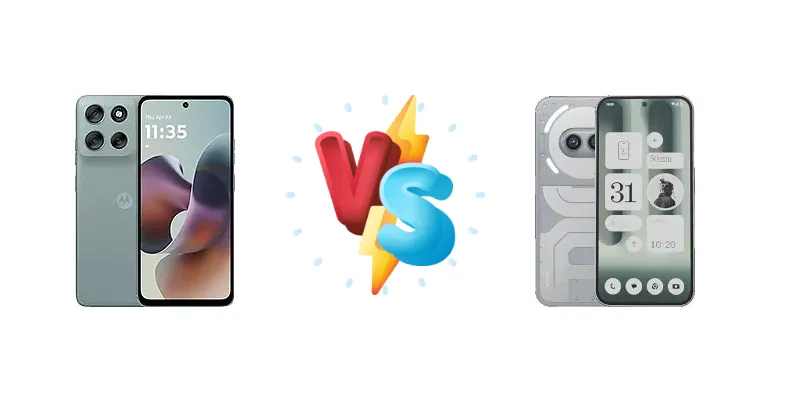
|
🏆 Quick Verdict
For the average user prioritizing longevity and value, the Motorola Moto G56 emerges as the winner. Its remarkable 49-hour battery endurance significantly outpaces the Nothing Phone (2a) Plus’s 16:34h score. However, users who demand faster performance and a brighter screen will find the Nothing Phone (2a) Plus a compelling alternative.
| PHONES | ||
|---|---|---|
| Phone Names | Motorola Moto G56 | Nothing Phone (2a) Plus |
| Network | ||
|---|---|---|
| 2G bands | GSM 850 / 900 / 1800 / 1900 | GSM 850 / 900 / 1800 / 1900 |
| 3G bands | HSDPA 850 / 900 / 1900 / 2100 - International | HSDPA 800 / 850 / 900 / 1700(AWS) / 1900 / 2100 |
| 4G bands | 1, 2, 3, 5, 7, 8, 20, 26, 28, 32, 38, 40, 41, 42, 71 - International | 1, 3, 4, 5, 7, 8, 18, 19, 20, 26, 28, 38, 39, 40, 41, 42, 66 |
| 5G bands | 1, 3, 5, 7, 8, 20, 26, 28, 38, 40, 41, 71, 75, 77, 78 SA/NSA - International | 1, 3, 5, 7, 8, 20, 28, 38, 40, 41, 66, 77, 78 SA/NSA |
| Speed | HSPA, LTE, 5G | HSPA, LTE, 5G |
| Technology | GSM / HSPA / LTE / 5G | GSM / HSPA / LTE / 5G |
| Launch | ||
|---|---|---|
| Announced | 2025, May 29 | 2024, July 31 |
| Status | Available. Released 2025, May 29 | Available. Released 2024, August 03 |
| Body | ||
|---|---|---|
| Build | Glass front (Gorilla Glass 7i), plastic frame, silicone polymer (eco leather) back | Glass front (Gorilla Glass 5), plastic frame, plastic back |
| Dimensions | 165.8 x 76.3 x 8.4 mm (6.53 x 3.00 x 0.33 in) | 161.7 x 76.3 x 8.5 mm (6.37 x 3.00 x 0.33 in) |
| SIM | · Nano-SIM· Nano-SIM + eSIM· Nano-SIM + Nano-SIM | Nano-SIM + Nano-SIM |
| Weight | 200 g (7.05 oz) | 190 g (6.70 oz) |
| Display | ||
|---|---|---|
| Protection | Corning Gorilla Glass 7i, Mohs level 6 | Corning Gorilla Glass 5 |
| Resolution | 1080 x 2400 pixels, 20:9 ratio (~392 ppi density) | 1080 x 2412 pixels, 20:9 ratio (~395 ppi density) |
| Size | 6.72 inches, 109.0 cm2 (~86.2% screen-to-body ratio) | 6.7 inches, 107.5 cm2 (~87.1% screen-to-body ratio) |
| Type | IPS LCD, 120Hz | AMOLED, 1B colors, 120Hz, 2160Hz PWM, HDR10+, 700 nits (typ), 1100 nits (HBM), 1300 nits (peak) |
| Platform | ||
|---|---|---|
| CPU | Octa-core (2x2.6 GHz Cortex-A78 & 6x2.0 GHz Cortex-A55) | Octa-core (2x3.0 GHz Cortex-A715 & 6x 2.0 GHz Cortex-A510) |
| Chipset | Mediatek Dimensity 7060 (6 nm) | Mediatek Dimensity 7350 Pro (4 nm) |
| GPU | IMG BXM-8-256 | Mali-G610 MC4 |
| OS | Android 15 | Android 14, up to 3 major Android upgrades, Nothing OS 3.0 |
| Memory | ||
|---|---|---|
| Card slot | microSDXC (uses shared SIM slot) | No |
| Internal | 128GB 4GB RAM, 128GB 8GB RAM, 256GB 8GB RAM, 256GB 12GB RAM, 512GB 12GB RAM | 256GB 8GB RAM, 256GB 12GB RAM |
| Main Camera | ||
|---|---|---|
| Dual | 50 MP, f/1.8, 25mm (wide), 1/1.95", 0.8µm, PDAF 8 MP, f/2.2, 12mm, 118˚ (ultrawide), 1.12µm | 50 MP, f/1.9, 24mm (wide), 1/1.57", 1.0µm, PDAF, OIS 50 MP, f/2.2, 114˚ (ultrawide), 1/2.76", 0.64µm |
| Features | LED flash, HDR, panorama | LED flash, panorama, HDR |
| Video | 1080p@30/60fps | 4K@30fps, 1080p@60/120fps, gyro-EIS |
| Selfie camera | ||
|---|---|---|
| Features | HDR | HDR |
| Single | 32 MP, f/2.2, (wide), 0.7µm | 50 MP, f/2.2, (wide), 1/2.76" |
| Video | Yes | 4K@30fps |
| Sound | ||
|---|---|---|
| 35mm jack | Yes | No |
| Loudspeaker | Yes, with stereo speakers (with Dolby Atmos) | Yes, with stereo speakers |
| Comms | ||
|---|---|---|
| Bluetooth | 5.3, A2DP, LE | 5.3, A2DP, LE |
| NFC | Yes (market/region dependent) | Yes, 360˚ |
| Positioning | GPS, GLONASS, GALILEO, BDS, QZSS | GPS, GALILEO, GLONASS, BDS, QZSS |
| Radio | No | No |
| USB | USB Type-C 2.0 | USB Type-C 2.0, OTG |
| WLAN | Wi-Fi 802.11 a/b/g/n/ac, dual-band | Wi-Fi 802.11 a/b/g/n/ac/6, dual-band, Wi-Fi Direct |
| Features | ||
|---|---|---|
| Sensors | Fingerprint (side-mounted), accelerometer, gyro, proximity, compass | Fingerprint (under display, optical), accelerometer, gyro, proximity, compass |
| Battery | ||
|---|---|---|
| Charging | 30W wired | 50W wired, 50% in 21 min, 100% in 56 min |
| Type | 5200 mAh | 5000 mAh |
| Misc | ||
|---|---|---|
| Colors | Pantone: Black Oyster, Gray Mist, Dazzling Blue, Dill | Black, Grey |
| Models | XT2529-2, XT2529-1 | A142P |
| Price | $ 221.00 / C$ 259.99 / £ 155.99 / € 159.50 | € 269.90 / ₹ 22,599 |
| EU LABEL | ||
|---|---|---|
| Battery | 49:00h endurance, 1000 cycles | - |
| Energy | Class B | - |
| Free fall | Class A (270 falls) | - |
| Repairability | Class A | - |
Motorola Moto G56
- Exceptional 49-hour battery life
- 1000 charge cycle battery longevity
- Efficient Dimensity 7060 chipset
- Slower 30W charging
- Display brightness likely lower than competitor
Nothing Phone (2a) Plus
- Bright 1097 nit display
- Powerful Dimensity 7350 Pro chipset
- Fast 50W charging (56 min to full)
- Significantly shorter battery life (16:34h)
- Potentially higher thermal throttling under sustained load
Display Comparison
The Nothing Phone (2a) Plus boasts a significantly brighter display, peaking at 1097 nits, making it far more usable in direct sunlight compared to the Moto G56 (brightness data unavailable). While the G56’s panel specifics are unknown, the Nothing Phone (2a) Plus’s brightness advantage is a clear win for outdoor users. The Nothing Phone (2a) Plus likely utilizes a higher-quality panel, offering superior color accuracy and viewing angles, though this requires further testing. The lack of LTPO technology on either device means refresh rate scaling isn't as efficient as on flagship models.
Camera Comparison
Without detailed camera specs for the Moto G56, a direct comparison is limited. However, the Nothing Phone (2a) Plus likely benefits from a more advanced image signal processor (ISP) within the Dimensity 7350 Pro chipset, potentially leading to better image processing and low-light performance. The Nothing Phone (2a) Plus’s camera system is expected to feature a larger main sensor and potentially optical image stabilization (OIS), further enhancing image quality. The presence of a dedicated OIS system on the Nothing Phone (2a) Plus would be a significant advantage for capturing stable videos and sharper photos in challenging lighting conditions.
Performance
The Nothing Phone (2a) Plus’s Mediatek Dimensity 7350 Pro (4nm) offers a clear architectural advantage over the Moto G56’s Dimensity 7060 (6nm). The 4nm process node translates to improved power efficiency and thermal performance, allowing the 7350 Pro to sustain higher clock speeds for longer periods. The CPU configuration – 2x3.0 GHz Cortex-A715 vs 2x2.6 GHz Cortex-A78 – further favors the Nothing Phone (2a) Plus in CPU-intensive tasks. While both phones utilize an octa-core setup, the newer Cortex-A715 cores in the Nothing Phone (2a) Plus deliver a noticeable performance uplift. The G56's Dimensity 7060 is still capable for everyday tasks, but will show its limits in demanding games or multitasking.
Battery Life
The Motorola Moto G56’s standout feature is its exceptional 49-hour battery endurance, a testament to the efficiency of the Dimensity 7060 chipset and likely optimized software. In contrast, the Nothing Phone (2a) Plus achieves 16:34h of active use. While the Nothing Phone (2a) Plus offers significantly faster charging – 50W wired, reaching 50% in 21 minutes and 100% in 56 minutes – the Moto G56’s 30W charging is slower. The G56 also boasts a claimed 1000 charge cycles, suggesting superior long-term battery health. The Nothing Phone (2a) Plus’s faster charging is convenient, but the G56’s longevity is a compelling trade-off.
Buying Guide
Buy the Motorola Moto G56 if you need a phone that can reliably last through two full days of moderate use, and value long-term battery health with its 1000 cycle lifespan. Buy the Nothing Phone (2a) Plus if you prioritize a vibrant, high-brightness display for outdoor visibility and smoother performance for demanding applications and gaming, and are willing to charge more frequently.