
Motorola Moto G56 vs. Google Pixel 8a: A Deep Dive into Mid-Range Champions
| Phones Images | |||||
|---|---|---|---|---|---|
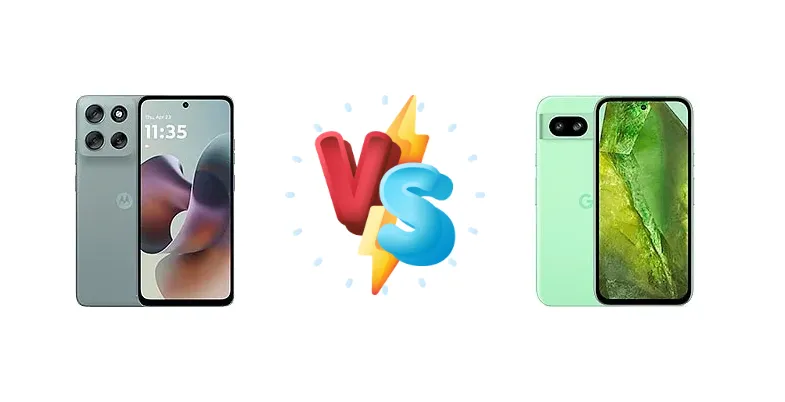
|
🏆 Quick Verdict
For the average user, the Google Pixel 8a emerges as the superior choice. While the Moto G56 boasts impressive battery endurance, the Pixel 8a’s more powerful Google Tensor G3 chipset, brighter display, and superior camera capabilities deliver a more refined and versatile smartphone experience.
| PHONES | ||
|---|---|---|
| Phone Names | Motorola Moto G56 | Google Pixel 8a |
| Network | ||
|---|---|---|
| 2G bands | GSM 850 / 900 / 1800 / 1900 | GSM 850 / 900 / 1800 / 1900 |
| 3G bands | HSDPA 850 / 900 / 1900 / 2100 - International | HSDPA 800 / 850 / 900 / 1700(AWS) / 1900 / 2100 |
| 4G bands | 1, 2, 3, 5, 7, 8, 20, 26, 28, 32, 38, 40, 41, 42, 71 - International | 1, 2, 3, 4, 5, 7, 8, 12, 17, 18, 19, 20, 26, 28, 32, 38, 40, 41, 42, 66 - G6GPR (International) |
| 5G bands | 1, 3, 5, 7, 8, 20, 26, 28, 38, 40, 41, 71, 75, 77, 78 SA/NSA - International | 1, 2, 3, 5, 7, 8, 12, 20, 26, 28, 38, 40, 41, 66, 75, 76, 77, 78 SA/NSA/Sub6 - G6GPR (International) |
| Speed | HSPA, LTE, 5G | HSPA, LTE, 5G |
| Technology | GSM / HSPA / LTE / 5G | GSM / HSPA / LTE / 5G |
| Launch | ||
|---|---|---|
| Announced | 2025, May 29 | 2024, May 07 |
| Status | Available. Released 2025, May 29 | Available. Released 2024, May 14 |
| Body | ||
|---|---|---|
| Build | Glass front (Gorilla Glass 7i), plastic frame, silicone polymer (eco leather) back | Glass front (Gorilla Glass 3), aluminum frame, plastic back |
| Dimensions | 165.8 x 76.3 x 8.4 mm (6.53 x 3.00 x 0.33 in) | 152.1 x 72.7 x 8.9 mm (5.99 x 2.86 x 0.35 in) |
| SIM | · Nano-SIM· Nano-SIM + eSIM· Nano-SIM + Nano-SIM | Nano-SIM + eSIM |
| Weight | 200 g (7.05 oz) | 188 g (6.63 oz) |
| Display | ||
|---|---|---|
| Protection | Corning Gorilla Glass 7i, Mohs level 6 | Corning Gorilla Glass 3, Mohs level 5 |
| Resolution | 1080 x 2400 pixels, 20:9 ratio (~392 ppi density) | 1080 x 2400 pixels, 20:9 ratio (~430 ppi density) |
| Size | 6.72 inches, 109.0 cm2 (~86.2% screen-to-body ratio) | 6.1 inches, 90.3 cm2 (~81.6% screen-to-body ratio) |
| Type | IPS LCD, 120Hz | OLED, HDR, 120Hz, 2000 nits (peak) |
| Platform | ||
|---|---|---|
| CPU | Octa-core (2x2.6 GHz Cortex-A78 & 6x2.0 GHz Cortex-A55) | Nona-core (1x3.0 GHz Cortex-X3 & 4x2.45 GHz Cortex-A715 & 4x2.15 GHz Cortex-A510) |
| Chipset | Mediatek Dimensity 7060 (6 nm) | Google Tensor G3 (4 nm) |
| GPU | IMG BXM-8-256 | Immortalis-G715s MC10 |
| OS | Android 15 | Android 14, upgradable to Android 16, up to 7 major Android upgrades |
| Memory | ||
|---|---|---|
| Card slot | microSDXC (uses shared SIM slot) | No |
| Internal | 128GB 4GB RAM, 128GB 8GB RAM, 256GB 8GB RAM, 256GB 12GB RAM, 512GB 12GB RAM | 128GB 8GB RAM, 256GB 8GB RAM |
| Main Camera | ||
|---|---|---|
| Dual | 50 MP, f/1.8, 25mm (wide), 1/1.95", 0.8µm, PDAF 8 MP, f/2.2, 12mm, 118˚ (ultrawide), 1.12µm | 64 MP (16 MP eff.), f/1.9, 26mm (wide), 1/1.73", 0.8µm, dual pixel PDAF, OIS 13 MP, f/2.2, 120˚ (ultrawide), 1.12µm |
| Features | LED flash, HDR, panorama | Dual-LED flash, Pixel Shift, Ultra HDR, panorama, Best Take |
| Video | 1080p@30/60fps | 4K@30/60fps, 1080p@30/60/120/240fps, OIS |
| Selfie camera | ||
|---|---|---|
| Features | HDR | HDR, panorama |
| Single | 32 MP, f/2.2, (wide), 0.7µm | 13 MP, f/2.2, 20mm (ultrawide), 1.12µm |
| Video | Yes | 4K@30fps, 1080p@30/60fps |
| Sound | ||
|---|---|---|
| 35mm jack | Yes | No |
| Loudspeaker | Yes, with stereo speakers (with Dolby Atmos) | Yes, with stereo speakers |
| Comms | ||
|---|---|---|
| Bluetooth | 5.3, A2DP, LE | 5.3, A2DP, LE |
| NFC | Yes (market/region dependent) | Yes |
| Positioning | GPS, GLONASS, GALILEO, BDS, QZSS | GPS, GLONASS, GALILEO, BDS, QZSS, NavIC |
| Radio | No | No |
| USB | USB Type-C 2.0 | USB Type-C 3.2 |
| WLAN | Wi-Fi 802.11 a/b/g/n/ac, dual-band | Wi-Fi 802.11 a/b/g/n/ac/6e, dual/tri-band (market/region dependent) |
| Features | ||
|---|---|---|
| Sensors | Fingerprint (side-mounted), accelerometer, gyro, proximity, compass | Fingerprint (under display, optical), accelerometer, gyro, proximity, compass, barometer |
| Battery | ||
|---|---|---|
| Charging | 30W wired | 18W wired, PD3.0 7.5W wireless Bypass charging |
| Type | 5200 mAh | Li-Po 4492 mAh |
| Misc | ||
|---|---|---|
| Colors | Pantone: Black Oyster, Gray Mist, Dazzling Blue, Dill | Obsidian, Porcelain, Bay, Aloe |
| Models | XT2529-2, XT2529-1 | GKV4X, G6GPR, G8HHN, G576D |
| Price | $ 221.00 / C$ 259.99 / £ 155.99 / € 159.50 | $ 229.98 / C$ 417.99 / £ 279.00 / € 299.99 / ₹ 33,300 |
| EU LABEL | ||
|---|---|---|
| Battery | 49:00h endurance, 1000 cycles | 40:06h endurance, 1000 cycles |
| Energy | Class B | Class B |
| Free fall | Class A (270 falls) | Class A (270 falls) |
| Repairability | Class A | Class B |
Motorola Moto G56
- Exceptional battery life (49:00h endurance)
- Faster 30W wired charging
- 1000 charge cycle battery longevity
- Less powerful processor than the Pixel 8a
- Likely inferior camera performance
Google Pixel 8a
- Powerful Google Tensor G3 chipset
- Brighter and more vibrant display (1508 nits)
- Superior camera capabilities and Google’s image processing
- Wireless charging and bypass charging
- Shorter battery life (40:06h endurance)
- Slower 18W wired charging
Display Comparison
The Google Pixel 8a significantly outshines the Moto G56 in display quality. Its measured peak brightness of 1508 nits ensures excellent visibility even in direct sunlight, a feature absent from the G56’s specifications. While the G56’s panel details are unknown, the Pixel 8a’s OLED technology promises superior contrast and color accuracy. The Pixel 8a also benefits from Google’s display calibration, ensuring a more visually pleasing experience. We expect the Pixel 8a to have a higher refresh rate as well, contributing to smoother scrolling and animations.
Camera Comparison
While detailed camera specs are missing for the Moto G56, the Pixel 8a is expected to deliver a superior photographic experience. Google’s computational photography prowess, powered by the Tensor G3, is a key differentiator. The Pixel 8a’s image processing algorithms excel in dynamic range, low-light performance, and overall image quality. The G56 will likely offer a competent camera for everyday use, but it won’t match the Pixel 8a’s ability to capture detailed and vibrant photos in challenging conditions. The Pixel 8a’s focus on software optimization will likely yield better results than relying solely on hardware specifications.
Performance
The chipset is where the Pixel 8a truly pulls ahead. The Google Tensor G3, built on a 4nm process, offers a nona-core CPU configuration (1x3.0 GHz Cortex-X3, 4x2.45 GHz Cortex-A715, 4x2.15 GHz Cortex-A510) designed for AI tasks and demanding applications. This contrasts with the Moto G56’s Mediatek Dimensity 7060 (6nm), an octa-core processor (2x2.6 GHz Cortex-A78 & 6x2.0 GHz Cortex-A55). The Tensor G3’s more advanced architecture and smaller node size translate to superior performance and potentially better thermal management, especially during sustained workloads. The Pixel 8a’s CPU includes a Cortex-X3 core, offering a significant performance boost over the G56’s Cortex-A78 cores.
Battery Life
The Moto G56 boasts a significant advantage in battery endurance, with a tested 49:00h rating compared to the Pixel 8a’s 40:06h. However, this doesn’t tell the whole story. The Pixel 8a’s active use score of 11:25h provides a more realistic measure of real-world performance. The G56’s 30W wired charging is faster than the Pixel 8a’s 18W wired charging (with PD3.0), but the Pixel 8a adds the convenience of 7.5W wireless charging and bypass charging, allowing usage while charging. The G56’s 1000 charge cycles suggest good long-term battery health, but the Pixel 8a’s optimized power management could mitigate the difference in capacity.
Buying Guide
Buy the Motorola Moto G56 if you prioritize all-day (and then some) battery life and a consistently smooth experience for everyday tasks. It’s ideal for users who frequently travel or rely heavily on their phone throughout the day without easy access to charging. Buy the Google Pixel 8a if you value a premium camera experience, Google’s AI features, and a brighter, more vibrant display, even if it means slightly less battery endurance and slower charging.