
Moto G55 vs. Google Pixel 8a: A Deep Dive into Battery, Performance, and Value
| Phones Images | |||||
|---|---|---|---|---|---|
|
🏆 Quick Verdict
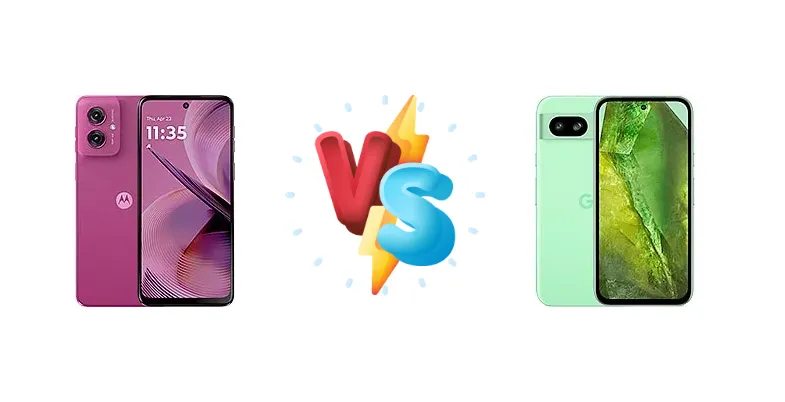
For users prioritizing all-day (and then some) battery life, the Motorola Moto G55 is the clear winner, offering over 52 hours of endurance. However, the Google Pixel 8a delivers a more refined experience with its Tensor G3 chip and superior display, making it ideal for those valuing performance and camera capabilities.
| PHONES | ||
|---|---|---|
| Phone Names | Motorola Moto G55 | Google Pixel 8a |
| Network | ||
|---|---|---|
| 2G bands | GSM 850 / 900 / 1800 / 1900 | GSM 850 / 900 / 1800 / 1900 |
| 3G bands | HSDPA 850 / 900 / 1900 / 2100 - International | HSDPA 800 / 850 / 900 / 1700(AWS) / 1900 / 2100 |
| 4G bands | 1, 2, 3, 5, 7, 8, 20, 26, 28, 32, 38, 40, 41, 42, 66 - International | 1, 2, 3, 4, 5, 7, 8, 12, 17, 18, 19, 20, 26, 28, 32, 38, 40, 41, 42, 66 - G6GPR (International) |
| 5G bands | 1, 3, 5, 7, 8, 20, 26, 28, 38, 40, 41, 77, 78 SA/NSA - International | 1, 2, 3, 5, 7, 8, 12, 20, 26, 28, 38, 40, 41, 66, 75, 76, 77, 78 SA/NSA/Sub6 - G6GPR (International) |
| Speed | HSPA, LTE, 5G | HSPA, LTE, 5G |
| Technology | GSM / HSPA / LTE / 5G | GSM / HSPA / LTE / 5G |
| Launch | ||
|---|---|---|
| Announced | 2024, August 29 | 2024, May 07 |
| Status | Available. Released 2024, September 06 | Available. Released 2024, May 14 |
| Body | ||
|---|---|---|
| Build | Glass front (Gorilla Glass 5), plastic frame, plastic back or silicone polymer (eco leather) back | Glass front (Gorilla Glass 3), aluminum frame, plastic back |
| Dimensions | 161.6 x 73.8 x 8.1 mm (6.36 x 2.91 x 0.32 in) | 152.1 x 72.7 x 8.9 mm (5.99 x 2.86 x 0.35 in) |
| SIM | · Nano-SIM + eSIM· Nano-SIM + Nano-SIM | Nano-SIM + eSIM |
| Weight | 179 g or 182 g (6.31 oz) | 188 g (6.63 oz) |
| Display | ||
|---|---|---|
| Protection | Corning Gorilla Glass 5, Mohs level 4 | Corning Gorilla Glass 3, Mohs level 5 |
| Resolution | 1080 x 2400 pixels, 20:9 ratio (~405 ppi density) | 1080 x 2400 pixels, 20:9 ratio (~430 ppi density) |
| Size | 6.49 inches, 102.2 cm2 (~85.7% screen-to-body ratio) | 6.1 inches, 90.3 cm2 (~81.6% screen-to-body ratio) |
| Type | IPS LCD, 120Hz | OLED, HDR, 120Hz, 2000 nits (peak) |
| Platform | ||
|---|---|---|
| CPU | Octa-core (2x2.5 GHz Cortex-A78 & 6x2.0 GHz Cortex-A55) | Nona-core (1x3.0 GHz Cortex-X3 & 4x2.45 GHz Cortex-A715 & 4x2.15 GHz Cortex-A510) |
| Chipset | Mediatek Dimensity 7025 (6 nm) | Google Tensor G3 (4 nm) |
| GPU | IMG BXM-8-256 | Immortalis-G715s MC10 |
| OS | Android 14 | Android 14, upgradable to Android 16, up to 7 major Android upgrades |
| Memory | ||
|---|---|---|
| Card slot | microSDXC (dedicated slot) | No |
| Internal | 128GB 4GB RAM, 128GB 8GB RAM, 256GB 8GB RAM | 128GB 8GB RAM, 256GB 8GB RAM |
| Main Camera | ||
|---|---|---|
| Dual | 50 MP, f/1.8 (wide), 0.61µm, PDAF, OIS 8 MP, f/2.2, 118˚ (ultrawide), 1.12µm, AF | 64 MP (16 MP eff.), f/1.9, 26mm (wide), 1/1.73", 0.8µm, dual pixel PDAF, OIS 13 MP, f/2.2, 120˚ (ultrawide), 1.12µm |
| Features | LED flash, HDR, panorama | Dual-LED flash, Pixel Shift, Ultra HDR, panorama, Best Take |
| Video | 1080p@30/60fps | 4K@30/60fps, 1080p@30/60/120/240fps, OIS |
| Selfie camera | ||
|---|---|---|
| Features | HDR | HDR, panorama |
| Single | 16 MP, f/2.4, (wide), 1.0µm | 13 MP, f/2.2, 20mm (ultrawide), 1.12µm |
| Video | 1080p@30fps | 4K@30fps, 1080p@30/60fps |
| Sound | ||
|---|---|---|
| 35mm jack | Yes | No |
| Loudspeaker | Yes, with stereo speakers | Yes, with stereo speakers |
| Comms | ||
|---|---|---|
| Bluetooth | 5.3, A2DP, LE | 5.3, A2DP, LE |
| NFC | Yes (market/region dependent) | Yes |
| Positioning | GPS, GLONASS, GALILEO, BDS, QZSS | GPS, GLONASS, GALILEO, BDS, QZSS, NavIC |
| Radio | FM radio | No |
| USB | USB Type-C 2.0 | USB Type-C 3.2 |
| WLAN | Wi-Fi 802.11 a/b/g/n/ac, dual-band | Wi-Fi 802.11 a/b/g/n/ac/6e, dual/tri-band (market/region dependent) |
| Features | ||
|---|---|---|
| Sensors | Fingerprint (side-mounted), accelerometer, gyro, proximity, compass | Fingerprint (under display, optical), accelerometer, gyro, proximity, compass, barometer |
| Battery | ||
|---|---|---|
| Charging | 30W wired | 18W wired, PD3.0 7.5W wireless Bypass charging |
| Type | Li-Po 5000 mAh | Li-Po 4492 mAh |
| Misc | ||
|---|---|---|
| Colors | Forest Grey, Smoky Green, Twilight Purple | Obsidian, Porcelain, Bay, Aloe |
| Models | XT2435-2 | GKV4X, G6GPR, G8HHN, G576D |
| Price | € 157.50 / $ 185.00 | $ 229.98 / C$ 417.99 / £ 279.00 / € 299.99 / ₹ 33,300 |
| EU LABEL | ||
|---|---|---|
| Battery | 52:04h endurance, 800 cycles | 40:06h endurance, 1000 cycles |
| Energy | Class B | Class B |
| Free fall | Class B (180 falls) | Class A (270 falls) |
| Repairability | Class B | Class B |
Motorola Moto G55
- Exceptional battery life (52:04h endurance)
- High battery cycle count (800 cycles)
- Efficient Dimensity 7025 chipset
- Likely less powerful processor than Tensor G3
- Display brightness and quality likely inferior to Pixel 8a
Google Pixel 8a
- Powerful Google Tensor G3 processor
- Bright and vibrant OLED display (1508 nits)
- Advanced camera features and image processing
- Shorter battery life (40:06h endurance)
- Slower charging speed (18W wired)
Display Comparison
The Google Pixel 8a boasts a significantly brighter display, reaching a measured peak of 1508 nits, compared to an unstated value for the Moto G55. This brightness advantage translates to superior visibility in direct sunlight. While the Moto G55’s panel technology isn’t specified, the Pixel 8a’s OLED panel delivers vibrant colors and deep blacks. The Pixel 8a’s smaller size (6.1” vs. likely 6.6” for the G55) also contributes to a higher pixel density, resulting in a sharper image. Bezels are expected to be slimmer on the Pixel 8a, further enhancing the viewing experience.
Camera Comparison
Without detailed camera specs for the Moto G55, it’s difficult to make a direct comparison. However, the Pixel 8a benefits from Google’s renowned computational photography expertise. The Pixel 8a’s image processing algorithms excel in dynamic range, low-light performance, and portrait mode. While sensor size isn’t specified for either phone, the Pixel 8a’s focus on software optimization allows it to extract more detail and clarity from its sensor. The G55 likely includes standard camera features, but will likely lack the advanced features like Magic Eraser and Photo Unblur found on the Pixel 8a.
Performance
The Google Pixel 8a’s Tensor G3, built on a 4nm process, offers a more complex CPU configuration – a nona-core setup with a Cortex-X3 prime core – compared to the Moto G55’s octa-core Dimensity 7025 (6nm). The Cortex-X3 in the Tensor G3 provides a substantial performance uplift in single-core tasks and AI processing. While the Dimensity 7025 is a capable chip, the Tensor G3’s architecture is geared towards more demanding applications and Google’s machine learning features. The Pixel 8a’s RAM configuration (likely LPDDR5x) is also expected to be faster than the G55’s, contributing to smoother multitasking. The 4nm process of the Tensor G3 also implies better thermal efficiency, potentially reducing throttling during sustained workloads.
Battery Life
The Motorola Moto G55 shines in battery endurance, achieving an impressive 52:04 hours of usage, and a remarkable 800 charge cycles. This significantly surpasses the Pixel 8a’s 40:06 hours of endurance and 1000 cycles. However, the Pixel 8a offers faster charging with 18W wired charging (PD3.0) and 7.5W wireless charging, while the G55 is limited to 30W wired charging. The Pixel 8a also features bypass charging, allowing it to charge directly to the battery without warming up the phone, potentially extending battery lifespan. The G55’s larger endurance rating suggests a more efficient chipset and optimized power management, despite the Pixel 8a’s active use score of 11:25h.
Buying Guide
Buy the Motorola Moto G55 if you need a phone that can reliably last through two full days of moderate use, and value long-term battery health with its 800 cycle rating. Buy the Google Pixel 8a if you prefer a smoother, more responsive user experience, a brighter and more color-accurate display, and benefit from Google’s exclusive software features like Magic Eraser and Best Take.