
Moto G54 Power vs. Google Pixel 7a: A Deep Dive into Battery, Performance, and Value
| Phones Images | |||||
|---|---|---|---|---|---|
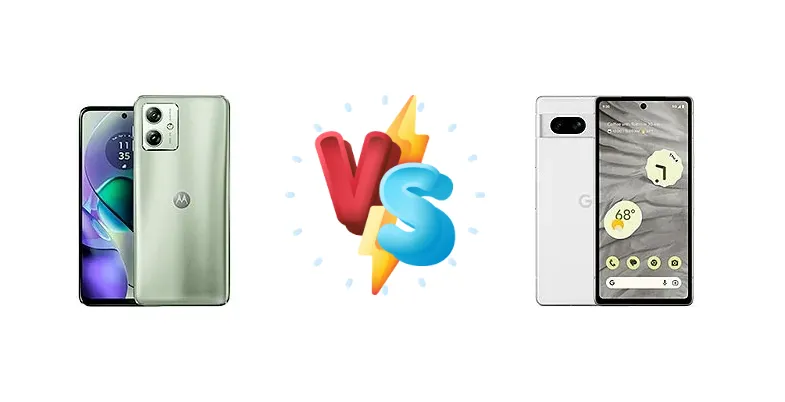
|
🏆 Quick Verdict
For users prioritizing all-day (and then some) battery life, the Motorola Moto G54 Power is the clear winner, offering over 13 hours of active use. However, the Google Pixel 7a delivers a significantly smoother and more responsive experience thanks to its Tensor G2 chipset, making it the better choice for power users and photography enthusiasts.
| PHONES | ||
|---|---|---|
| Phone Names | Motorola Moto G54 Power | Google Pixel 7a |
| Network | ||
|---|---|---|
| 2G bands | GSM 850 / 900 / 1800 / 1900 | GSM 850 / 900 / 1800 / 1900 |
| 3G bands | HSDPA 850 / 900 / 1900 / 2100 | HSDPA 800 / 850 / 900 / 1700(AWS) / 1900 / 2100 |
| 4G bands | 1, 2, 3, 5, 7, 8, 18, 19, 20, 26, 28, 32, 38, 40, 41, 42 | 1, 2, 3, 4, 5, 7, 8, 12, 13, 14, 17, 20, 25, 26, 28, 29, 30, 38, 40, 41, 48, 66, 71 - GWKK3, G0DZQ |
| 5G bands | 1, 2, 3, 5, 7, 8, 20, 28, 38, 40, 41, 66, 77, 78 SA/NSA | 1, 2, 3, 5, 7, 8, 12, 14, 20, 25, 28, 30, 38, 41, 48, 66, 71, 77, 78 SA/NSA/Sub6 - GWKK3 |
| Speed | HSPA, LTE, 5G | HSPA, LTE, 5G |
| Technology | GSM / HSPA / LTE / 5G | GSM / HSPA / LTE / 5G |
| - | 1, 2, 3, 5, 7, 8, 12, 20, 25, 28, 38, 40, 41, 66, 75, 76, 77, 78, 79 SA/NSA/Sub6 - GHL1X, G82U8 | |
| Launch | ||
|---|---|---|
| Announced | 2023, September 05 | 2023, May 10 |
| Status | Available. Released 2023, September | Available. Released 2023, May 10 |
| Body | ||
|---|---|---|
| Build | Glass front, plastic back, plastic frame | Glass front (Gorilla Glass 3), aluminum frame, plastic back |
| Dimensions | 161.6 x 73.8 x 8.9 mm (6.36 x 2.91 x 0.35 in) | 152 x 72.9 x 9 mm (5.98 x 2.87 x 0.35 in) |
| SIM | · Nano-SIM + eSIM· Nano-SIM + Nano-SIM | Nano-SIM + eSIM |
| Weight | 192 g (6.77 oz) | 193.5 g (6.84 oz) |
| - | IP67 dust/water resistant (up to 1m for 30 min) | |
| Display | ||
|---|---|---|
| Protection | - | Corning Gorilla Glass 3 |
| Resolution | 1080 x 2400 pixels, 20:9 ratio (~405 ppi density) | 1080 x 2400 pixels, 20:9 ratio (~429 ppi density) |
| Size | 6.5 inches, 102.0 cm2 (~85.5% screen-to-body ratio) | 6.1 inches, 90.7 cm2 (~81.8% screen-to-body ratio) |
| Type | IPS LCD, 120Hz | OLED, HDR, 90Hz |
| - | Always-on display | |
| Platform | ||
|---|---|---|
| CPU | Octa-core (2x2.2 GHz Cortex-A78 & 6x2.0 GHz Cortex-A55) | Octa-core (2x2.85 GHz Cortex-X1 & 2x2.35 GHz Cortex-A78 & 4x1.80 GHz Cortex-A55) |
| Chipset | Mediatek Dimensity 7020 (6 nm) | Google Tensor G2 (5 nm) |
| GPU | IMG BXM-8-256 | Mali-G710 MP7 |
| OS | Android 13 | Android 13, upgradable to Android 15, up to 5 major Android upgrades |
| Memory | ||
|---|---|---|
| Card slot | microSDXC (uses shared SIM slot) | No |
| Internal | 128GB 8GB RAM, 256GB 12GB RAM, 256GB 8GB RAM | 128GB 8GB RAM |
| - | UFS 3.1 | |
| Main Camera | ||
|---|---|---|
| Dual | 50 MP, f/1.8 (wide), 0.61µm, PDAF, OIS 8 MP, f/2.2, 118˚ (ultrawide), 1.12µm, AF | 64 MP, f/1.9, 26mm (wide), 1/1.73", 0.8µm, dual pixel PDAF, OIS 13 MP, f/2.2, 120˚ (ultrawide), 1.12µm |
| Features | LED flash, HDR, panorama | Dual-LED flash, Pixel Shift, Auto-HDR, panorama |
| Video | 1080p@30fps | 4K@30/60fps, 1080p@30/60/120/240fps, OIS |
| Selfie camera | ||
|---|---|---|
| Features | HDR | HDR, panorama |
| Single | 16 MP, f/2.4, (wide), 1.0µm | 13 MP, f/2.2, 20mm (ultrawide), 1.12µm |
| Video | 1080p@30fps | 4K@30fps, 1080p@30fps |
| Sound | ||
|---|---|---|
| 3.5mm jack | - | No |
| 35mm jack | Yes | No |
| Loudspeaker | Yes, with stereo speakers | Yes, with stereo speakers |
| Comms | ||
|---|---|---|
| Bluetooth | 5.3, A2DP, LE | 5.3, A2DP, LE |
| NFC | Yes (market/region dependent) | Yes |
| Positioning | GPS, GLONASS, GALILEO, BDS, QZSS | GPS, GLONASS, GALILEO, BDS, QZSS, NavIC |
| Radio | FM radio | No |
| USB | USB Type-C 2.0, OTG | USB Type-C 3.2 |
| WLAN | Wi-Fi 802.11 a/b/g/n/ac, dual-band | Wi-Fi 802.11 a/b/g/n/ac/6e, tri-band |
| Features | ||
|---|---|---|
| Sensors | Fingerprint (side-mounted), accelerometer, gyro, proximity, compass | Fingerprint (under display, optical), accelerometer, gyro, proximity, compass, barometer |
| Battery | ||
|---|---|---|
| Charging | 33W wired, PD3.0, QC3+, 50% in 33 min Reverse wired | 18W wired, PD3.0 7.5W wireless |
| Type | Li-Po 6000 mAh | Li-Po 4385 mAh |
| Misc | ||
|---|---|---|
| Colors | Midnight Blue, Pearl Blue, Mint Green | Charcoal, Snow, Sea, Coral |
| Models | XT2343-6 | GWKK3, GHL1X, G0DZQ, G82U8 |
| Price | € 163.20 | € 179.90 / $ 150.00 / £ 170.00 / ₹ 25,980 |
Motorola Moto G54 Power
- Exceptional battery life (13:54h active use)
- Faster charging (33W) with multiple standards
- Reverse wired charging capability
- Less powerful processor compared to the Pixel 7a
- Lower display brightness and potentially lower refresh rate
Google Pixel 7a
- Superior processor performance (Google Tensor G2)
- Brighter display for outdoor visibility
- Excellent camera with Google’s image processing
- Slower charging speed (18W)
- Shorter battery life compared to the Moto G54 Power
Display Comparison
The Pixel 7a boasts a significantly brighter display, reaching 1070 nits compared to the Moto G54 Power’s 489 nits. This translates to superior visibility outdoors under direct sunlight. While the Moto G54 Power offers a respectable 1569:1 contrast ratio, the Pixel 7a’s OLED panel inherently provides better blacks and overall image quality. Neither specification details refresh rate, but the Pixel 7a is known to have a 90Hz panel, offering smoother scrolling and animations, a feature likely absent on the G54 Power.
Camera Comparison
Both phones offer photo and video capabilities, but the Pixel 7a leverages Google’s renowned computational photography algorithms. While sensor sizes aren’t specified, the Pixel 7a’s image processing excels in dynamic range and low-light performance. The Moto G54 Power likely relies more on hardware capabilities, and while it can produce good results, it won’t match the Pixel’s consistently high image quality. The absence of details regarding OIS on the G54 Power suggests it may struggle with video stabilization compared to the Pixel 7a.
Performance
The Google Pixel 7a’s Tensor G2 (5nm) chipset, with its Cortex-X1 prime core clocked at 2.85 GHz, demonstrably outperforms the Motorola Moto G54 Power’s Dimensity 7020 (6nm) in CPU-intensive tasks. The Tensor G2’s architecture, including the dedicated TPU for AI processing, provides a smoother experience in tasks like image processing and voice recognition. While the Dimensity 7020 is a capable chip, its Cortex-A78 cores at 2.2 GHz are less efficient than the X1 cores in the Pixel. The 5nm process node of the Tensor G2 also contributes to better thermal efficiency, potentially reducing throttling during sustained workloads.
Battery Life
The Motorola Moto G54 Power shines in battery endurance, achieving an impressive 13:54h of active use. This is likely due to the efficient Dimensity 7020 chipset and optimized software. The Pixel 7a, with an older endurance rating of 76h, falls behind, though still respectable. The G54 Power’s 33W charging with PD3.0 and QC3+ allows for a 50% charge in 33 minutes, while the Pixel 7a’s 18W charging is considerably slower. The G54 Power also offers reverse wired charging, a feature absent on the Pixel 7a.
Buying Guide
Buy the Motorola Moto G54 Power if you need a phone that can reliably last through two full days of moderate use, and value affordability above all else. It’s ideal for travelers, commuters, or anyone who dislikes frequent charging. Buy the Google Pixel 7a if you prefer a premium software experience, excellent camera performance with Google’s computational photography, and a faster, more responsive processor for demanding apps and games.