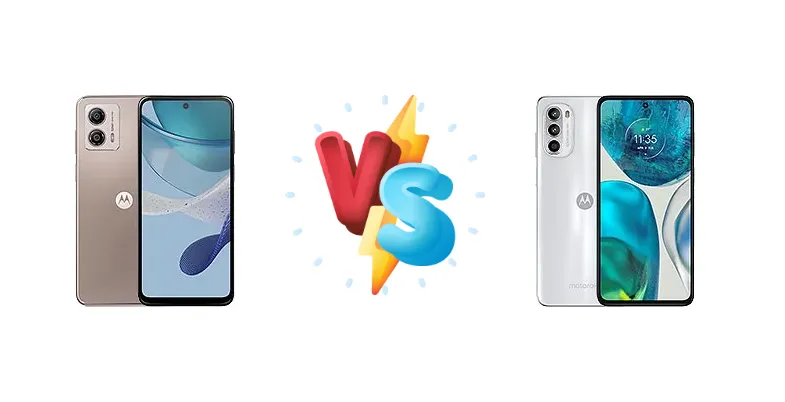
Motorola consistently delivers solid budget smartphones, and the Moto G53 and G52 are prime examples. But which one offers the best value for your money? This comprehensive comparison dives deep into their specs, features, and performance to help you make an informed decision.
🏆 Quick Verdict
The Moto G53 edges out the G52 thanks to its 5G connectivity, brighter display, and potentially faster chipset. However, the G52’s 30W charging and more established Snapdragon 680 offer a compelling alternative for those prioritizing faster charging and 4G reliability.
| Network |
|---|
| 2G bands | GSM 850 / 900 / 1800 / 1900 | GSM 850 / 900 / 1800 / 1900 |
| 3G bands | HSDPA 850 / 900 / 1900 / 2100 - EMEA & AP, China | HSDPA 850 / 900 / 1700(AWS) / 1900 / 2100 |
| 4G bands | 1, 2, 3, 5, 7, 8, 18, 19, 20, 26, 28, 32, 38, 40, 41, 42 - EMEA & AP | LTE |
| 5G bands | 1, 3, 5, 7, 8, 20, 28, 38, 40, 41, 77, 78 SA/NSA - EMEA & AP | - |
| Speed | HSPA, LTE, 5G | HSPA, LTE |
| Technology | GSM / CDMA / HSPA / LTE / 5G | GSM / HSPA / LTE |
| | 1, 5, 8, 28, 41, 78 SA/NSA - China | - |
| Launch |
|---|
| Announced | 2022, December 15 | 2022, April 12 |
| Status | Available. Released 2022, December 15 | Available. Released 2022, April 20 |
| Body |
|---|
| Build | Glass front, plastic back, plastic frame | - |
| Dimensions | 162.7 x 74.7 x 8.2 mm (6.41 x 2.94 x 0.32 in) | 160.1 x 74.5 x 8 mm (6.30 x 2.93 x 0.31 in) |
| SIM | · Nano-SIM + eSIM· Nano-SIM + Nano-SIM | Nano-SIM + Nano-SIM |
| Weight | 183 g (6.46 oz) | 169 g (5.96 oz) |
| | Water-resistant design | Water-repellent design |
| Display |
|---|
| Resolution | 720 x 1600 pixels, 20:9 ratio (~270 ppi density) | 1080 x 2400 pixels, 20:9 ratio (~402 ppi density) |
| Size | 6.5 inches, 102.0 cm2 (~83.9% screen-to-body ratio) | 6.6 inches, 103.6 cm2 (~86.9% screen-to-body ratio) |
| Type | IPS LCD, 120Hz | AMOLED, 90Hz |
| Platform |
|---|
| CPU | Octa-core (2x2.2 GHz Kryo 460 & 6x1.8 GHz Kryo 460) | Octa-core (4x2.4 GHz Kryo 265 Gold & 4x1.9 GHz Kryo 265 Silver) |
| Chipset | Qualcomm SM4350-AC Snapdragon 480+ 5G (8 nm) | Qualcomm SM6225 Snapdragon 680 4G (6 nm) |
| GPU | Adreno 619 | Adreno 610 |
| OS | Android 13, planned upgrade to Android 14 | Android 12, planned upgrade to Android 13 |
| Memory |
|---|
| Card slot | microSDXC (uses shared SIM slot) | microSDXC (uses shared SIM slot) |
| Internal | 64GB 4GB RAM, 128GB 4GB RAM, 128GB 6GB RAM, 128GB 8GB RAM | 64GB 4GB RAM, 128GB 4GB RAM, 128GB 6GB RAM, 256GB 6GB RAM |
| Main Camera |
|---|
| Dual | 50 MP, f/1.8 (wide), 1/2.76", 0.64µm, PDAF
2 MP (macro) | - |
| Features | LED flash, HDR, panorama | LED flash, HDR, panorama |
| Triple | - | 50 MP, f/1.8 (wide), 1/2.76", 0.64µm, PDAF
8 MP, f/2.2, 118˚ (ultrawide), 1/4.0", 1.12µm
2 MP (macro) |
| Video | 1080p@30fps | 1080p@30fps |
| Selfie camera |
|---|
| Single | 8 MP, f/2.0, (wide), 1/4.0", 1.12µm
or
16 MP, f/2.2, (wide), 1.0µm | 16 MP, f/2.5, (wide), 1.0µm |
| Video | 1080p@30fps | 1080p@30fps |
| Sound |
|---|
| 3.5mm jack | Yes | Yes |
| 35mm jack | Yes | Yes |
| Loudspeaker | Yes, with stereo speakers | Yes, with stereo speakers |
| Comms |
|---|
| Bluetooth | 5.1, A2DP, LE | 5.0, A2DP, LE |
| NFC | Yes (market/region dependent) | Yes (market/region dependent) |
| Positioning | GPS, GLONASS, GALILEO, BDS | GPS, GLONASS, GALILEO |
| Radio | FM radio (market/region dependent) | Unspecified |
| USB | USB Type-C 2.0, OTG | USB Type-C 2.0 |
| WLAN | Wi-Fi 802.11 a/b/g/n/ac, dual-band | Wi-Fi 802.11 a/b/g/n/ac, dual-band, Wi-Fi Direct |
| Features |
|---|
| Sensors | Fingerprint (side-mounted), accelerometer, gyro, proximity, compass | Fingerprint (side-mounted), accelerometer, gyro, proximity, compass |
| Battery |
|---|
| Charging | 18W wired (China, LATAM)
10W wired (International)
Reverse wired | 30W wired |
| Type | Li-Po 5000 mAh | Li-Po 5000 mAh |
| Misc |
|---|
| Colors | Ink Blue, Arctic Silver, Pale Pink | Charcoal Gray, Porcelain White |
| Models | XT2335-2 | XT2221-1, XT2221-2 |
| Price | $ 295.00 / £ 143.15 | About 470 EUR |
| Tests |
|---|
| Battery life |
Endurance rating 123h
| - |
| Camera |
Photo / Video | - |
| Display |
Contrast ratio: 1746:1 (nominal) | - |
| Loudspeaker |
-26.0 LUFS (Very good)
| - |
| Performance |
AnTuTu: 314195 (v9)
GeekBench: 1594 (v5.1), 1797 (v6.0)
GFXBench: 29fps (ES 3.1 onscreen) | - |
Motorola Moto G53
- 5G Connectivity
- Brighter Display (599 nits)
- Potentially Faster Performance
- Excellent Battery Life (123h Endurance)
- Slower Charging (10W/18W)
- Chipset less mature than Snapdragon 680
Motorola Moto G52
- Faster Charging (30W)
- Reliable 4G Connectivity
- Established Snapdragon 680 Chipset
- Lower Peak Brightness
- No 5G
- Potentially Slower Performance
Display Comparison
The Moto G53 boasts a significantly higher peak brightness of 599 nits compared to the G52 (estimated around 450-500 nits). Both offer excellent contrast ratios (1746:1 for G53, nominal for G52), promising vibrant colors and deep blacks. The G53's higher brightness gives it a clear advantage in direct sunlight.
Camera Comparison
Camera performance is difficult to definitively assess without detailed testing. Both phones feature 'Photo / Video' capabilities, suggesting similar camera setups. However, the G53's newer chipset *might* offer slightly improved image processing. Real-world camera quality will depend on software optimization and sensor quality, which are not specified.
Performance
The Moto G53's Snapdragon 480+ 5G chipset, built on an 8nm process, generally offers better performance than the G52's Snapdragon 680 4G (6nm). While the G52's Kryo 265 cores are individually faster, the 480+'s overall architecture and 5G capabilities give it an edge in multitasking and demanding apps. Expect smoother performance on the G53.
Battery Life
The Moto G53 claims an impressive endurance rating of 123h, suggesting exceptional battery life. The G52's battery capacity is likely similar, but the G53's power efficiency due to its chipset could contribute to its superior endurance. The G52's 30W charging is a significant advantage, allowing for much faster top-ups compared to the G53's 10W (International) or 18W (China/LATAM) charging.
Buying Guide
The Moto G53 is ideal for users who want 5G connectivity and a brighter screen for outdoor use. The Moto G52 is a better choice for those who prioritize faster charging speeds and a reliable 4G experience, and potentially prefer a slightly more mature chipset.
Frequently Asked Questions
❓ Does the Moto G53 support 5G?
Yes, the Moto G53 is a 5G capable device, offering faster download and upload speeds where 5G networks are available.
❓ How long does it take to fully charge the Moto G52?
With its 30W charging, the Moto G52 can typically be fully charged in around 60-75 minutes, depending on the charger used.