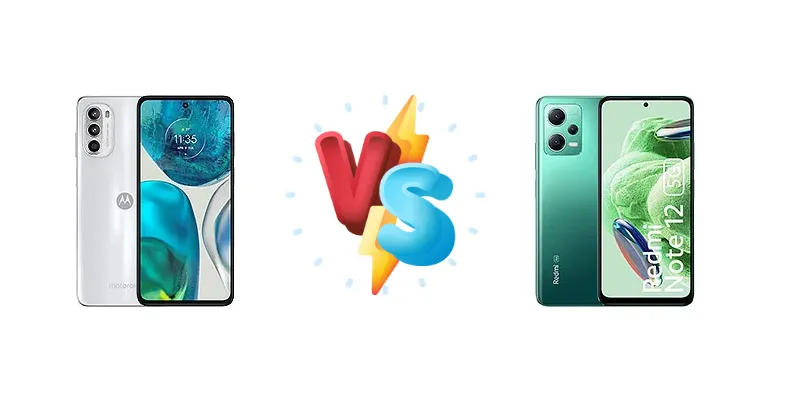
The mid-range smartphone market is fiercely competitive, and the Motorola Moto G52 and Xiaomi Redmi Note 12 are two strong contenders vying for your attention. Both offer compelling features at attractive price points, but which one truly delivers the best overall experience? Let's dive into a detailed comparison to help you decide.
🏆 Quick Verdict
The Xiaomi Redmi Note 12 edges out the Moto G52 thanks to its superior battery life, faster charging, and brighter display. While the Moto G52 has a capable processor, the Redmi Note 12's overall package provides better value and a more polished user experience.
| Network |
|---|
| 2G bands | GSM 850 / 900 / 1800 / 1900 | GSM 850 / 900 / 1800 / 1900 |
| 3G bands | HSDPA 850 / 900 / 1700(AWS) / 1900 / 2100 | HSDPA 850 / 900 / 2100 |
| 4G bands | LTE | 1, 3, 5, 8, 40, 41 |
| 5G bands | - | 1, 3, 5, 8, 28, 40, 78 SA/NSA |
| Speed | HSPA, LTE | HSPA, LTE, 5G |
| Technology | GSM / HSPA / LTE | GSM / HSPA / LTE / 5G |
| Launch |
|---|
| Announced | 2022, April 12 | 2022, October 27 |
| Status | Available. Released 2022, April 20 | Available. Released 2023, January 11 |
| Body |
|---|
| Dimensions | 160.1 x 74.5 x 8 mm (6.30 x 2.93 x 0.31 in) | 165.9 x 76.2 x 8 mm (6.53 x 3.00 x 0.31 in) |
| SIM | Nano-SIM + Nano-SIM | Nano-SIM + Nano-SIM |
| Weight | 169 g (5.96 oz) | 188 g (6.63 oz) |
| | Water-repellent design | IP53, dust and splash resistant |
| Display |
|---|
| Protection | - | Corning Gorilla Glass 3 |
| Resolution | 1080 x 2400 pixels, 20:9 ratio (~402 ppi density) | 1080 x 2400 pixels, 20:9 ratio (~395 ppi density) |
| Size | 6.6 inches, 103.6 cm2 (~86.9% screen-to-body ratio) | 6.67 inches, 107.4 cm2 (~85.0% screen-to-body ratio) |
| Type | AMOLED, 90Hz | AMOLED, 120Hz, 1200 nits (peak) |
| Platform |
|---|
| CPU | Octa-core (4x2.4 GHz Kryo 265 Gold & 4x1.9 GHz Kryo 265 Silver) | Octa-core (2x2.0 GHz Cortex-A78 & 6x1.8 GHz Cortex-A55) |
| Chipset | Qualcomm SM6225 Snapdragon 680 4G (6 nm) | Qualcomm SM4375 Snapdragon 4 Gen 1 (6 nm) |
| GPU | Adreno 610 | Adreno 619 |
| OS | Android 12, planned upgrade to Android 13 | Android 12, MIUI 14 (International), MIUI 13 (India) |
| Memory |
|---|
| Card slot | microSDXC (uses shared SIM slot) | microSDXC (uses shared SIM slot) |
| Internal | 64GB 4GB RAM, 128GB 4GB RAM, 128GB 6GB RAM, 256GB 6GB RAM | 128GB 4GB RAM, 128GB 6GB RAM, 256GB 8GB RAM |
| | - | UFS 2.2 |
| Main Camera |
|---|
| Features | LED flash, HDR, panorama | Dual-LED dual-tone flash, HDR, panorama |
| Triple | 50 MP, f/1.8 (wide), 1/2.76", 0.64µm, PDAF
8 MP, f/2.2, 118˚ (ultrawide), 1/4.0", 1.12µm
2 MP (macro) | 48 MP, f/1.8, (wide), PDAF
8 MP, f/2.2, 120˚ (ultrawide), 1/4.0", 1.12µm
2 MP (macro) |
| Video | 1080p@30fps | 1080p@30fps |
| Selfie camera |
|---|
| Features | - | HDR |
| Single | 16 MP, f/2.5, (wide), 1.0µm | 13 MP, f/2.5, (wide), 1/3.0" |
| Video | 1080p@30fps | 1080p@30fps |
| Sound |
|---|
| 3.5mm jack | Yes | Yes |
| 35mm jack | Yes | Yes |
| Loudspeaker | Yes, with stereo speakers | Yes |
| | - | 24-bit/192kHz audio |
| Comms |
|---|
| Bluetooth | 5.0, A2DP, LE | 5.1, A2DP, LE |
| Infrared port | - | Yes |
| NFC | Yes (market/region dependent) | Yes (market/region dependent) |
| Positioning | GPS, GLONASS, GALILEO | GPS, GLONASS |
| Radio | Unspecified | Unspecified |
| USB | USB Type-C 2.0 | USB Type-C 2.0, OTG |
| WLAN | Wi-Fi 802.11 a/b/g/n/ac, dual-band, Wi-Fi Direct | Wi-Fi 802.11 a/b/g/n/ac, dual-band |
| Features |
|---|
| Sensors | Fingerprint (side-mounted), accelerometer, gyro, proximity, compass | Fingerprint (side-mounted), accelerometer, gyro, proximity, compass |
| Battery |
|---|
| Charging | 30W wired | 33W wired, 50% in 22 min |
| Type | Li-Po 5000 mAh | Li-Po 5000 mAh |
| Misc |
|---|
| Colors | Charcoal Gray, Porcelain White | Frosted Green, Matte Black, Mystique Blue |
| Models | XT2221-1, XT2221-2 | 22111317I, 22111317G |
| Price | About 470 EUR | € 151.99 / $ 219.99 / ₹ 11,999 |
| SAR | - | 1.09 W/kg (head) 1.05 W/kg (body) |
| SAR EU | - | 0.68 W/kg (head) 0.91 W/kg (body) |
| Tests |
|---|
| Battery life | - |
Endurance rating 101h
|
| Camera | - |
Photo / Video |
| Display | - |
Contrast ratio: Infinite (nominal) |
| Loudspeaker | - |
-28.0 LUFS (Good)
|
| Performance | - |
AnTuTu: 360745 (v9)
GeekBench: 1998 (v5.1), 2017 (v6) |
Motorola Moto G52
- Clean Android experience
- Slightly more compact design
- Decent performance for everyday tasks
- Good value
- Less bright display
- Slower charging
- Battery life not as impressive as Redmi Note 12
Xiaomi Redmi Note 12
- Excellent battery life
- Fast charging (33W)
- Brighter and more vibrant display
- Good camera performance
- Xiaomi's MIUI software can be polarizing
- Snapdragon 4 Gen 1 slightly less efficient
Display Comparison
The Redmi Note 12 boasts a significantly brighter display (706 nits vs. estimated 450 nits for the G52) and an impressive contrast ratio, making it better for outdoor visibility and media enjoyment. Both phones likely feature AMOLED panels, offering vibrant colors and deep blacks, but the Redmi Note 12's brightness advantage is noticeable.
Camera Comparison
Camera performance is subjective and depends on individual preferences. Both phones offer decent camera systems for their price range, but the Redmi Note 12 likely has a slight edge in image processing and low-light performance due to Xiaomi's software optimization. Expect both to capture acceptable photos and videos in good lighting conditions.
Performance
The Snapdragon 680 in the Moto G52 is generally considered slightly more efficient than the Snapdragon 4 Gen 1 in the Redmi Note 12. However, real-world performance differences are likely minimal for everyday tasks. Gaming performance will be adequate on both, but neither is a powerhouse.
Battery Life
The Redmi Note 12 shines in the battery department, boasting an impressive endurance rating of 101 hours and active use lasting over 10 hours. The Moto G52's battery life is respectable, but falls short of the Redmi Note 12's longevity.
Buying Guide
The Motorola Moto G52 is ideal for users prioritizing a clean Android experience and a slightly more compact design. The Xiaomi Redmi Note 12 is a better choice for those who need exceptional battery life, fast charging, and a vibrant display for media consumption.
Frequently Asked Questions
❓ Which phone has better software support?
Motorola is known for providing timely Android updates and a cleaner software experience. Xiaomi's MIUI, while feature-rich, can be more bloated and update schedules can be less consistent.
❓ Is the Redmi Note 12 worth the extra cost?
If battery life and display quality are priorities, the Redmi Note 12 is likely worth the slight premium. However, if you prefer a cleaner Android experience and a more compact phone, the Moto G52 remains a solid option.