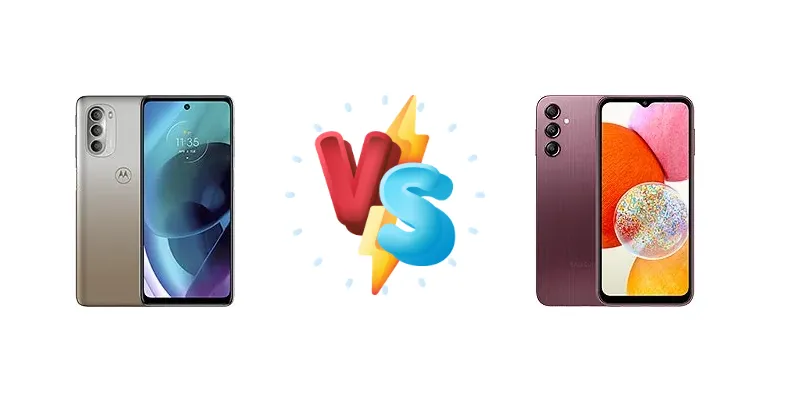
The budget smartphone market is fiercely competitive, offering incredible value for your money. Two contenders vying for your attention are the Motorola Moto G51 5G and the Samsung Galaxy A14. Both promise a solid experience, but which one truly delivers? Let's dive into a detailed comparison.
🏆 Quick Verdict
The Moto G51 5G boasts a brighter display and significantly longer battery life. However, the Galaxy A14 benefits from Samsung's brand recognition and potentially better software support. For pure battery endurance and screen brightness, the Moto G51 5G edges out the A14, but consider your priorities.
| Network |
|---|
| 2G bands | GSM 850 / 900 / 1800 / 1900 | GSM 850 / 900 / 1800 / 1900 |
| 3G bands | HSDPA 800 / 850 / 900 / 1900 / 2100 - Europe, Asia, Saudi Arabia | HSDPA 850 / 900 / 2100 |
| 4G bands | 1, 2, 3, 5, 7, 8, 18, 20, 26, 28, 32, 38, 40, 41, 42, 43 - Europe/Asia | 1, 3, 5, 7, 8, 20, 28, 38, 40, 41 |
| 5G bands | 1, 3, 5, 7, 8, 20, 28, 38, 40, 41, 77, 78 SA/NSA/Sub6 - Europe/Asia | - |
| Speed | HSPA 42.2/5.76 Mbps, LTE Cat18 1200/150 Mbps, 5G | HSPA, LTE |
| Technology | GSM / HSPA / LTE / 5G | GSM / HSPA / LTE |
| | 1, 5, 8, 28, 41, 78 SA/NSA/Sub6 - China | - |
| Launch |
|---|
| Announced | 2021, November 03 | 2023, February 28 |
| Status | Available. Released 2021, December 16 | Available. Released 2023, March 27 |
| Body |
|---|
| Build | Glass front, plastic frame, plastic back | Glass front, plastic back, plastic frame |
| Dimensions | 170.5 x 76.5 x 9.1 mm (6.71 x 3.01 x 0.36 in) | 167.7 x 78 x 9.1 mm (6.60 x 3.07 x 0.36 in) |
| SIM | Nano-SIM + Nano-SIM | · Nano-SIM· Nano-SIM + Nano-SIM |
| Weight | 208 g (7.34 oz) | 201 g (7.09 oz) |
| | Water-repellent design | - |
| Display |
|---|
| Resolution | 1080 x 2400 pixels, 20:9 ratio (~387 ppi density) | 1080 x 2408 pixels, 20:9 ratio (~400 ppi density) |
| Size | 6.8 inches, 111.6 cm2 (~85.6% screen-to-body ratio) | 6.6 inches, 104.9 cm2 (~80.2% screen-to-body ratio) |
| Type | IPS LCD, 120Hz | PLS LCD |
| Platform |
|---|
| CPU | Octa-core (2x2.2 GHz Kryo 460 & 6x1.8 GHz Kryo 460) | Octa-core (2x2.0 GHz Cortex-A75 & 6x1.8 GHz Cortex-A55) - Version AOcta-core (4x2.0 GHz Cortex-A55 & 4x2.0 GHz Cortex-A55) - Version B |
| Chipset | Qualcomm SM4350-AC Snapdragon 480+ 5G (8 nm) | Mediatek MT6769 Helio G80 (12 nm) - Version AExynos 850 (8 nm) - Version B |
| GPU | Adreno 619 | Mali-G52 MC2 |
| OS | Android 11, upgradable to Android 12 | Android 13, upgradable to Android 15, One UI 7 |
| Memory |
|---|
| Card slot | microSDXC (uses shared SIM slot) | microSDXC (dedicated slot) |
| Internal | 64GB 4GB RAM, 64GB 6GB RAM 128GB 4GB RAM, 128GB 6GB RAM, 128GB 8GB RAM | 64GB 4GB RAM, 128GB 4GB RAM, 128GB 6GB RAM |
| Main Camera |
|---|
| Features | LED flash, HDR, panorama | LED flash, panorama, HDR |
| Single | - | 13 MP, f/2.0, (wide) |
| Triple | 50 MP, f/1.8 (wide), 1/2.76", 0.64µm, PDAF
8 MP, f/2.2, 118˚ (ultrawide), 1/4.0", 1.12µm
2 MP (macro) | 50 MP, f/1.8, 26mm (wide), 1/2.75", 0.64µm, PDAF
5 MP, f/2.2, 17mm (ultrawide), 1/5.0", 1.12µm
2 MP (macro) |
| Video | 1080p@30/60/240fps | 1080p@30fps |
| Selfie camera |
|---|
| Single | 13 MP, f/2.2, (wide), 1.12µm - Global
or
16 MP, f/2.2, (wide), 1.12µm - China only | 13 MP, f/2.0, 26mm (wide), 1/3.1", 1.12µm |
| Video | 1080p@30fps | 1080p@30fps |
| Sound |
|---|
| 3.5mm jack | Yes | Yes |
| 35mm jack | Yes | Yes |
| Loudspeaker | Yes | Yes |
| Comms |
|---|
| Bluetooth | 5.1, A2DP, LE, aptX HD/Adaptive | 5.1 or 5.3, A2DP, LE |
| NFC | Yes (market/region dependent) | Yes (market/region dependent) |
| Positioning | GPS, GLONASS, GALILEO | GPS, GALILEO, GLONASS, BDS, QZSS |
| Radio | FM radio | Unspecified |
| USB | USB Type-C 2.0 | USB Type-C 2.0 |
| WLAN | Wi-Fi 802.11 a/b/g/n/ac, dual-band, Wi-Fi Direct | Wi-Fi 802.11 a/b/g/n/ac, dual-band, Wi-Fi Direct |
| Features |
|---|
| Sensors | Fingerprint (side-mounted), accelerometer, gyro, proximity, compass | Fingerprint (side-mounted), accelerometer, proximity, compass |
| Battery |
|---|
| Charging | 20W wired (India)
10W wired (Global) | 15W wired |
| Type | Li-Po 5000 mAh | Li-Po 5000 mAh |
| Misc |
|---|
| Colors | Indigo Blue, Bright Silver, Aqua Blue | Black, Dark Red, Silver, Green |
| Models | XT2171-2, XT2171-1 | SM-A145F, SM-A145F/DSN, SM-A145M, SM-A145M/DS, SM-A145P, SM-A145R |
| Price | About 210 EUR | € 85.76 / $ 147.60 / £ 79.95 |
| SAR EU | - | 0.46 W/kg (head) 1.37 W/kg (body) |
| Tests |
|---|
| Battery life |
Endurance rating 124h
| - |
| Camera |
Photo / Video | - |
| Display |
Contrast ratio: 1634:1 | - |
| Loudspeaker |
-28.3 LUFS (Average)
| - |
| Performance |
AnTuTu: 302859 (v9)
GeekBench: 1696 (v5.1)
GFXBench: 26fps (ES 3.1 onscreen) | - |
Motorola Moto G51 5G
- Exceptional battery life (124h endurance)
- Brighter and more vibrant display
- 5G connectivity
- Decent performance for the price
- Camera performance could be better
- Plastic build quality
- Charging speed (10W/20W depending on region) is slow
Samsung Galaxy A14
- Samsung brand recognition and software support
- Reliable everyday performance
- Large display
- Expandable storage (microSD card slot)
- Less impressive battery life
- Dimmer display
- Slower charging (15W)
- Performance can be inconsistent depending on chipset variant
Display Comparison
The Moto G51 5G takes the display crown with a measured peak brightness of 595 nits and an impressive 1634:1 contrast ratio. This translates to a noticeably brighter and more vibrant viewing experience, especially outdoors. The Galaxy A14's display is adequate but lacks the same punch. Both feature similar resolutions, but the Moto G51 5G's superior brightness is a key differentiator.
Camera Comparison
Camera performance is generally comparable. Both phones offer decent image quality in good lighting conditions. Low-light performance is where both struggle. The Moto G51 5G likely has a slight advantage in video recording due to the Snapdragon chipset's image processing capabilities, but both lack advanced camera features.
Performance
The Snapdragon 480+ 5G in the Moto G51 5G offers a slight edge in raw processing power compared to the Helio G80 in the Galaxy A14, although both are entry-level chips. Real-world performance will be similar for everyday tasks. The A14's Exynos 850 variant (Version B) might offer slightly better efficiency, but it's less common. Expect some lag with demanding games on both devices.
Battery Life
The Moto G51 5G absolutely dominates in battery life, boasting an endurance rating of 124 hours. This is exceptional. The Galaxy A14's battery life is respectable, but falls significantly short of the Moto G51 5G's longevity. This makes the Moto G51 5G a clear winner for users who need a phone that can last for days on a single charge.
Buying Guide
The Motorola Moto G51 5G is ideal for users prioritizing battery life and a vibrant display on a tight budget. The Samsung Galaxy A14 is a good choice for those who prefer the Samsung ecosystem, value brand recognition, and want a reliable, everyday smartphone.
Frequently Asked Questions
❓ Which phone has better software support?
Samsung generally offers longer software update support for its Galaxy A series devices compared to Motorola.
❓ Is the Galaxy A14 worth the extra cost?
It depends. If you prioritize brand recognition and Samsung's ecosystem, the A14 might be worth it. Otherwise, the Moto G51 5G offers better value for its price, especially considering its superior battery life and display.