
Motorola Moto G50 vs Samsung Galaxy A52s 5G: A Detailed Comparison
| Phones Images | |||||
|---|---|---|---|---|---|
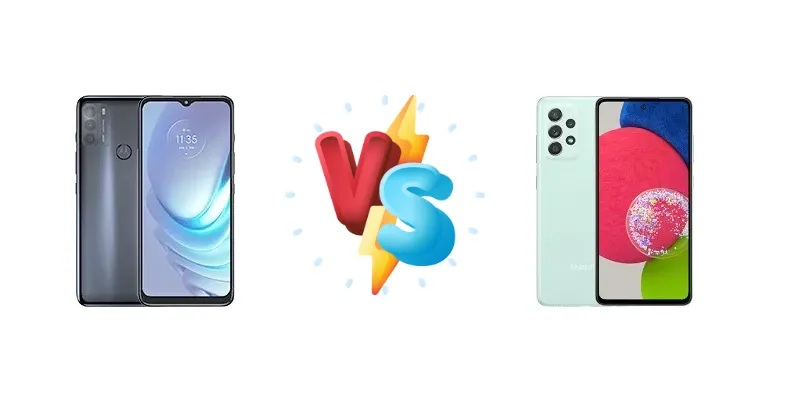
|
🏆 Quick Verdict
For most users, the Samsung Galaxy A52s 5G is the superior choice. Its Snapdragon 778G chipset delivers substantially better performance, and its brighter display enhances usability. While the Moto G50 boasts longer endurance, the A52s 5G’s overall experience is more refined and capable.
| PHONES | ||
|---|---|---|
| Phone Names | Motorola Moto G50 | Samsung Galaxy A52s 5G |
| Network | ||
|---|---|---|
| 2G bands | GSM 850 / 900 / 1800 / 1900 | GSM 850 / 900 / 1800 / 1900 |
| 3G bands | HSDPA 850 / 900 / 1700(AWS) / 1900 / 2100 | HSDPA 850 / 900 / 1700(AWS) / 1900 / 2100 |
| 4G bands | 1, 2, 3, 4, 5, 7, 8, 12, 13, 17, 18, 19, 20, 26, 28, 32, 38, 40, 41, 42, 43, 66 | 1, 2, 3, 4, 5, 7, 8, 12, 17, 20, 26, 28, 32, 38, 40, 41, 66 |
| 5G bands | 1, 3, 5, 7, 8, 20, 28, 38, 40, 41, 77, 78 SA/NSA | 1, 3, 5, 7, 8, 20, 28, 38, 40, 41, 66, 78 SA/NSA/Sub6 |
| Speed | HSPA, LTE, 5G | HSPA 42.2/5.76 Mbps, LTE Cat18 1200/150 Mbps, 5G |
| Technology | GSM / HSPA / LTE / 5G | GSM / HSPA / LTE / 5G |
| Launch | ||
|---|---|---|
| Announced | 2021, March 25 | 2021, August 17 |
| Status | Available. Released 2021, April 26 | Available. Released 2021, September 01 |
| Body | ||
|---|---|---|
| Build | Glass front, plastic back, plastic frame | Glass front (Gorilla Glass 5), plastic back |
| Dimensions | 164.9 x 74.9 x 9 mm (6.49 x 2.95 x 0.35 in) | 159.9 x 75.1 x 8.4 mm (6.30 x 2.96 x 0.33 in) |
| SIM | · Nano-SIM· Nano-SIM + Nano-SIM | · Nano-SIM· Nano-SIM + Nano-SIM |
| Weight | 192 g (6.77 oz) | 189 g (6.67 oz) |
| Water-repellent design | IP67 dust/water resistant (up to 1m for 30 min) | |
| Display | ||
|---|---|---|
| Protection | - | Corning Gorilla Glass 5 |
| Resolution | 720 x 1600 pixels, 20:9 ratio (~269 ppi density) | 1080 x 2400 pixels, 20:9 ratio (~405 ppi density) |
| Size | 6.5 inches, 102.8 cm2 (~83.2% screen-to-body ratio) | 6.5 inches, 102.0 cm2 (~84.9% screen-to-body ratio) |
| Type | IPS LCD, 90Hz | Super AMOLED, 120Hz, 800 nits (HBM) |
| Platform | ||
|---|---|---|
| CPU | Octa-core (2x2.0 GHz Kryo 460 & 6x1.8 GHz Kryo 460) | Octa-core (1x2.4 GHz Cortex-A78 & 3x2.2 GHz Cortex-A78 & 4x1.9 GHz Cortex-A55) |
| Chipset | Qualcomm SM4350 Snapdragon 480 5G (8 nm) | Qualcomm SM7325 Snapdragon 778G 5G (6 nm) |
| GPU | Adreno 619 | Adreno 642L |
| OS | Android 11, upgradable to Android 12 | Android 11, upgradable to Android 14, One UI 6 |
| Memory | ||
|---|---|---|
| Card slot | microSDXC (uses shared SIM slot) | microSDXC (uses shared SIM slot) |
| Internal | 64GB 4GB RAM, 128GB 4GB RAM | 128GB 4GB RAM, 128GB 6GB RAM, 128GB 8GB RAM, 256GB 6GB RAM, 256GB 8GB RAM |
| Main Camera | ||
|---|---|---|
| Features | LED flash, HDR, panorama | LED flash, panorama, HDR |
| Quad | - | 64 MP, f/1.8, 26mm (wide), 1/1.7", 0.8µm, PDAF, OIS 12 MP, f/2.2, 123˚ (ultrawide), 1.12µm 5 MP (macro) Auxiliary lens |
| Single | - | 32 MP, f/2.2, 26mm (wide), 1/2.8", 0.8µm |
| Triple | 48 MP, f/1.7, 26mm (wide), 1/2.0", 0.8µm, PDAF 5 MP (macro) Auxiliary lens | - |
| Video | 1080p@30/60fps | 4K@30fps, 1080p@30/60fps; gyro-EIS |
| Selfie camera | ||
|---|---|---|
| Features | HDR | HDR |
| Single | 13 MP, f/2.2, (wide), 1/3.1", 1.12µm | 32 MP, f/2.2, 26mm (wide), 1/2.8", 0.8µm |
| Video | 1080p@30/60fps | 4K@30fps, 1080p@30/60fps |
| Sound | ||
|---|---|---|
| 3.5mm jack | Yes | Yes |
| 35mm jack | Yes | Yes |
| Loudspeaker | Yes | Yes, with stereo speakers |
| Comms | ||
|---|---|---|
| Bluetooth | 5.0, A2DP, LE | 5.0, A2DP, LE |
| NFC | Yes | Yes (market/region dependent) |
| Positioning | GPS, GLONASS, GALILEO | GPS, GLONASS, GALILEO, BDS, QZSS |
| Radio | FM radio | No |
| USB | USB Type-C 2.0, OTG | USB Type-C 2.0, OTG |
| WLAN | Wi-Fi 802.11 a/b/g/n/ac, dual-band, Wi-Fi Direct | Wi-Fi 802.11 a/b/g/n/ac/6, dual-band, Wi-Fi Direct |
| Features | ||
|---|---|---|
| Sensors | Fingerprint (rear-mounted), accelerometer, gyro, proximity, barometer (market dependant) | Fingerprint (under display, optical), accelerometer, gyro, compass |
| - | Virtual Proximity Sensing | |
| Battery | ||
|---|---|---|
| Charging | 15W wired | 25W wired |
| Type | Li-Po 5000 mAh | Li-Ion 4500 mAh |
| Misc | ||
|---|---|---|
| Colors | Steel Gray, Aqua Green | Awesome Black, Awesome White, Awesome Purple, Awesome Mint |
| Models | XT2137-1, XT2137-2 | SM-A528B, SM-A528B/DS, SM-A528N |
| Price | About 190 EUR | £ 112.98 / € 249.47 |
| SAR | - | 0.72 W/kg (head) |
| SAR EU | - | 0.88 W/kg (head) 0.84 W/kg (body) |
| Tests | ||
|---|---|---|
| Battery life | Endurance rating 133h | Endurance rating 113h |
| Camera | Photo / Video | Photo / Video |
| Display | Contrast ratio: 1819:1 (nominal) | Contrast ratio: Infinite (nominal) |
| Loudspeaker | -28.0 LUFS (Good) | -27.5 LUFS (Good) |
| Performance | AnTuTu: 286916 (v9) GeekBench: 1620 (v5.1) GFXBench: 27fps (ES 3.1 onscreen) | AnTuTu: 429675 (v8), 506432(v9) GeekBench: 11060 (v4.4), 2801 (v5.1) GFXBench: 28fps (ES 3.1 onscreen) |
Motorola Moto G50
- Longer battery endurance (133h)
- More affordable price point
- 5G connectivity
- Significantly slower processor
- Dimmer display
- Slower charging speed
Samsung Galaxy A52s 5G
- Much faster processor (Snapdragon 778G)
- Brighter and more vibrant display
- Faster 25W charging
- Slightly shorter battery endurance (113h)
- Generally higher price
Display Comparison
The Samsung Galaxy A52s 5G immediately pulls ahead in the display department with a measured peak brightness of 800 nits, compared to the Moto G50’s 362 nits. This difference is crucial for outdoor visibility. While the Moto G50 offers a 1819:1 contrast ratio, the A52s 5G’s ‘Infinite’ contrast ratio (typical of AMOLED panels) delivers deeper blacks and more vibrant colors. Both displays feature a standard refresh rate, but the A52s 5G’s superior brightness and color reproduction make it the clear winner for media consumption and general use.
Camera Comparison
Both phones offer photo and video capabilities, but details beyond that are limited in the provided data. However, given Samsung’s image processing expertise and the A52s 5G’s more powerful chipset, it’s reasonable to expect superior image quality, particularly in challenging lighting conditions. The A52s 5G likely benefits from more advanced computational photography features. Without specific sensor size or aperture information, it’s difficult to make a definitive judgment, but the A52s 5G’s processing power gives it an edge.
Performance
The core difference between these phones lies in their chipsets. The Moto G50 utilizes the Qualcomm Snapdragon 480 5G (8nm), while the A52s 5G is powered by the Snapdragon 778G 5G (6nm). The 778G’s architecture – featuring a Cortex-A78 prime core – provides a significant performance uplift. The A52s 5G’s CPU configuration (1x2.4 GHz Cortex-A78 & 3x2.2 GHz Cortex-A78 & 4x1.9 GHz Cortex-A55) is demonstrably faster than the G50’s (2x2.0 GHz Kryo 460 & 6x1.8 GHz Kryo 460). The 6nm process node of the 778G also contributes to better thermal efficiency, reducing the likelihood of performance throttling during sustained workloads. This translates to smoother gaming and faster app loading times on the A52s 5G.
Battery Life
The Moto G50 boasts an endurance rating of 133 hours, while the A52s 5G achieves 113 hours. This suggests the G50 offers longer battery life on a single charge. However, the A52s 5G compensates with 25W wired charging, significantly faster than the G50’s 15W charging. This means the A52s 5G can replenish its battery much more quickly, mitigating the difference in overall endurance. The faster charging is a significant convenience factor for users who frequently need to top up their battery.
Buying Guide
Buy the Motorola Moto G50 if your priority is maximizing battery life and you primarily use your phone for basic tasks like calling, texting, and light social media. It’s a solid option for those on a very tight budget. Buy the Samsung Galaxy A52s 5G if you value performance for gaming, multitasking, and demanding applications, and if you appreciate a brighter, more vibrant display. It’s the better choice for users who want a smoother, more responsive experience.