
Motorola Moto G45 vs Nothing Phone (2a) Plus: A Detailed Comparison
| Phones Images | |||||
|---|---|---|---|---|---|
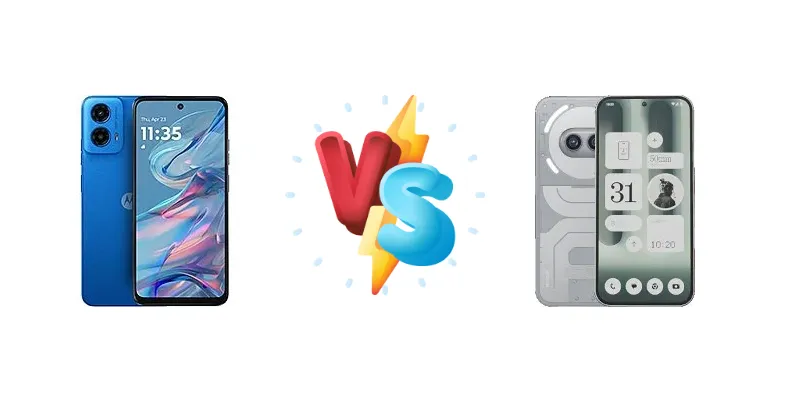
|
🏆 Quick Verdict
For the average user prioritizing all-around performance and faster charging, the Nothing Phone (2a) Plus is the stronger contender. Its Dimensity 7350 Pro chipset and 50W charging significantly outperform the Moto G45’s Snapdragon 6s Gen 3 and 18W charging, justifying the likely price difference.
| PHONES | ||
|---|---|---|
| Phone Names | Motorola Moto G45 | Nothing Phone (2a) Plus |
| Network | ||
|---|---|---|
| 2G bands | GSM 850 / 900 / 1800 / 1900 | GSM 850 / 900 / 1800 / 1900 |
| 3G bands | HSDPA 800 / 850 / 900 / 1900 / 2100 | HSDPA 800 / 850 / 900 / 1700(AWS) / 1900 / 2100 |
| 4G bands | 1, 2, 3, 5, 7, 8, 18, 19, 20, 26, 28, 32, 38, 40, 41, 42 | 1, 3, 4, 5, 7, 8, 18, 19, 20, 26, 28, 38, 39, 40, 41, 42, 66 |
| 5G bands | 1, 3, 5, 7, 8, 20, 28, 38, 40, 41, 77, 78 SA/NSA | 1, 3, 5, 7, 8, 20, 28, 38, 40, 41, 66, 77, 78 SA/NSA |
| Speed | HSPA, LTE, 5G | HSPA, LTE, 5G |
| Technology | GSM / HSPA / LTE / 5G | GSM / HSPA / LTE / 5G |
| Launch | ||
|---|---|---|
| Announced | 2024, August 21 | 2024, July 31 |
| Status | Available. Released 2024, August 28 | Available. Released 2024, August 03 |
| Body | ||
|---|---|---|
| Build | Glass front (Gorilla Glass 3), plastic frame, silicone polymer (eco leather) back | Glass front (Gorilla Glass 5), plastic frame, plastic back |
| Dimensions | 162.7 x 74.6 x 8 mm (6.41 x 2.94 x 0.31 in) | 161.7 x 76.3 x 8.5 mm (6.37 x 3.00 x 0.33 in) |
| SIM | Nano-SIM + Nano-SIM | Nano-SIM + Nano-SIM |
| Weight | 183 g (6.46 oz) | 190 g (6.70 oz) |
| Display | ||
|---|---|---|
| Protection | Corning Gorilla Glass 3 | Corning Gorilla Glass 5 |
| Resolution | 720 x 1600 pixels, 20:9 ratio (~270 ppi density) | 1080 x 2412 pixels, 20:9 ratio (~395 ppi density) |
| Size | 6.5 inches, 102.0 cm2 (~84.0% screen-to-body ratio) | 6.7 inches, 107.5 cm2 (~87.1% screen-to-body ratio) |
| Type | IPS LCD, 120Hz | AMOLED, 1B colors, 120Hz, 2160Hz PWM, HDR10+, 700 nits (typ), 1100 nits (HBM), 1300 nits (peak) |
| Platform | ||
|---|---|---|
| CPU | Octa-core (2x2.3 GHz Cortex-A78 & 6x2.0 GHz Cortex-A55) | Octa-core (2x3.0 GHz Cortex-A715 & 6x 2.0 GHz Cortex-A510) |
| Chipset | Qualcomm SM6375 Snapdragon 6s Gen 3 (6 nm) | Mediatek Dimensity 7350 Pro (4 nm) |
| GPU | Adreno 619 | Mali-G610 MC4 |
| OS | Android 14 | Android 14, up to 3 major Android upgrades, Nothing OS 3.0 |
| Memory | ||
|---|---|---|
| Card slot | microSDXC (uses shared SIM slot) | No |
| Internal | 128GB 4GB RAM, 128GB 8GB RAM | 256GB 8GB RAM, 256GB 12GB RAM |
| Main Camera | ||
|---|---|---|
| Dual | 50 MP, f/1.8 (wide), 1/2.76", 0.64µm, PDAF 2 MP (macro) | 50 MP, f/1.9, 24mm (wide), 1/1.57", 1.0µm, PDAF, OIS 50 MP, f/2.2, 114˚ (ultrawide), 1/2.76", 0.64µm |
| Features | LED flash, HDR, panorama | LED flash, panorama, HDR |
| Video | 1080p@30fps, gyro-EIS | 4K@30fps, 1080p@60/120fps, gyro-EIS |
| Selfie camera | ||
|---|---|---|
| Features | - | HDR |
| Single | 16 MP, f/2.4, (wide), 1.0µm | 50 MP, f/2.2, (wide), 1/2.76" |
| Video | 1080p@30fps | 4K@30fps |
| Sound | ||
|---|---|---|
| 35mm jack | Yes | No |
| Loudspeaker | Yes, with stereo speakers | Yes, with stereo speakers |
| Comms | ||
|---|---|---|
| Bluetooth | 5.1, A2DP, LE | 5.3, A2DP, LE |
| NFC | Yes | Yes, 360˚ |
| Positioning | GPS, GALILEO, GLONASS, QZSS | GPS, GALILEO, GLONASS, BDS, QZSS |
| Radio | FM radio | No |
| USB | USB Type-C 2.0 | USB Type-C 2.0, OTG |
| WLAN | Wi-Fi 802.11 a/b/g/n/ac, dual-band, Wi-Fi Direct | Wi-Fi 802.11 a/b/g/n/ac/6, dual-band, Wi-Fi Direct |
| Features | ||
|---|---|---|
| Sensors | Fingerprint (side-mounted), accelerometer, gyro, proximity, compass | Fingerprint (under display, optical), accelerometer, gyro, proximity, compass |
| Battery | ||
|---|---|---|
| Charging | 18W wired, PD, QC | 50W wired, 50% in 21 min, 100% in 56 min |
| Type | 5000 mAh | 5000 mAh |
| Misc | ||
|---|---|---|
| Colors | Brilliant Blue, Brilliant Green, Viva Magenta | Black, Grey |
| Models | - | A142P |
| Price | ₹ 10,890 | € 269.90 / ₹ 22,599 |
Motorola Moto G45
- More affordable price point
- Reliable Qualcomm Snapdragon chipset
- Potentially longer software support (Motorola's recent commitment)
- Slower charging speed (18W)
- Less powerful processor
- Likely lower display brightness
Nothing Phone (2a) Plus
- Faster 50W charging
- More powerful Mediatek Dimensity 7350 Pro chipset
- Brighter and more vibrant display (1097 nits)
- Higher price tag
- Nothing OS may not appeal to all users
- Potential for software bloat (though Nothing is generally minimal)
Display Comparison
The Nothing Phone (2a) Plus boasts a significantly brighter display, reaching a measured peak of 1097 nits. This is a substantial advantage over what we'd expect from the Moto G45, making the Nothing Phone (2a) Plus far more usable in direct sunlight. While the Moto G45’s panel specifications are currently unknown, its price point suggests a less advanced panel. The Nothing Phone (2a) Plus’s brightness also contributes to a more vibrant and engaging viewing experience for media consumption. We anticipate the Nothing Phone (2a) Plus will have better color accuracy and viewing angles.
Camera Comparison
Without detailed camera specifications for the Moto G45, a direct comparison is limited. However, the Nothing Phone (2a) Plus is expected to have a more sophisticated camera system, leveraging the processing power of the Dimensity 7350 Pro. Image processing algorithms benefit greatly from a powerful chipset. We can assume the Nothing Phone (2a) Plus will deliver better low-light performance and more detailed images. The Moto G45 will likely focus on providing adequate image quality for social media sharing, but won't compete with the Nothing Phone (2a) Plus in terms of dynamic range or detail.
Performance
The core difference lies in the chipsets. The Nothing Phone (2a) Plus utilizes the Mediatek Dimensity 7350 Pro, built on a more efficient 4nm process, featuring a more powerful CPU configuration with 2x3.0 GHz Cortex-A715 cores. This contrasts with the Moto G45’s Qualcomm Snapdragon 6s Gen 3 (6nm) and its 2x2.3 GHz Cortex-A78 cores. The Dimensity 7350 Pro’s architecture translates to noticeably faster application loading times and smoother multitasking. While both phones feature 6x2.0 GHz cores for efficiency, the Nothing Phone (2a) Plus will likely exhibit superior sustained performance due to the 4nm node’s improved thermal characteristics, reducing throttling during extended gaming sessions.
Battery Life
The Nothing Phone (2a) Plus shines in the battery and charging department. Its 50W wired charging capability allows for a 50% charge in just 21 minutes and a full charge in 56 minutes – a significant time saving compared to the Moto G45’s 18W charging. While the Moto G45’s battery capacity is unknown, the Nothing Phone (2a) Plus’s active use score of 16:34h demonstrates excellent battery life. The faster charging speed of the Nothing Phone (2a) Plus mitigates any potential concerns about battery capacity, offering a more convenient user experience.
Buying Guide
Buy the Motorola Moto G45 if you need a reliable, budget-friendly smartphone for everyday tasks and aren't heavily reliant on demanding applications or gaming. Buy the Nothing Phone (2a) Plus if you prioritize a smoother user experience, faster charging speeds, and a brighter display, and are willing to spend a bit more for those enhancements.