
Motorola Moto G45 vs. Edge (2024): A Deep Dive into Snapdragon Performance and Value
| Phones Images | |||||
|---|---|---|---|---|---|
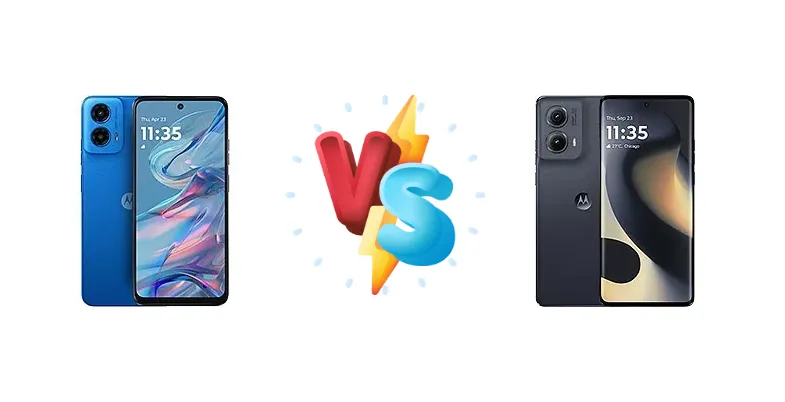
|
🏆 Quick Verdict
For the average user prioritizing value and all-day battery life, the Motorola Moto G45 offers a compelling package. However, the Motorola Edge (2024) is the clear winner for those who demand faster charging speeds and a noticeable performance boost for demanding tasks and gaming.
| PHONES | ||
|---|---|---|
| Phone Names | Motorola Moto G45 | Motorola Edge (2024) |
| Network | ||
|---|---|---|
| 2G bands | GSM 850 / 900 / 1800 / 1900 | GSM 850 / 900 / 1800 / 1900 |
| 3G bands | HSDPA 800 / 850 / 900 / 1900 / 2100 | HSDPA 850 / 900 / 1700(AWS) / 1900 / 2100 |
| 4G bands | 1, 2, 3, 5, 7, 8, 18, 19, 20, 26, 28, 32, 38, 40, 41, 42 | 1, 2, 3, 4, 5, 7, 8, 12, 13, 14, 17, 18, 19, 20, 25, 26, 29, 30, 38, 39, 40, 41, 48, 66, 71 |
| 5G bands | 1, 3, 5, 7, 8, 20, 28, 38, 40, 41, 77, 78 SA/NSA | 1, 2, 3, 5, 7, 12, 14, 20, 25, 26, 29, 30, 38, 40, 41, 48, 66, 70, 71, 77, 78 SA/NSA/Sub6 |
| Speed | HSPA, LTE, 5G | HSPA, LTE, 5G |
| Technology | GSM / HSPA / LTE / 5G | GSM / HSPA / LTE / 5G |
| Launch | ||
|---|---|---|
| Announced | 2024, August 21 | 2024, June 04 |
| Status | Available. Released 2024, August 28 | Available. Released 2024, June 20 |
| Body | ||
|---|---|---|
| Build | Glass front (Gorilla Glass 3), plastic frame, silicone polymer (eco leather) back | Glass front, aluminum frame, silicone polymer back (eco leather) |
| Dimensions | 162.7 x 74.6 x 8 mm (6.41 x 2.94 x 0.31 in) | 159.6 x 72 x 8.1 mm (6.28 x 2.83 x 0.32 in) |
| SIM | Nano-SIM + Nano-SIM | Nano-SIM + eSIM |
| Weight | 183 g (6.46 oz) | 174 g (6.14 oz) |
| Display | ||
|---|---|---|
| Protection | Corning Gorilla Glass 3 | Corning Gorilla Glass 3 |
| Resolution | 720 x 1600 pixels, 20:9 ratio (~270 ppi density) | 1080 x 2400 pixels, 20:9 ratio (~402 ppi density) |
| Size | 6.5 inches, 102.0 cm2 (~84.0% screen-to-body ratio) | 6.6 inches, 103.6 cm2 (~90.2% screen-to-body ratio) |
| Type | IPS LCD, 120Hz | P-OLED, 1B colors, 144Hz, 1300 nits (peak) |
| Platform | ||
|---|---|---|
| CPU | Octa-core (2x2.3 GHz Cortex-A78 & 6x2.0 GHz Cortex-A55) | Octa-core (4x2.40 GHz Cortex-A78 & 4x1.95 GHz Cortex-A55) |
| Chipset | Qualcomm SM6375 Snapdragon 6s Gen 3 (6 nm) | Qualcomm SM7435-AB Snapdragon 7s Gen 2 (4 nm) |
| GPU | Adreno 619 | Adreno 710 |
| OS | Android 14 | Android 14 |
| Memory | ||
|---|---|---|
| Card slot | microSDXC (uses shared SIM slot) | No |
| Internal | 128GB 4GB RAM, 128GB 8GB RAM | 256GB 8GB RAM |
| Main Camera | ||
|---|---|---|
| Dual | 50 MP, f/1.8 (wide), 1/2.76", 0.64µm, PDAF 2 MP (macro) | 50 MP, f/1.8, (wide), 1/1.5", 1.0µm, multi-directional PDAF, OIS 13 MP, f/2.2, 120˚ (ultrawide), 1.12µm, AF |
| Features | LED flash, HDR, panorama | Dual-LED flash, HDR, panorama |
| Video | 1080p@30fps, gyro-EIS | 4K@30fps, 1080p@30/60fps, HDR, gyro-EIS |
| Selfie camera | ||
|---|---|---|
| Features | - | HDR |
| Single | 16 MP, f/2.4, (wide), 1.0µm | 32 MP, f/2.4, (wide), 0.7µm, AF |
| Video | 1080p@30fps | 1080p@30fps |
| Sound | ||
|---|---|---|
| 35mm jack | Yes | No |
| Loudspeaker | Yes, with stereo speakers | Yes, with stereo speakers |
| Comms | ||
|---|---|---|
| Bluetooth | 5.1, A2DP, LE | 5.2, A2DP, LE |
| NFC | Yes | Yes |
| Positioning | GPS, GALILEO, GLONASS, QZSS | GPS, GLONASS, GALILEO |
| Radio | FM radio | No |
| USB | USB Type-C 2.0 | USB Type-C 3.1, DisplayPort 1.4 |
| WLAN | Wi-Fi 802.11 a/b/g/n/ac, dual-band, Wi-Fi Direct | Wi-Fi 802.11 a/b/g/n/ac/6e, tri-band, Wi-Fi Direct |
| Features | ||
|---|---|---|
| Sensors | Fingerprint (side-mounted), accelerometer, gyro, proximity, compass | Fingerprint (under display, optical), accelerometer, gyro, proximity, compass |
| Battery | ||
|---|---|---|
| Charging | 18W wired, PD, QC | 68W wired 15W wireless |
| Type | 5000 mAh | 5000 mAh |
| Misc | ||
|---|---|---|
| Colors | Brilliant Blue, Brilliant Green, Viva Magenta | Black |
| Models | - | XT2405V, XT-2405V |
| Price | ₹ 10,890 | $ 186.72 / C$ 254.99 |
Motorola Moto G45
- More affordable price point
- Potentially longer battery life due to efficient chipset
- Reliable performance for everyday tasks
- Slower charging speeds
- Less powerful processor for demanding games
- Likely lower quality display
Motorola Edge (2024)
- Significantly faster 68W wired charging
- More powerful Snapdragon 7s Gen 2 processor
- Potential for a higher-quality display and camera system
- Higher price tag
- Potentially shorter battery life under heavy load
- May require more frequent charging if used intensively
Display Comparison
While display specifications are missing, we can infer differences based on the target market. The Edge (2024), being the more premium device, likely features a higher resolution and potentially a higher refresh rate panel. The G45 will likely prioritize cost-effectiveness with a standard 60Hz or 90Hz display. The Edge's potential for OLED technology, versus the G45's likely LCD, would also contribute to superior contrast and color accuracy.
Camera Comparison
Without detailed camera specs, it's difficult to make definitive claims. However, the Edge (2024), positioned as a more premium device, likely features a larger main sensor and potentially optical image stabilization (OIS). The Snapdragon 7s Gen 2’s image signal processor (ISP) is also more advanced, enabling better noise reduction and dynamic range. While both phones likely include standard features like portrait mode and night mode, the Edge will likely deliver superior image quality, particularly in challenging lighting conditions. We anticipate the G45 will focus on providing acceptable image quality at a lower cost.
Performance
The core difference lies in the chipsets. The Motorola Edge (2024) utilizes the Qualcomm SM7435-AB Snapdragon 7s Gen 2, fabricated on a more efficient 4nm process. This translates to better thermal management and sustained performance compared to the Moto G45’s Snapdragon 6s Gen 3 (6nm). The Edge’s CPU configuration – 4x2.40 GHz Cortex-A78 cores – offers a higher peak clock speed than the G45’s 2x2.3 GHz Cortex-A78 setup, resulting in snappier application launches and smoother multitasking. The 4nm process also contributes to improved power efficiency, potentially offsetting the Edge’s higher performance demands.
Battery Life
The Motorola Edge (2024) boasts a significant advantage in charging speed with its 68W wired charging, capable of rapidly replenishing the battery. The G45’s 18W charging is considerably slower. The Edge also adds 15W wireless charging, a feature absent on the G45. While battery capacity isn't specified, the faster charging of the Edge mitigates the impact of a potentially smaller battery, allowing for quick top-ups throughout the day. The G45 will rely on its battery capacity and the efficiency of the Snapdragon 6s Gen 3 to deliver all-day battery life.
Buying Guide
Buy the Motorola Moto G45 if you need a reliable daily driver with good battery life and don't require the absolute fastest performance. It's ideal for students, casual users, and those on a tight budget. Buy the Motorola Edge (2024) if you prioritize rapid charging, smoother multitasking, and a more responsive experience for gaming or content creation, and are willing to spend a bit more.