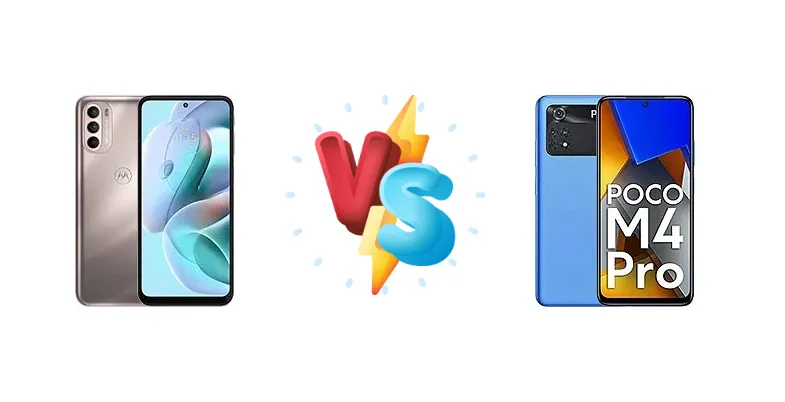
The Motorola Moto G41 and Xiaomi Poco M4 Pro represent compelling options in the crowded budget smartphone market. Both aim to deliver a solid experience without breaking the bank, but they take different approaches. The G41 focuses on a clean software experience and efficient chipset, while the Poco M4 Pro prioritizes display quality and a more powerful processor. This comparison will dissect their key differences to help you choose the right phone for your needs.
🏆 Quick Verdict
For most users, the Xiaomi Poco M4 Pro emerges as the better choice. Its Helio G96 chipset offers a noticeable performance uplift over the Moto G41’s Helio G85, and the significantly brighter 737 nit display enhances outdoor visibility. While battery life is comparable, the Poco M4 Pro’s faster 33W charging is a practical advantage.
| Network |
|---|
| 2G bands | GSM 850 / 900 / 1800 / 1900 | GSM 850 / 900 / 1800 / 1900 |
| 3G bands | HSDPA 800 / 850 / 900 / 1900 / 2100 - Europe | HSDPA 850 / 900 / 1700(AWS) / 1900 / 2100 - International |
| 4G bands | 1, 2, 3, 5, 7, 8, 18, 19, 20, 26, 28, 38, 40, 41 - Europe | 1, 2, 3, 4, 5, 7, 8, 20, 28, 38, 40, 41 - International |
| Speed | HSPA 42.2/5.76 Mbps, LTE Cat7 300/150 Mbps | HSPA, LTE |
| Technology | GSM / HSPA / LTE | GSM / HSPA / LTE |
| | 1, 2, 3, 4, 5, 7, 8, 12, 13, 26, 28, 40, 66 - LATAM, Brazil | 1, 3, 5, 8, 40, 41 - India |
| Launch |
|---|
| Announced | 2021, November 18 | 2022, February 28 |
| Status | Available. Released 2022, January 28 | Available. Released 2022, March 16 |
| Body |
|---|
| Build | - | Glass front (Gorilla Glass 3), plastic frame, plastic back |
| Dimensions | 161.9 x 73.9 x 8.3 mm (6.37 x 2.91 x 0.33 in) | 159.9 x 73.9 x 8.1 mm (6.30 x 2.91 x 0.32 in) |
| SIM | · Nano-SIM· Nano-SIM + Nano-SIM | Nano-SIM + Nano-SIM |
| Weight | 178 g (6.28 oz) | 179.5 g (6.31 oz) |
| | Water-repellent design | IP53, dust and splash resistant |
| Display |
|---|
| Protection | - | Corning Gorilla Glass 3 |
| Resolution | 1080 x 2400 pixels, 20:9 ratio (~411 ppi density) | 1080 x 2400 pixels, 20:9 ratio (~409 ppi density) |
| Size | 6.4 inches, 98.9 cm2 (~82.7% screen-to-body ratio) | 6.43 inches, 99.8 cm2 (~84.5% screen-to-body ratio) |
| Type | AMOLED | AMOLED, 90Hz, 700 nits, 1000 nits (peak) |
| Platform |
|---|
| CPU | Octa-core (2x2.0 GHz Cortex-A75 & 6x1.8 GHz Cortex-A55) | Octa-core (2x2.05 GHz Cortex-A76 & 6x2.0 GHz Cortex-A55) |
| Chipset | Mediatek MT6769Z Helio G85 (12 nm) | Mediatek MT6781 Helio G96 (12 nm) |
| GPU | Mali-G52 MC2 | Mali-G57 MC2 |
| OS | Android 11 | Android 11, MIUI 13 for POCO |
| Memory |
|---|
| Card slot | microSDXC (uses shared SIM slot) | microSDXC (dedicated slot) |
| Internal | 128GB 4GB RAM, 128GB 6GB RAM | 64GB 6GB RAM, 128GB 6GB RAM, 128GB 8GB RAM, 256GB 8GB RAM |
| | - | UFS 2.2 |
| Main Camera |
|---|
| Features | LED flash, HDR, panorama | LED flash, HDR, panorama |
| Single | - | 16 MP, f/2.5, (wide), 1/3.06" 1.0µm |
| Triple | 48 MP, f/1.7, (wide), 1/2.0", 0.8µm, PDAF, OIS
8 MP, f/2.2, 118˚ (ultrawide), 1/4.0", 1.12µm
2 MP (macro) | 64 MP, f/1.8, 26mm (wide), 0.7µm, PDAF
8 MP, f/2.2, 118˚ (ultrawide), 1/4.0", 1.12µm
2 MP (macro) |
| Video | 1080p@30fps | 1080p@30fps |
| Selfie camera |
|---|
| Features | - | HDR |
| Single | 13 MP, f/2.2, (wide), 1.12µm | 16 MP, f/2.5, (wide), 1/3.06" 1.0µm |
| Video | 1080p@30fps | 1080p@30fps |
| Sound |
|---|
| 3.5mm jack | Yes | Yes |
| 35mm jack | Yes | Yes |
| Loudspeaker | Yes | Yes, with stereo speakers |
| | - | 24-bit/192kHz audio |
| Comms |
|---|
| Bluetooth | 5.0, A2DP, LE | 5.0, A2DP, LE |
| Infrared port | - | Yes |
| NFC | Yes | Yes |
| Positioning | GPS, GLONASS, GALILEO | GPS, GLONASS, BDS, GALILEO |
| Radio | FM radio | FM radio, recording |
| USB | USB Type-C 2.0 | USB Type-C 2.0, OTG |
| WLAN | Wi-Fi 802.11 a/b/g/n/ac, dual-band, Wi-Fi Direct | Wi-Fi 802.11 a/b/g/n/ac, dual-band, Wi-Fi Direct |
| Features |
|---|
| Sensors | Fingerprint (side-mounted), accelerometer, gyro, proximity, compass | Fingerprint (side-mounted), accelerometer, gyro, compass |
| | - | Virtual proximity sensing |
| Battery |
|---|
| Charging | 30W wired | 33W wired, PD3.0, QC3, 100% in 58 min |
| Type | Li-Po 5000 mAh | Li-Po 5000 mAh |
| Misc |
|---|
| Colors | Meteorite Black, Pearl Gold | Power Black, Cool Blue, Poco Yellow |
| Models | XT2167-2 | MZB0B5VIN, 2201117PI, 2201117PG |
| Price | About 150 EUR | € 100.18 |
| SAR | - | 0.85 W/kg (head) 0.85 W/kg (body) |
| SAR EU | - | 0.59 W/kg (head) 0.84 W/kg (body) |
| Tests |
|---|
| Battery life | - |
Endurance rating 126h
|
| Camera | - |
Photo / Video |
| Display | - |
Contrast ratio: Infinite (nominal) |
| Loudspeaker | - |
-25.2 LUFS (Very good)
|
| Performance | - |
AnTuTu: 318444 (v9)
GeekBench: 1836 (v5.1)
GFXBench: 12fps (ES 3.1 onscreen) |
Motorola Moto G41
- Clean and bloatware-free Android experience
- Efficient processor for everyday tasks
- Competitive price point
- Less powerful processor compared to the Poco M4 Pro
- Dimmer display, potentially problematic outdoors
- Slower charging speeds
Xiaomi Poco M4 Pro
- More powerful Helio G96 processor
- Significantly brighter display for better visibility
- Faster 33W charging with PD3.0/QC3 support
- MIUI software can be heavily customized and include bloatware
- Potentially higher power consumption due to the more powerful processor
- May be slightly more expensive than the Moto G41
Display Comparison
The Poco M4 Pro boasts a substantial advantage in display quality, achieving a measured peak brightness of 737 nits. This is crucial for outdoor use, where the Moto G41’s display (brightness unspecified) will likely struggle. While both feature an 'infinite' contrast ratio (a marketing term), the higher brightness of the Poco M4 Pro translates to a more vivid and engaging viewing experience. Bezels appear similar based on available imagery, but the overall visual impact favors the Poco M4 Pro.
Camera Comparison
Both phones offer photo and video capabilities, but detailed camera specifications are limited. Without sensor size or aperture information, a direct comparison is difficult. However, the Poco M4 Pro’s marketing often emphasizes its camera prowess, suggesting a more refined image processing pipeline. The inclusion of features like Night Mode and AI scene detection are likely more advanced on the Poco M4 Pro. The presence of a 2MP macro camera on both devices is largely a marketing tactic, offering limited practical benefit due to the small sensor size and fixed focus.
Performance
At the heart of the Poco M4 Pro lies the Mediatek Helio G96, featuring a CPU configuration of 2x2.05 GHz Cortex-A76 cores and 6x2.0 GHz Cortex-A55 cores. This is a step up from the Moto G41’s Helio G85, which utilizes 2x2.0 GHz Cortex-A75 cores and 6x1.8 GHz Cortex-A55 cores. The Cortex-A76 cores in the G96 offer improved single-core performance, beneficial for app loading and responsiveness. While both chipsets are built on a 12nm process, the architectural improvements in the G96 provide a tangible performance advantage, particularly in gaming and demanding applications. The RAM configuration is not specified for either device, but faster LPDDR4X or LPDDR5 RAM would further enhance the Poco M4 Pro’s performance.
Battery Life
Both the Motorola Moto G41 and the Xiaomi Poco M4 Pro achieve an endurance rating of 126 hours, indicating similar overall battery life. However, the Poco M4 Pro distinguishes itself with 33W wired charging, supporting PD3.0 and QC3 standards, and achieving a full charge in just 58 minutes. The Moto G41’s 30W charging is slower, meaning longer downtime between uses. While the mAh capacity isn’t specified for either, the faster charging of the Poco M4 Pro provides a significant convenience factor.
Buying Guide
Buy the Motorola Moto G41 if you prioritize a streamlined Android experience with minimal bloatware and value efficient power consumption for all-day use. Buy the Xiaomi Poco M4 Pro if you frequently consume media, play mobile games, or need a brighter, more vibrant display, and appreciate faster charging speeds despite potentially more software customization.
Frequently Asked Questions
❓ Does the Poco M4 Pro's MIUI software significantly impact performance?
MIUI, while feature-rich, is known for its customizations and pre-installed apps. This can consume system resources and potentially impact performance, especially on a device with a mid-range chipset like the Helio G96. However, the G96's processing power is sufficient to handle MIUI without significant lag for most users. Disabling or uninstalling unnecessary apps can further optimize performance.
❓ Is the 30W charging on the Moto G41 slow compared to the Poco M4 Pro's 33W?
Yes, the 33W charging on the Poco M4 Pro is noticeably faster, completing a full charge in 58 minutes. The Moto G41’s 30W charging will take longer, potentially exceeding an hour and a half. This difference is significant for users who frequently need to quickly top up their battery.
❓ Will the Poco M4 Pro struggle with demanding games like PUBG Mobile?
The Helio G96 in the Poco M4 Pro is capable of running PUBG Mobile, but you may need to lower graphics settings to achieve a consistently smooth frame rate. The G96 isn't a dedicated gaming chipset, so don't expect maximum settings at high frame rates. The Moto G41's Helio G85 will likely require even more significant compromises in graphics settings.