
Motorola Moto G41 vs Samsung Galaxy A33 5G: A Deep Dive into Budget 5G Contenders
| Phones Images | |||||
|---|---|---|---|---|---|
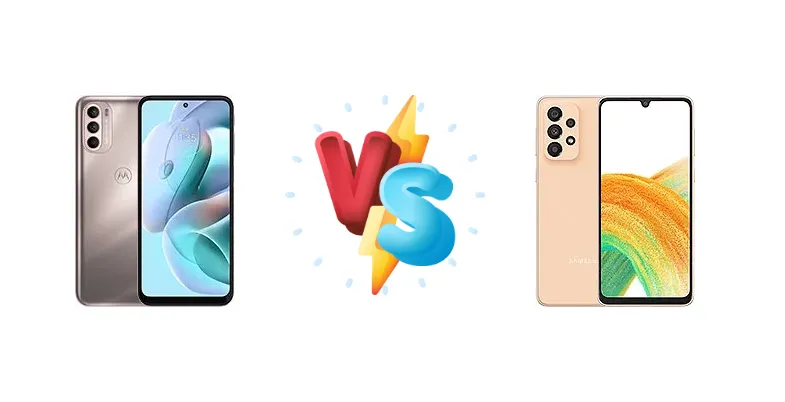
|
🏆 Quick Verdict
For most users, the Samsung Galaxy A33 5G emerges as the stronger choice. Its Exynos 1280 chipset, built on a more efficient 5nm process, provides a noticeable performance advantage over the Moto G41’s Helio G85, translating to smoother multitasking and gaming. While charging is slightly slower, the comparable battery endurance makes it a worthwhile trade-off.
| PHONES | ||
|---|---|---|
| Phone Names | Motorola Moto G41 | Samsung Galaxy A33 5G |
| Network | ||
|---|---|---|
| 2G bands | GSM 850 / 900 / 1800 / 1900 | GSM 850 / 900 / 1800 / 1900 |
| 3G bands | HSDPA 800 / 850 / 900 / 1900 / 2100 - Europe | HSDPA 850 / 900 / 1700(AWS) / 1900 / 2100 |
| 4G bands | 1, 2, 3, 5, 7, 8, 18, 19, 20, 26, 28, 38, 40, 41 - Europe | 1, 2, 3, 4, 5, 7, 8, 12, 17, 20, 26, 28, 32, 38, 40, 41, 66 |
| 5G bands | - | 1, 3, 5, 7, 8, 20, 28, 38, 40, 41, 66, 78 SA/NSA/Sub6 |
| Speed | HSPA 42.2/5.76 Mbps, LTE Cat7 300/150 Mbps | HSPA, LTE, 5G |
| Technology | GSM / HSPA / LTE | GSM / HSPA / LTE / 5G |
| 1, 2, 3, 4, 5, 7, 8, 12, 13, 26, 28, 40, 66 - LATAM, Brazil | - | |
| Launch | ||
|---|---|---|
| Announced | 2021, November 18 | 2022, March 17 |
| Status | Available. Released 2022, January 28 | Available. Released 2022, April 20 |
| Body | ||
|---|---|---|
| Build | - | Glass front (Gorilla Glass 5), plastic frame, plastic back |
| Dimensions | 161.9 x 73.9 x 8.3 mm (6.37 x 2.91 x 0.33 in) | 159.7 x 74 x 8.1 mm (6.29 x 2.91 x 0.32 in) |
| SIM | · Nano-SIM· Nano-SIM + Nano-SIM | · Nano-SIM· Nano-SIM + Nano-SIM |
| Weight | 178 g (6.28 oz) | 186 g (6.56 oz) |
| Water-repellent design | IP67 dust/water resistant (up to 1m for 30 min) | |
| Display | ||
|---|---|---|
| Protection | - | Corning Gorilla Glass 5 |
| Resolution | 1080 x 2400 pixels, 20:9 ratio (~411 ppi density) | 1080 x 2400 pixels, 20:9 ratio (~411 ppi density) |
| Size | 6.4 inches, 98.9 cm2 (~82.7% screen-to-body ratio) | 6.4 inches, 98.9 cm2 (~83.7% screen-to-body ratio) |
| Type | AMOLED | Super AMOLED, 90Hz |
| Platform | ||
|---|---|---|
| CPU | Octa-core (2x2.0 GHz Cortex-A75 & 6x1.8 GHz Cortex-A55) | Octa-core (2x2.4 GHz Cortex-A78 & 6x2.0 GHz Cortex-A55) |
| Chipset | Mediatek MT6769Z Helio G85 (12 nm) | Exynos 1280 (5 nm) |
| GPU | Mali-G52 MC2 | Mali-G68 |
| OS | Android 11 | Android 12, up to 4 major Android upgrades, One UI 8 |
| Memory | ||
|---|---|---|
| Card slot | microSDXC (uses shared SIM slot) | microSDXC (uses shared SIM slot) |
| Internal | 128GB 4GB RAM, 128GB 6GB RAM | 128GB 4GB RAM, 128GB 6GB RAM, 128GB 8GB RAM, 256GB 8GB RAM |
| Main Camera | ||
|---|---|---|
| Features | LED flash, HDR, panorama | LED flash, panorama, HDR |
| Quad | - | 48 MP, f/1.8, 26mm (wide), 1/2.0", 0.8µm, PDAF, OIS 8 MP, f/2.2, 123˚, (ultrawide), 1/4.0", 1.12µm 5 MP (macro) Auxiliary lens |
| Single | - | 13 MP, f/2.2, (wide), 1/3.1", 1.12µm |
| Triple | 48 MP, f/1.7, (wide), 1/2.0", 0.8µm, PDAF, OIS 8 MP, f/2.2, 118˚ (ultrawide), 1/4.0", 1.12µm 2 MP (macro) | - |
| Video | 1080p@30fps | 4K@30fps, 1080p@30/60fps |
| Selfie camera | ||
|---|---|---|
| Single | 13 MP, f/2.2, (wide), 1.12µm | 13 MP, f/2.2, (wide), 1/3.1", 1.12µm |
| Video | 1080p@30fps | 4K@30fps, 1080p@30fps |
| Sound | ||
|---|---|---|
| 3.5mm jack | Yes | No |
| 35mm jack | Yes | No |
| Loudspeaker | Yes | Yes, with stereo speakers |
| Comms | ||
|---|---|---|
| Bluetooth | 5.0, A2DP, LE | 5.1, A2DP, LE |
| NFC | Yes | Yes (market/region dependent) |
| Positioning | GPS, GLONASS, GALILEO | GPS, GLONASS, GALILEO, BDS |
| Radio | FM radio | No |
| USB | USB Type-C 2.0 | USB Type-C 2.0, OTG |
| WLAN | Wi-Fi 802.11 a/b/g/n/ac, dual-band, Wi-Fi Direct | Wi-Fi 802.11 a/b/g/n/ac, dual-band, Wi-Fi Direct |
| Features | ||
|---|---|---|
| Sensors | Fingerprint (side-mounted), accelerometer, gyro, proximity, compass | Fingerprint (under display, optical), accelerometer, gyro, compass |
| - | Virtual proximity sensing | |
| Battery | ||
|---|---|---|
| Charging | 30W wired | 25W wired |
| Type | Li-Po 5000 mAh | Li-Po 5000 mAh |
| Misc | ||
|---|---|---|
| Colors | Meteorite Black, Pearl Gold | Black, White, Blue, Peach |
| Models | XT2167-2 | SM-A336E, SM-A336B, SM-A336B/DS, SM-A336B/DSN, SM-A336E/DS, SM-A336M, SM-A3360 |
| Price | About 150 EUR | £ 174.99 / € 187.50 / ₹ 21,999 |
| SAR | - | 0.35 W/kg (head) |
| SAR EU | - | 0.57 W/kg (head) 1.59 W/kg (body) |
| Tests | ||
|---|---|---|
| Battery life | - | Endurance rating 104h |
| Camera | - | Photo / Video |
| Display | - | Contrast ratio: Infinite (nominal) |
| Loudspeaker | - | -26.5 LUFS (Good) |
| Performance | - | AnTuTu: 354420 (v8), 394918 (v9) GeekBench: 1900 (v5.1) GFXBench: 20fps (ES 3.1 onscreen) |
Motorola Moto G41
- More affordable price point
- Faster 30W charging
- Acceptable battery life for light users
- Less powerful Helio G85 chipset
- Potentially lower display quality
- Less refined camera system
Samsung Galaxy A33 5G
- More powerful and efficient Exynos 1280 chipset
- Brighter and more vibrant display
- Potentially superior camera performance
- Slightly slower 25W charging
- Higher price tag
- May require more careful thermal management during extended gaming
Display Comparison
The Samsung Galaxy A33 5G boasts a significantly brighter display, reaching a measured 728 nits, compared to an unspecified brightness for the Moto G41. This higher peak brightness ensures better visibility outdoors under direct sunlight. While both displays have an 'infinite' contrast ratio (typical for AMOLED/OLED panels), the A33’s superior brightness is a key advantage. The Moto G41’s display specifications are less detailed, suggesting a potentially lower-quality panel. The A33’s panel is likely to offer more accurate color reproduction and wider viewing angles.
Camera Comparison
Both devices feature photo and video capabilities, but detailed sensor information is lacking for both. However, given Samsung’s history, the A33 likely benefits from more sophisticated image processing algorithms and potentially larger sensor sizes. The Moto G41’s camera system is likely to be more basic, focusing on providing acceptable results in good lighting conditions. The presence of a 2MP macro camera on the G41 is a common budget tactic, offering limited real-world utility compared to a well-tuned primary sensor. The A33’s camera is expected to deliver more consistent image quality across various lighting scenarios.
Performance
The core difference lies in the chipsets. The Samsung Galaxy A33 5G’s Exynos 1280 (5nm) is a substantial upgrade over the Motorola Moto G41’s MediaTek Helio G85 (12nm). The 5nm fabrication process of the Exynos 1280 results in significantly improved power efficiency and thermal management, allowing for sustained performance under load. The A33’s CPU configuration – 2x2.4 GHz Cortex-A78 & 6x2.0 GHz Cortex-A55 – is also more powerful than the G41’s 2x2.0 GHz Cortex-A75 & 6x1.8 GHz Cortex-A55. This translates to faster app launch times, smoother multitasking, and a better gaming experience on the A33.
Battery Life
Interestingly, both phones share an endurance rating of 104 hours, suggesting comparable real-world battery life despite the differing chipsets. However, the Exynos 1280’s superior efficiency means the A33 achieves this endurance with a more demanding workload. The Moto G41 supports 30W wired charging, slightly faster than the A33’s 25W, potentially leading to quicker top-ups, but the efficiency of the A33’s chipset may offset this difference in daily use.
Buying Guide
Buy the Motorola Moto G41 if you prioritize a lower upfront cost and are a light user who primarily needs a phone for basic communication and occasional social media. Buy the Samsung Galaxy A33 5G if you value smoother performance for gaming and demanding apps, a brighter and more vibrant display, and a more refined software experience, even if it means spending a bit more.