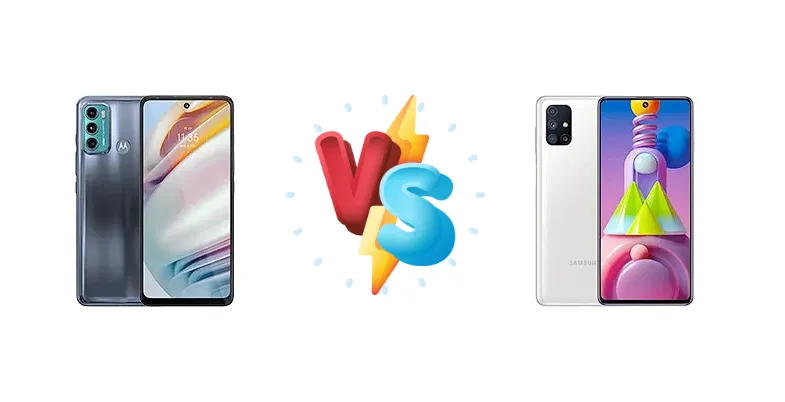
The Motorola Moto G40 Fusion and Samsung Galaxy M51 represent compelling options in the mid-range smartphone market, but cater to slightly different priorities. The M51, released earlier, established itself as a battery life champion, while the G40 Fusion aims to offer a more modern chipset and faster charging at a competitive price. This comparison dissects their key differences to determine which device delivers the best overall value.
🏆 Quick Verdict
For most users, the Samsung Galaxy M51 emerges as the stronger choice. While the Moto G40 Fusion boasts a slightly newer Snapdragon 732G, the M51’s exceptional battery endurance, coupled with its respectable performance and bright display, provides a more consistently reliable experience. The G40 Fusion is a good option for gamers prioritizing raw processing power, but the M51’s longevity is a significant advantage.
| Network |
|---|
| 2G bands | GSM 850 / 900 / 1800 / 1900 | GSM 850 / 900 / 1800 / 1900 |
| 3G bands | HSDPA 850 / 900 / 1700(AWS) / 1900 / 2100 | HSDPA 850 / 900 / 1700(AWS) / 1900 / 2100 |
| 4G bands | 1, 2, 3, 4, 5, 7, 8, 18, 19, 20, 26, 28, 38, 40, 41 | 1, 2, 3, 4, 5, 7, 8, 12, 17, 20, 26, 28, 38, 40, 41, 66 |
| Speed | HSPA, LTE | HSPA 42.2/5.76 Mbps, LTE (2CA) Cat6 400/50 Mbps |
| Technology | GSM / HSPA / LTE | GSM / HSPA / LTE |
| Launch |
|---|
| Announced | 2021, April 20 | 2020, August 31. Released 2020, September 11 |
| Status | Available. Released 2021, May 01 | Discontinued |
| Body |
|---|
| Build | Glass front, plastic frame, plastic back | Glass front (Gorilla Glass 3+), plastic back, plastic frame |
| Dimensions | 169.6 x 75.9 x 9.7 mm (6.68 x 2.99 x 0.38 in) | 163.9 x 76.3 x 9.5 mm (6.45 x 3.00 x 0.37 in) |
| SIM | Nano-SIM + Nano-SIM | Nano-SIM + Nano-SIM |
| Weight | 225 g (7.94 oz) | 213 g (7.51 oz) |
| | Water repellent design | - |
| Display |
|---|
| Protection | - | Corning Gorilla Glass 3+ |
| Resolution | 1080 x 2460 pixels (~395 ppi density) | 1080 x 2400 pixels, 20:9 ratio (~393 ppi density) |
| Size | 6.8 inches, 109.8 cm2 (~85.3% screen-to-body ratio) | 6.7 inches, 108.4 cm2 (~86.7% screen-to-body ratio) |
| Type | IPS LCD, 120Hz, HDR10 | Super AMOLED Plus |
| Platform |
|---|
| CPU | Octa-core (2x2.3 GHz Kryo 470 Gold & 6x1.8 GHz Kryo 470 Silver) | Octa-core (2x2.2 GHz Kryo 470 Gold & 6x1.8 GHz Kryo 470 Silver) |
| Chipset | Qualcomm SM7150 Snapdragon 732G (8 nm) | Qualcomm SDM730 Snapdragon 730G (8 nm) |
| GPU | Adreno 618 | Adreno 618 |
| OS | Android 11, upgradable to Android 12 | Android 10, upgradable to Android 12, One UI 4.1 |
| Memory |
|---|
| Card slot | microSDXC (uses shared SIM slot) | microSDXC (dedicated slot) |
| Internal | 64GB 4GB RAM, 128GB 6GB RAM | 128GB 6GB RAM, 128GB 8GB RAM |
| | UFS 2.1 | - |
| Main Camera |
|---|
| Features | LED flash, HDR, panorama | LED flash, panorama, HDR |
| Quad | - | 64 MP, f/1.8, 26mm (wide), 1/1.73", 0.8µm, PDAF
12 MP, f/2.2, 123˚ (ultrawide)
5 MP (macro)
Auxiliary lens |
| Triple | 64 MP, f/1.7 (wide), 0.7µm, PDAF
8 MP, f/2.2, 118˚ (ultrawide), 1/4.0", 1.12µm
Auxiliary lens | - |
| Video | 4K@30/120fps, 1080p@30/60/240fps | 4K@30fps, 1080p@30fps |
| Selfie camera |
|---|
| Features | HDR | HDR |
| Single | 16 MP, f/2.2, (wide), 1.0µm | 32 MP, f/2.0, 26mm (wide), 1/2.8", 0.8µm |
| Video | 4K@30fps, 1080p@30/60/240fps | 4K@30fps, 1080p@30fps |
| Sound |
|---|
| 3.5mm jack | Yes | Yes |
| 35mm jack | Yes | Yes |
| Loudspeaker | Yes | Yes |
| Comms |
|---|
| Bluetooth | 5.0, A2DP, LE | 5.0, A2DP, LE |
| NFC | Yes | Yes |
| Positioning | GPS, GLONASS, GALILEO | GPS, GLONASS, GALILEO, BDS |
| Radio | FM radio | FM radio, RDS |
| USB | USB Type-C 2.0, OTG | USB Type-C 2.0, OTG |
| WLAN | Wi-Fi 802.11 a/b/g/n/ac, dual-band, Wi-Fi Direct | Wi-Fi 802.11 a/b/g/n/ac, dual-band, Wi-Fi Direct |
| Features |
|---|
| Sensors | Fingerprint (rear-mounted), accelerometer, gyro, proximity | Fingerprint (side-mounted), accelerometer, gyro, proximity, compass |
| Battery |
|---|
| Charging | 20W wired, QC4 | 25W wired, 100% in 115 min
Reverse wired |
| Type | Li-Po 6000 mAh | Li-Po 7000 mAh |
| Misc |
|---|
| Colors | Dynamic Gray, Frosted Champagne | Celestial Black, Electric Blue, White |
| Models | PANV0001IN, PANV0005IN, PANV0009IN | SM-M515F, SM-M515F/DSN |
| Price | About 180 EUR | About 470 EUR |
| SAR | 0.85 W/kg (head) 1.20 W/kg (body) | 1.38 W/kg (head) |
| SAR EU | - | 0.61 W/kg (head) 1.45 W/kg (body) |
| Tests |
|---|
| Battery life | - | Endurance rating 156h |
| Camera | - |
Photo / Video |
| Display | - |
Contrast ratio: Infinite (nominal) |
| Loudspeaker | - |
-28.5 LUFS (Average) |
| Performance | - |
AnTuTu: 266620 (v8)
GeekBench: 1774 (v5.1)
GFXBench: 15fps (ES 3.1 onscreen) |
Motorola Moto G40 Fusion
- Slightly newer and faster Snapdragon 732G chipset
- Faster charging with QC4 support
- Potentially more optimized software experience
- Likely shorter battery life compared to the M51
- Missing reverse wired charging
- Display brightness data unavailable
Samsung Galaxy M51
- Exceptional battery life (156h endurance rating)
- Brighter display (677 nits)
- 25W fast charging with reverse wired charging
- Older Snapdragon 730G chipset
- Potentially slower app loading times
- Larger form factor due to battery size
Display Comparison
The Samsung Galaxy M51 features a notably brighter display, reaching a measured 677 nits, which translates to better visibility outdoors compared to the Moto G40 Fusion (brightness data unavailable). While both utilize LCD panels, the M51’s higher peak brightness is a tangible benefit. Contrast ratios are listed as infinite (nominal) for the M51, typical of LCDs, but the G40 Fusion’s display characteristics remain less defined without further data. The absence of high refresh rate support on either device is a common trade-off in this price segment.
Camera Comparison
Both phones offer photo and video capabilities, but detailed camera specifications are limited. Without sensor size or aperture information, a direct comparison is difficult. The M51’s camera system likely prioritizes versatility, while the G40 Fusion’s image processing may lean towards a more vibrant aesthetic. The inclusion of a 2MP macro camera on both devices is largely a marketing tactic, offering limited practical benefit due to the small sensor size and lack of optical image stabilization (OIS).
Performance
Both devices are powered by Qualcomm Snapdragon 7-series chipsets fabricated on an 8nm process, but the Moto G40 Fusion’s Snapdragon 732G offers a marginal performance uplift over the Galaxy M51’s Snapdragon 730G. The CPU configuration is nearly identical – octa-core with 2x2.3 GHz Kryo 470 Gold and 6x1.8 GHz Kryo 470 Silver in the G40 Fusion versus 2x2.2 GHz Kryo 470 Gold and 6x1.8 GHz Kryo 470 Silver in the M51. This slight clock speed difference, combined with potential optimizations in the 732G, may result in marginally faster app loading and smoother multitasking. However, the real-world difference will likely be subtle for most users.
Battery Life
The Samsung Galaxy M51’s standout feature is its exceptional battery life, boasting an endurance rating of 156 hours. This is achieved through a large battery capacity (specific mAh not provided in context) and efficient power management. The Moto G40 Fusion, while offering 20W wired charging with Quick Charge 4 (QC4) support, is likely to have a shorter battery life. The M51 supports 25W wired charging, reaching 100% in 115 minutes, and also includes reverse wired charging, a feature absent on the G40 Fusion. This makes the M51 a more versatile power bank for other devices.
Buying Guide
Buy the Motorola Moto G40 Fusion if you prioritize gaming performance and faster charging speeds, and don't mind potentially shorter battery life. Its Snapdragon 732G offers a slight edge in demanding applications. Buy the Samsung Galaxy M51 if you value exceptional battery life above all else, and need a phone that can easily last a full day – or even two – on a single charge. It’s the ideal choice for heavy users and those frequently away from power outlets.
Frequently Asked Questions
❓ Does the Snapdragon 730G in the Galaxy M51 struggle with demanding games like PUBG?
While not the latest chipset, the Snapdragon 730G is capable of running PUBG Mobile at medium to high settings with stable frame rates. However, users seeking the absolute best gaming performance may notice some occasional stuttering or frame drops, especially during intense firefights. The Moto G40 Fusion’s 732G will offer a slight improvement, but both phones are not designed for ultra-high settings.
❓ How significant is the difference in charging speed between 20W and 25W charging?
The difference between 20W and 25W charging is noticeable, but not dramatic. The Galaxy M51 takes 115 minutes to reach 100%, while the Moto G40 Fusion’s charging time is not specified but will likely be longer. The 25W charging on the M51 provides a quicker top-up, especially useful for users who need to quickly replenish their battery during short breaks.
❓ Is the reverse wired charging on the Galaxy M51 useful for everyday use?
Yes, reverse wired charging can be surprisingly useful. It allows you to use the Galaxy M51 as a power bank to charge other devices, such as wireless earbuds, smartwatches, or even another smartphone. While not a replacement for a dedicated power bank, it’s a convenient feature to have in emergencies or when traveling.