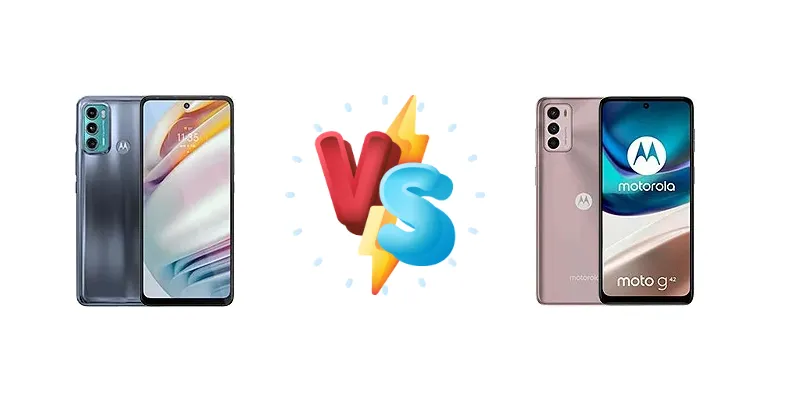
Motorola consistently delivers solid budget smartphones, and the G40 Fusion and G42 are prime examples. But which one offers the best value for your money? This comprehensive comparison dives deep into their features, performance, and overall appeal to help you make an informed decision.
🏆 Quick Verdict
The Moto G40 Fusion takes the crown for raw power and faster charging thanks to its Snapdragon 732G chipset. However, the Moto G42 boasts a more modern design, potentially better camera software, and a slightly more efficient 6nm process. It depends on your priorities: performance or refinement.
| Network |
|---|
| 2G bands | GSM 850 / 900 / 1800 / 1900 | GSM 850 / 900 / 1800 / 1900 |
| 3G bands | HSDPA 850 / 900 / 1700(AWS) / 1900 / 2100 | HSDPA 800 / 850 / 1700 / 1900 / 2100 - International |
| 4G bands | 1, 2, 3, 4, 5, 7, 8, 18, 19, 20, 26, 28, 38, 40, 41 | 1, 2, 3, 4, 5, 7, 8, 12, 13, 26, 28, 40, 41, 66 - LATAM, Brazil |
| Speed | HSPA, LTE | HSPA, LTE |
| Technology | GSM / HSPA / LTE | GSM / HSPA / LTE |
| | - | 1, 2, 3, 5, 7, 8, 18, 19, 20, 26, 28, 38, 40, 41 - India |
| Launch |
|---|
| Announced | 2021, April 20 | 2022, June 09 |
| Status | Available. Released 2021, May 01 | Available. Released 2022, June 28 |
| Body |
|---|
| Build | Glass front, plastic frame, plastic back | Glass front, plastic frame, plastic back |
| Dimensions | 169.6 x 75.9 x 9.7 mm (6.68 x 2.99 x 0.38 in) | 160.4 x 73.5 x 8 mm (6.31 x 2.89 x 0.31 in) |
| SIM | Nano-SIM + Nano-SIM | Nano-SIM + Nano-SIM |
| Weight | 225 g (7.94 oz) | 175 g (6.17 oz) |
| | Water repellent design | Water-repellent design |
| Display |
|---|
| Resolution | 1080 x 2460 pixels (~395 ppi density) | 1080 x 2400 pixels, 20:9 ratio (~411 ppi density) |
| Size | 6.8 inches, 109.8 cm2 (~85.3% screen-to-body ratio) | 6.4 inches, 98.9 cm2 (~83.9% screen-to-body ratio) |
| Type | IPS LCD, 120Hz, HDR10 | AMOLED |
| Platform |
|---|
| CPU | Octa-core (2x2.3 GHz Kryo 470 Gold & 6x1.8 GHz Kryo 470 Silver) | Octa-core (4x2.4 GHz Kryo 265 Gold & 4x1.9 GHz Kryo 265 Silver) |
| Chipset | Qualcomm SM7150 Snapdragon 732G (8 nm) | Qualcomm SM6225 Snapdragon 680 4G (6 nm) |
| GPU | Adreno 618 | Adreno 610 |
| OS | Android 11, upgradable to Android 12 | Android 12, planned upgrade to Android 13 |
| Memory |
|---|
| Card slot | microSDXC (uses shared SIM slot) | microSDXC (dedicated slot) |
| Internal | 64GB 4GB RAM, 128GB 6GB RAM | 64GB 4GB RAM, 128GB 4GB RAM |
| | UFS 2.1 | - |
| Main Camera |
|---|
| Features | LED flash, HDR, panorama | LED flash, HDR, panorama |
| Triple | 64 MP, f/1.7 (wide), 0.7µm, PDAF
8 MP, f/2.2, 118˚ (ultrawide), 1/4.0", 1.12µm
Auxiliary lens | 50 MP, f/1.8 (wide), 1/2.76", 0.64µm, PDAF
8 MP, f/2.2, 118˚ (ultrawide), 1/4.0", 1.12µm
2 MP (macro) |
| Video | 4K@30/120fps, 1080p@30/60/240fps | 1080p@30fps |
| Selfie camera |
|---|
| Features | HDR | - |
| Single | 16 MP, f/2.2, (wide), 1.0µm | 16 MP, f/2.2, (wide), 1.0µm |
| Video | 4K@30fps, 1080p@30/60/240fps | 1080p@30fps |
| Sound |
|---|
| 3.5mm jack | Yes | Yes |
| 35mm jack | Yes | Yes |
| Loudspeaker | Yes | Yes, with stereo speakers |
| Comms |
|---|
| Bluetooth | 5.0, A2DP, LE | 5.0, A2DP, LE |
| NFC | Yes | Yes |
| Positioning | GPS, GLONASS, GALILEO | GPS, GLONASS, GALILEO |
| Radio | FM radio | FM radio |
| USB | USB Type-C 2.0, OTG | USB Type-C 2.0 |
| WLAN | Wi-Fi 802.11 a/b/g/n/ac, dual-band, Wi-Fi Direct | Wi-Fi 802.11 a/b/g/n/ac, dual-band, Wi-Fi Direct |
| Features |
|---|
| Sensors | Fingerprint (rear-mounted), accelerometer, gyro, proximity | Fingerprint (side-mounted), accelerometer, gyro, proximity, compass |
| Battery |
|---|
| Charging | 20W wired, QC4 | 18W wired |
| Type | Li-Po 6000 mAh | Li-Po 5000 mAh |
| Misc |
|---|
| Colors | Dynamic Gray, Frosted Champagne | Atlantic Green, Metallic Rose |
| Models | PANV0001IN, PANV0005IN, PANV0009IN | XT2233-2 |
| Price | About 180 EUR | About 170 EUR |
| SAR | 0.85 W/kg (head) 1.20 W/kg (body) | - |
Motorola Moto G40 Fusion
- Superior Performance (Snapdragon 732G)
- Larger Battery (6000mAh)
- Faster Charging (20W)
- Higher Refresh Rate Display (120Hz)
- IPS LCD Display (less vibrant than AMOLED)
- Potentially less refined camera software
Motorola Moto G42
- AMOLED Display (vibrant colors)
- Potentially better camera software and OIS
- More modern design
- More efficient 6nm process
- Weaker Performance (Snapdragon 680)
- Smaller Battery (5000mAh)
- Slower Charging (18W)
- Lower Refresh Rate Display (60Hz)
Display Comparison
The Moto G42 features a 6.4-inch AMOLED display with a 60Hz refresh rate, offering vibrant colors and deep blacks. The Moto G40 Fusion has a 6.8-inch IPS LCD display with a 120Hz refresh rate, providing smoother scrolling and animations. While the G42's AMOLED is visually appealing, the G40 Fusion's higher refresh rate provides a more responsive feel.
Camera Comparison
Both phones feature capable camera systems. The Moto G40 Fusion typically has a 64MP main sensor, while the Moto G42 often includes a 50MP main sensor with OIS. While megapixels aren't everything, the G42's software processing and potential OIS could result in better low-light performance and more stable videos. Image quality is generally good on both, but the G42 might offer a slightly more refined experience.
Performance
The Snapdragon 732G in the Moto G40 Fusion is significantly more powerful than the Snapdragon 680 in the Moto G42. Expect noticeably faster app loading times, smoother multitasking, and better gaming performance on the G40 Fusion. The G42 is adequate for everyday tasks but will struggle with demanding games.
Battery Life
The Moto G40 Fusion packs a larger 6000mAh battery, providing excellent battery life, easily lasting a full day or more. The Moto G42 has a 5000mAh battery, which still offers good battery life but won't quite match the G40 Fusion's endurance. The G40 Fusion also supports 20W fast charging, while the G42 is limited to 18W.
Buying Guide
The Motorola Moto G40 Fusion is ideal for users who prioritize performance, gaming, and fast charging. The Moto G42 is a better choice for those seeking a more polished design, potentially improved camera experience, and a slightly more efficient device for everyday use.
Frequently Asked Questions
❓ Which phone is better for gaming?
The Moto G40 Fusion is significantly better for gaming due to its more powerful Snapdragon 732G chipset.
❓ Does the Moto G42 have a better camera?
While the Moto G42 might have slightly better camera software and potentially OIS, the G40 Fusion's hardware is generally comparable. Real-world results depend on the specific scene and lighting conditions.