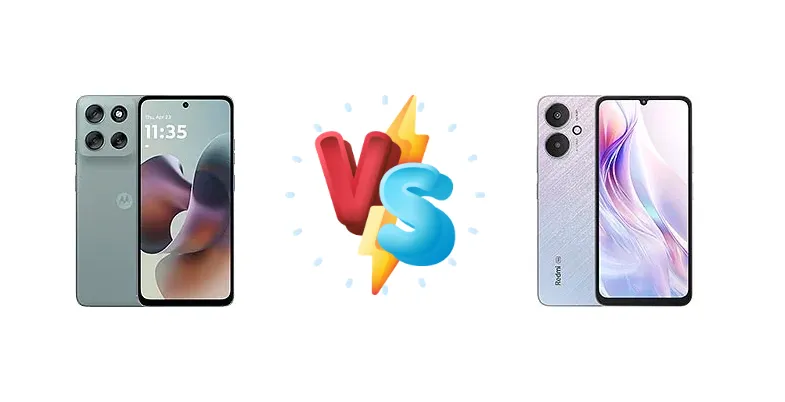
The Motorola Moto G36 and Xiaomi Redmi 13C 5G represent compelling options in the increasingly competitive sub-$200 5G smartphone market. While both aim to deliver affordable connectivity, they take different approaches to achieving this, primarily through their chipset choices. This comparison dissects those choices and their implications for everyday use.
🏆 Quick Verdict
For the average user prioritizing sustained performance and efficiency, the Motorola Moto G36 is the stronger choice. Its Snapdragon 7s Gen 2, built on a 4nm process, offers a noticeable advantage in processing power and thermal management over the Redmi 13C 5G’s Dimensity 6100+. However, the Redmi 13C 5G offers a lower entry price.
| Network |
|---|
| 2G bands | GSM 850 / 900 / 1800 / 1900 | GSM 850 / 900 / 1800 / 1900 |
| 3G bands | HSDPA 850 / 900 / 1900 / 2100 | HSDPA 800 / 850 / 900 / 1700(AWS) / 1900 / 2100 - International |
| 4G bands | LTE | 1, 2, 3, 4, 5, 7, 8, 12, 13, 17, 18, 19, 20, 26, 28, 32, 38, 40, 41, 66 - International |
| 5G bands | SA/NSA | 1, 3, 5, 7, 8, 20, 28, 38, 40, 41, 66, 77, 78 SA/NSA - International |
| Speed | HSPA, LTE, 5G | HSPA, LTE, 5G |
| Technology | GSM / HSPA / LTE / 5G | GSM / HSPA / LTE / 5G |
| Launch |
|---|
| Announced | Not announced yet | 2023, December 06 |
| Status | Rumored | Available. Released 2023, December 16 |
| Body |
|---|
| Build | - | Glass front (Gorilla Glass 3), plastic frame, plastic back |
| Dimensions | 166.3 x 76.5 x 8.7 mm (6.55 x 3.01 x 0.34 in) | 168.1 x 77.9 x 8.2 mm (6.62 x 3.07 x 0.32 in) |
| SIM | · Nano-SIM + eSIM· Nano-SIM + Nano-SIM | Nano-SIM + Nano-SIM |
| Weight | 210 g (7.41 oz) | 192 g or 195 g (6.77 oz) |
| Display |
|---|
| Protection | Unspecified | Corning Gorilla Glass 3 |
| Resolution | 1080 x 2400 pixels, 20:9 ratio (~392 ppi density) | 720 x 1600 pixels, 20:9 ratio (~260 ppi density) |
| Size | 6.72 inches, 109.0 cm2 (~85.7% screen-to-body ratio) | 6.74 inches, 109.7 cm2 (~83.8% screen-to-body ratio) |
| Type | IPS LCD, 120Hz, HDR10, 1000 nits (peak) | IPS LCD, 90Hz, 450 nits (typ), 600 nits (HBM) |
| Platform |
|---|
| CPU | Octa-core (4x2.40 GHz Cortex-A78 & 4x1.95 GHz Cortex-A55) | Octa-core (2x2.2 GHz Cortex-A76 & 6x2.0 GHz Cortex-A55) |
| Chipset | Qualcomm SM7435-AB Snapdragon 7s Gen 2 (4 nm) | Mediatek Dimensity 6100+ (6 nm) |
| GPU | Adreno 710 | Mali-G57 MC2 |
| OS | Android 15 | Android 13, MIUI 14 |
| Memory |
|---|
| Card slot | microSDXC (dedicated slot) | microSDXC (dedicated slot) |
| Internal | 128GB 4GB RAM, 128GB 8GB RAM, 256GB 4GB RAM, 256GB 8GB RAM, 512GB 12GB RAM | 64GB 4GB RAM, 128GB 4GB RAM, 128GB 6GB RAM, 256GB 8GB RAM |
| Main Camera |
|---|
| Dual | 50 MP, f/1.8 (wide), 0.64µm, PDAF
8 MP, f/2.2, 120˚ (ultrawide), 1/4.0", 1.12µm | - |
| Features | Dual-LED flash, HDR, panorama | LED flash, HDR |
| Single | - | 50 MP, f/1.8, 28mm (wide), 1/2.76", 1.12µm, PDAF
Auxiliary lens |
| Video | 4K@30fps, 1080p@30fps | 1080p@30fps |
| Selfie camera |
|---|
| Features | HDR | HDR |
| Single | 32 MP, f/2.2, (wide), 0.7µm | 5 MP, f/2.2, (wide) |
| Video | 1080p@30fps | 1080p@30fps |
| Sound |
|---|
| 35mm jack | Yes | Yes |
| Loudspeaker | Yes, with stereo speakers | Yes |
| Comms |
|---|
| Bluetooth | 5.3, A2DP, LE | 5.3, A2DP, LE |
| NFC | Yes (market/region dependent) | Yes (market/region dependent) |
| Positioning | GPS, GALILEO, GLONASS, BDS, QZSS | GPS, GLONASS, GALILEO, BDS |
| Radio | Unspecified | FM radio |
| USB | USB Type-C 2.0 | USB Type-C 2.0, OTG |
| WLAN | Wi-Fi 802.11 a/b/g/n/ac, dual-band | Wi-Fi 802.11 a/b/g/n/ac, dual-band |
| Features |
|---|
| Sensors | Fingerprint (side-mounted), accelerometer, gyro, proximity, compass | Fingerprint (side-mounted), accelerometer, compass |
| Battery |
|---|
| Charging | 33W wired | 18W wired, PD |
| Type | 7000 mAh | 5000 mAh |
| Misc |
|---|
| Colors | Black; other colors | Starry Black, Twilight Blue, Starry Silver, Starlight Black, Startrail Green, Startrail Silver |
| Models | XT2533-4 | 23124RN87G, 23124RN87I, 23124RN87C |
| Price | - | $ 198.99 / £ 119.00 / € 116.99 / ₹ 10,895 |
| SAR | - | 1.09 W/kg (head) 1.09 W/kg (body) |
| SAR EU | - | 0.98 W/kg (head) 0.98 W/kg (body) |
Motorola Moto G36
- More powerful and efficient Snapdragon 7s Gen 2 chipset
- Faster 33W wired charging
- Potentially better camera image processing
- Likely a slightly higher price point
- May lack features found on more expensive phones
Xiaomi Redmi 13C 5G
- Lower price point
- Power Delivery (PD) support for charging
- Acceptable performance for basic tasks
- Less powerful Dimensity 6100+ chipset
- Slower 18W charging
- Potential for throttling under heavy load
Display Comparison
Neither device boasts a standout display. While specific panel details (like peak brightness or color gamut coverage) are absent, the focus here is on the underlying processors. Display quality will likely be similar, leaning towards adequate for the price point. Bezels are expected to be noticeable on both, typical of this segment. The absence of high refresh rates on either device suggests a focus on power conservation.
Camera Comparison
Without detailed camera specs beyond the presence of cameras, a direct comparison is difficult. However, the chipset’s ISP (Image Signal Processor) plays a role. The Snapdragon 7s Gen 2 generally offers more advanced image processing capabilities than the Dimensity 6100+. This could translate to better dynamic range and noise reduction in photos taken with the Moto G36. The prevalence of 2MP macro lenses on both devices suggests they are largely marketing features and offer limited practical benefit. Expect similar performance in good lighting conditions, with the G36 potentially pulling ahead in low-light scenarios.
Performance
The core difference lies in the chipsets. The Motorola Moto G36’s Qualcomm Snapdragon 7s Gen 2 (4nm) is architecturally superior to the Redmi 13C 5G’s MediaTek Dimensity 6100+ (6nm). The Snapdragon utilizes Cortex-A78 cores in its octa-core configuration (4x2.40 GHz & 4x1.95 GHz), offering a performance uplift compared to the Dimensity’s Cortex-A76 cores (2x2.2 GHz & 6x2.0 GHz). The 4nm fabrication process of the Snapdragon is crucial; it translates to significantly better power efficiency and reduced heat generation, meaning the G36 is less likely to throttle under sustained load. This benefits gamers and users running multiple apps simultaneously. The Redmi 13C 5G will be adequate for everyday tasks, but will likely struggle with more intensive workloads.
Battery Life
The Redmi 13C 5G’s 18W charging with Power Delivery (PD) is slower than the Moto G36’s 33W wired charging. While battery capacity isn’t specified, the Snapdragon 7s Gen 2’s superior efficiency means the G36 will likely deliver comparable or better real-world battery life despite potentially having a smaller battery. The faster charging on the G36 will also reduce downtime, allowing for quicker top-ups.
Buying Guide
Buy the Motorola Moto G36 if you need a phone capable of handling demanding apps and moderate gaming without significant throttling, and value a more efficient processor for longer battery life. Buy the Xiaomi Redmi 13C 5G if you prioritize absolute affordability and are primarily focused on basic smartphone tasks like calling, texting, and light social media browsing, and are willing to trade some performance for a lower price point.
Frequently Asked Questions
❓ Will the Dimensity 6100+ in the Redmi 13C 5G struggle with graphically intensive games like PUBG Mobile?
Yes, the Dimensity 6100+ is likely to exhibit noticeable frame drops and throttling during extended gaming sessions with PUBG Mobile, especially at higher graphics settings. The Snapdragon 7s Gen 2 in the Moto G36 will provide a smoother, more consistent gaming experience.
❓ How much faster is the 33W charging on the Moto G36 compared to the 18W charging on the Redmi 13C 5G?
While exact 0-100% times depend on battery capacity, the 33W charging on the Moto G36 will significantly reduce charging time. Expect a roughly 30-50% faster charge compared to the Redmi 13C 5G, meaning less time tethered to a wall outlet.
❓ Does the Snapdragon 7s Gen 2 offer any advantages for video recording on the Moto G36?
The Snapdragon 7s Gen 2’s improved ISP supports better video stabilization and dynamic range during recording. While both phones likely record at 1080p, the Moto G36 should produce videos with more detail and less noise, particularly in challenging lighting conditions.