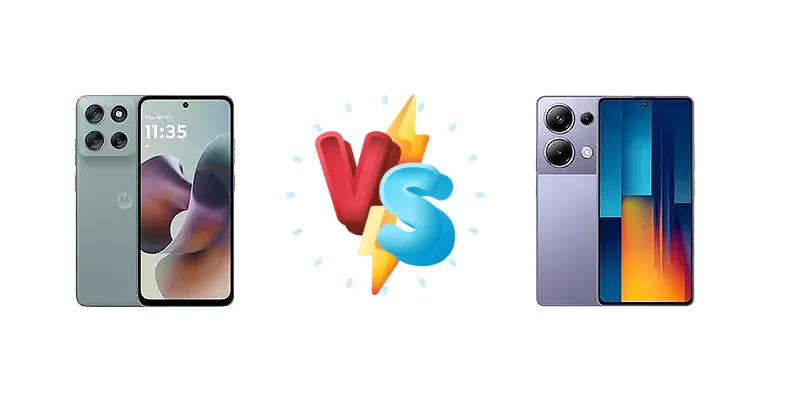
The Motorola Moto G36 and Xiaomi Poco M6 Pro 4G represent compelling options in the increasingly competitive sub-$250 smartphone market. The G36 leverages Qualcomm’s newer, more efficient Snapdragon 7s Gen 2, while the Poco M6 Pro 4G opts for MediaTek’s Helio G99 Ultra, prioritizing fast charging and a bright display. This comparison dissects their strengths and weaknesses to determine which device best suits your needs.
🏆 Quick Verdict
For the average user prioritizing sustained performance and future-proofing, the Motorola Moto G36 emerges as the winner. Its Snapdragon 7s Gen 2 chipset, built on a 4nm process, offers superior efficiency and processing power compared to the Poco M6 Pro 4G’s Helio G99 Ultra, despite the latter’s faster charging.
| Network |
|---|
| 2G bands | GSM 850 / 900 / 1800 / 1900 | GSM 850 / 900 / 1800 / 1900 |
| 3G bands | HSDPA 850 / 900 / 1900 / 2100 | HSDPA 800 / 850 / 900 / 1700(AWS) / 1900 / 2100 |
| 4G bands | LTE | 1, 2, 3, 4, 5, 7, 8, 12, 13, 17, 18, 19, 20, 26, 28, 38, 40, 41, 66 |
| 5G bands | SA/NSA | - |
| Speed | HSPA, LTE, 5G | HSPA, LTE |
| Technology | GSM / HSPA / LTE / 5G | GSM / HSPA / LTE |
| Launch |
|---|
| Announced | Not announced yet | 2024, January 11 |
| Status | Rumored | Available. Released 2024, January 12 |
| Body |
|---|
| Build | - | Glass front (Gorilla Glass 5), plastic frame |
| Dimensions | 166.3 x 76.5 x 8.7 mm (6.55 x 3.01 x 0.34 in) | 161.1 x 75 x 8 mm (6.34 x 2.95 x 0.31 in) |
| SIM | · Nano-SIM + eSIM· Nano-SIM + Nano-SIM | Nano-SIM + Nano-SIM |
| Weight | 210 g (7.41 oz) | 179 g (6.31 oz) |
| Display |
|---|
| Protection | Unspecified | Corning Gorilla Glass 5 |
| Resolution | 1080 x 2400 pixels, 20:9 ratio (~392 ppi density) | 1080 x 2400 pixels, 20:9 ratio (~395 ppi density) |
| Size | 6.72 inches, 109.0 cm2 (~85.7% screen-to-body ratio) | 6.67 inches, 107.4 cm2 (~88.9% screen-to-body ratio) |
| Type | IPS LCD, 120Hz, HDR10, 1000 nits (peak) | AMOLED, 120Hz, 1000 nits (HBM), 1300 nits (peak) |
| Platform |
|---|
| CPU | Octa-core (4x2.40 GHz Cortex-A78 & 4x1.95 GHz Cortex-A55) | Octa-core (2x2.2 GHz Cortex-A76 & 6x2.0 GHz Cortex-A55) |
| Chipset | Qualcomm SM7435-AB Snapdragon 7s Gen 2 (4 nm) | Mediatek Helio G99 Ultra |
| GPU | Adreno 710 | Mali-G57 MC2 |
| OS | Android 15 | Android 13, MIUI 14, planned upgrade to Android 14, HyperOS |
| Memory |
|---|
| Card slot | microSDXC (dedicated slot) | microSDXC (uses shared SIM slot) |
| Internal | 128GB 4GB RAM, 128GB 8GB RAM, 256GB 4GB RAM, 256GB 8GB RAM, 512GB 12GB RAM | 256GB 8GB RAM, 512GB 12GB RAM |
| Main Camera |
|---|
| Dual | 50 MP, f/1.8 (wide), 0.64µm, PDAF
8 MP, f/2.2, 120˚ (ultrawide), 1/4.0", 1.12µm | - |
| Features | Dual-LED flash, HDR, panorama | LED flash, HDR, panorama |
| Triple | - | 64 MP, f/1.8, 25mm (wide), 1/2.0", 0.7µm, PDAF, OIS
8 MP, f/2.2, (ultrawide)
2 MP (macro) |
| Video | 4K@30fps, 1080p@30fps | 1080p@30/60fps, gyro-EIS |
| Selfie camera |
|---|
| Features | HDR | - |
| Single | 32 MP, f/2.2, (wide), 0.7µm | 16 MP, f/2.5, (wide) |
| Video | 1080p@30fps | 1080p@30/60fps |
| Sound |
|---|
| 35mm jack | Yes | Yes |
| Loudspeaker | Yes, with stereo speakers | Yes, with dual speakers |
| Comms |
|---|
| Bluetooth | 5.3, A2DP, LE | 5.2, A2DP, LE |
| Infrared port | - | Yes |
| NFC | Yes (market/region dependent) | Yes (market/region dependent) |
| Positioning | GPS, GALILEO, GLONASS, BDS, QZSS | GPS, GALILEO, GLONASS, BDS |
| Radio | Unspecified | FM radio |
| USB | USB Type-C 2.0 | USB Type-C 2.0, OTG |
| WLAN | Wi-Fi 802.11 a/b/g/n/ac, dual-band | Wi-Fi 802.11 a/b/g/n/ac, dual-band |
| Features |
|---|
| Sensors | Fingerprint (side-mounted), accelerometer, gyro, proximity, compass | Fingerprint (under display, optical), accelerometer, gyro, compass |
| Battery |
|---|
| Charging | 33W wired | 67W wired, 100% in 44 min |
| Type | 7000 mAh | 5000 mAh |
| Misc |
|---|
| Colors | Black; other colors | Black, Blue, Purple |
| Models | XT2533-4 | 2312FPCA6G |
| Price | - | $ 170.00 |
| SAR | - | 1.09 W/kg (head) 1.09 W/kg (body) |
| SAR EU | - | 0.99 W/kg (head) 0.99 W/kg (body) |
Motorola Moto G36
- More efficient Snapdragon 7s Gen 2 chipset
- Potentially better sustained performance
- Likely better long-term software support
- Slower charging speed (33W)
- Display likely less bright than Poco M6 Pro
Xiaomi Poco M6 Pro 4G
- Extremely fast 67W charging (100% in 44 min)
- Very bright 1053 nit display
- Potentially more versatile camera features
- Less efficient Helio G99 Ultra chipset
- Potential for thermal throttling under heavy load
Display Comparison
The Xiaomi Poco M6 Pro 4G boasts a significantly brighter display, reaching a measured 1053 nits. This is a substantial advantage for outdoor use, where the Moto G36’s display brightness is not specified but likely falls below this figure. While the Moto G36’s panel technology isn’t detailed, the Poco M6 Pro 4G’s brightness suggests an IPS LCD panel optimized for peak luminance. Bezels are likely comparable given the price point, and color accuracy is an area where both phones will likely require calibration for professional use. The lack of high refresh rate panels on either device is typical for this segment.
Camera Comparison
Detailed camera specs are limited, but the focus should be on the main sensors. Without knowing the sensor sizes or apertures, it’s difficult to make a definitive judgment. However, the Poco M6 Pro 4G’s inclusion of 'Photo / Video' suggests a more versatile camera system, potentially with more shooting modes. The Moto G36’s camera performance will likely rely heavily on Qualcomm’s image signal processor (ISP) within the Snapdragon 7s Gen 2, offering good dynamic range and color accuracy. Both phones likely include a standard set of camera features, but the Poco M6 Pro 4G may offer more software-based enhancements.
Performance
The core difference lies in the chipsets. The Motorola Moto G36’s Qualcomm Snapdragon 7s Gen 2 (4nm) utilizes a more modern architecture – Cortex-A78 cores – and a smaller fabrication process than the Poco M6 Pro 4G’s MediaTek Helio G99 Ultra. This 4nm process translates to better thermal efficiency, meaning the G36 is less likely to throttle under sustained load. The Snapdragon 7s Gen 2’s CPU configuration (4x2.40 GHz Cortex-A78 & 4x1.95 GHz Cortex-A55) provides a performance edge over the Helio G99 Ultra’s (2x2.2 GHz Cortex-A76 & 6x2.0 GHz Cortex-A55). While both phones likely feature similar RAM configurations, the Snapdragon’s integrated GPU will offer a smoother gaming experience, particularly in graphically intensive titles.
Battery Life
The Xiaomi Poco M6 Pro 4G shines in charging speed, offering 67W wired charging and a claimed 100% charge in just 44 minutes. The Motorola Moto G36’s 33W charging is considerably slower. However, the Snapdragon 7s Gen 2’s efficiency may offset the Poco’s faster charging for users who don’t frequently need to top up. The Poco M6 Pro 4G’s active use score of 11:46h provides a solid baseline for battery life, but the G36’s more efficient chipset could deliver comparable or even better real-world endurance despite potentially having a smaller battery capacity (not specified).
Buying Guide
Buy the Motorola Moto G36 if you need a phone that can handle demanding apps and moderate gaming without significant throttling, and if long-term software support and efficient power management are important. Buy the Xiaomi Poco M6 Pro 4G if you prioritize extremely fast charging, a very bright display for outdoor visibility, and are willing to trade some processing power for those features. This phone is ideal for users who frequently find themselves needing a quick power boost.
Frequently Asked Questions
❓ Will the Helio G99 Ultra in the Poco M6 Pro 4G overheat during prolonged gaming sessions?
The Helio G99 Ultra is known to generate more heat than the Snapdragon 7s Gen 2. While the Poco M6 Pro 4G likely has thermal management features, expect some degree of throttling during extended gaming, potentially leading to frame rate drops. The Moto G36’s 4nm Snapdragon 7s Gen 2 will maintain performance for longer.
❓ How does the Snapdragon 7s Gen 2 handle multitasking compared to the Helio G99 Ultra?
The Snapdragon 7s Gen 2’s more efficient architecture and Cortex-A78 cores provide a noticeable advantage in multitasking. It can handle more apps in the background without significant slowdown, making it a better choice for users who frequently switch between applications.
❓ Is the 67W charging on the Poco M6 Pro 4G compatible with Power Delivery (PD) chargers?
While the Poco M6 Pro 4G supports 67W charging, it utilizes Xiaomi’s proprietary charging protocol. Therefore, it won’t achieve its maximum charging speed with standard Power Delivery (PD) chargers. You’ll need to use the included charger or a compatible Xiaomi charger to benefit from the 67W speed.