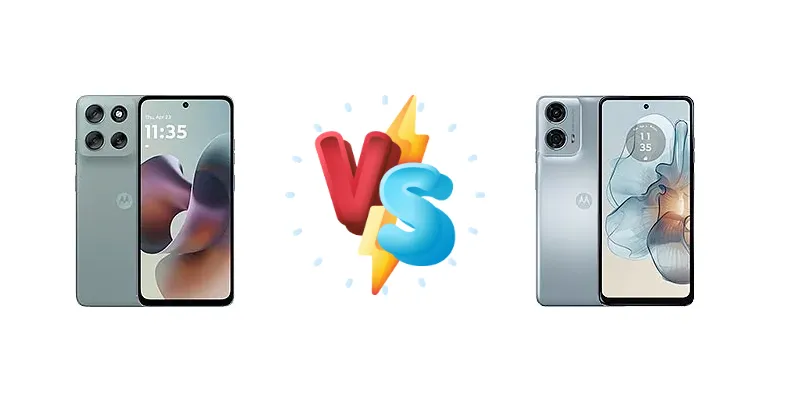
Motorola's G-series continues to dominate the budget smartphone space, but choosing the right model can be tricky. The Moto G36 introduces a newer, more efficient chipset with the Snapdragon 7s Gen 2, while the G24 Power focuses on maximizing battery life with a larger cell and a proven Helio G85 processor. This comparison dissects the key differences to determine which phone best suits your needs.
🏆 Quick Verdict
For most users, the Motorola Moto G36 emerges as the superior choice. Its Snapdragon 7s Gen 2 chipset delivers significantly better performance and future-proofing, despite a slightly smaller battery. The 33W charging also provides a marginal speed advantage. However, the G24 Power remains a compelling option for those prioritizing absolute battery longevity above all else.
| Network |
|---|
| 2G bands | GSM 850 / 900 / 1800 / 1900 | GSM 850 / 900 / 1800 / 1900 |
| 3G bands | HSDPA 850 / 900 / 1900 / 2100 | HSDPA 850 / 900 / 1900 / 2100 |
| 4G bands | LTE | 1, 2, 3, 5, 7, 8, 20, 28, 38, 40, 41 |
| 5G bands | SA/NSA | - |
| Speed | HSPA, LTE, 5G | HSPA, LTE |
| Technology | GSM / HSPA / LTE / 5G | GSM / HSPA / LTE |
| Launch |
|---|
| Announced | Not announced yet | 2024, January 30 |
| Status | Rumored | Available. Released 2024, February 07 |
| Body |
|---|
| Build | - | Glass front, plastic back, plastic frame |
| Dimensions | 166.3 x 76.5 x 8.7 mm (6.55 x 3.01 x 0.34 in) | 163.5 x 74.5 x 9 mm (6.44 x 2.93 x 0.35 in) |
| SIM | · Nano-SIM + eSIM· Nano-SIM + Nano-SIM | Nano-SIM + Nano-SIM |
| Weight | 210 g (7.41 oz) | 197 g (6.95 oz) |
| Display |
|---|
| Protection | Unspecified | - |
| Resolution | 1080 x 2400 pixels, 20:9 ratio (~392 ppi density) | 720 x 1612 pixels, 20:9 ratio (~269 ppi density) |
| Size | 6.72 inches, 109.0 cm2 (~85.7% screen-to-body ratio) | 6.56 inches, 103.4 cm2 (~84.9% screen-to-body ratio) |
| Type | IPS LCD, 120Hz, HDR10, 1000 nits (peak) | IPS LCD, 90Hz, 537 nits (peak) |
| Platform |
|---|
| CPU | Octa-core (4x2.40 GHz Cortex-A78 & 4x1.95 GHz Cortex-A55) | Octa-core (2x2.0 GHz Cortex-A75 & 6x1.7 GHz Cortex-A55) |
| Chipset | Qualcomm SM7435-AB Snapdragon 7s Gen 2 (4 nm) | Mediatek MT6769Z Helio G85 (12 nm) |
| GPU | Adreno 710 | Mali-G52 MC2 |
| OS | Android 15 | Android 14 |
| Memory |
|---|
| Card slot | microSDXC (dedicated slot) | microSDXC (dedicated slot) |
| Internal | 128GB 4GB RAM, 128GB 8GB RAM, 256GB 4GB RAM, 256GB 8GB RAM, 512GB 12GB RAM | 128GB 4GB RAM, 128GB 8GB RAM, 256GB 4GB RAM, 256GB 8GB RAM |
| Main Camera |
|---|
| Dual | 50 MP, f/1.8 (wide), 0.64µm, PDAF
8 MP, f/2.2, 120˚ (ultrawide), 1/4.0", 1.12µm | 50 MP, f/1.8 (wide), 0.64µm, PDAF
2 MP (macro) |
| Features | Dual-LED flash, HDR, panorama | LED flash, HDR, panorama |
| Video | 4K@30fps, 1080p@30fps | 1080p@30fps |
| Selfie camera |
|---|
| Features | HDR | - |
| Single | 32 MP, f/2.2, (wide), 0.7µm | 8 MP, f/2.0, (wide), 1.12µm - International version
16 MP, f/2.5, (wide), 1.0µm - India version |
| Video | 1080p@30fps | 1080p@30fps |
| Sound |
|---|
| 35mm jack | Yes | Yes |
| Loudspeaker | Yes, with stereo speakers | Yes, with stereo speakers |
| Comms |
|---|
| Bluetooth | 5.3, A2DP, LE | 5.0, A2DP, LE |
| NFC | Yes (market/region dependent) | Yes (market/region dependent) |
| Positioning | GPS, GALILEO, GLONASS, BDS, QZSS | GPS, GALILEO, GLONASS |
| Radio | Unspecified | FM radio (market/region dependent) |
| USB | USB Type-C 2.0 | USB Type-C 2.0 |
| WLAN | Wi-Fi 802.11 a/b/g/n/ac, dual-band | Wi-Fi 802.11 a/b/g/n/ac, dual-band |
| Features |
|---|
| Sensors | Fingerprint (side-mounted), accelerometer, gyro, proximity, compass | Fingerprint (side-mounted), accelerometer, gyro, proximity, compass |
| Battery |
|---|
| Charging | 33W wired | 30W wired |
| Type | 7000 mAh | 6000 mAh |
| Misc |
|---|
| Colors | Black; other colors | Glacier Blue, Ink Blue |
| Models | XT2533-4 | - |
| Price | - | € 132.29 |
Motorola Moto G36
- Significantly faster processor for smoother performance
- More power-efficient chipset for better battery life under load
- Faster 33W charging
- Potential for longer software support
- Potentially smaller battery capacity
- May be slightly more expensive
Motorola Moto G24 Power
- Likely larger battery capacity for extended runtime
- More affordable price point
- Proven and reliable Helio G85 chipset
- Focus on core functionality
- Slower processor and graphics performance
- Less efficient chipset leading to potential throttling
- Slower 30W charging
Display Comparison
While display specifications are missing, the G36's focus on a newer chipset suggests a potentially brighter and more color-accurate panel. The G24 Power, being a 'Power' variant, likely prioritizes power efficiency over display quality. The absence of high refresh rate information on both suggests standard 60Hz panels, focusing on battery conservation. Bezels are likely comparable given the price bracket, but the G36's processor could enable more sophisticated image processing for improved viewing experience.
Camera Comparison
Without detailed camera specs, it's difficult to make definitive claims. However, Motorola typically equips 'Power' models with a focus on main sensor quality. We can assume both phones will feature a multi-camera setup, but the G36’s more powerful processor allows for more advanced image processing algorithms, potentially leading to better low-light performance and dynamic range. The G36's ISP (Image Signal Processor) within the Snapdragon 7s Gen 2 will likely outperform the Helio G85's, even with similar sensor sizes. Expect the G36 to handle video recording with greater stability and detail.
Performance
The core difference lies in the chipsets. The Moto G36’s Qualcomm Snapdragon 7s Gen 2 (4nm) is a substantial upgrade over the G24 Power’s MediaTek Helio G85 (12nm). The 4nm process node translates to significantly improved power efficiency and thermal management, meaning the G36 will likely sustain peak performance for longer periods without throttling. The Snapdragon’s Cortex-A78 cores (2.40 GHz) are also architecturally superior to the Helio G85’s Cortex-A75 cores (2.0 GHz), resulting in faster single-core and multi-core performance. This benefits everything from app launch times to multitasking and gaming.
Battery Life
The G24 Power’s name implies a larger battery capacity, though the exact mAh is unspecified. However, the Snapdragon 7s Gen 2’s superior power efficiency in the G36 partially offsets this potential difference. The G36 offers 33W wired charging, slightly faster than the G24 Power’s 30W. While the difference isn’t massive, it translates to quicker top-ups. The G24 Power will likely offer longer screen-on time for basic usage, but the G36 will provide a more balanced experience with faster charging and sustained performance.
Buying Guide
Buy the Motorola Moto G36 if you need a phone capable of handling demanding apps, moderate gaming, and benefit from a more modern processor architecture for longer software support. Buy the Motorola Moto G24 Power if you prioritize all-day (and potentially multi-day) battery life and primarily use your phone for basic tasks like calling, texting, and social media, and are less concerned with peak performance.
Frequently Asked Questions
❓ Will the Snapdragon 7s Gen 2 in the Moto G36 handle demanding games like PUBG or Call of Duty?
Yes, the Snapdragon 7s Gen 2 is a capable chipset for gaming. While it won't deliver flagship-level performance, it should handle PUBG and Call of Duty at medium to high settings with playable frame rates. The 4nm process also helps mitigate thermal throttling during extended gaming sessions, providing a more consistent experience than the Helio G85.
❓ How much faster is the 33W charging on the Moto G36 compared to the 30W charging on the Moto G24 Power?
The difference in charging speed is incremental, not revolutionary. Expect the Moto G36 to charge approximately 5-10% faster from 0-100%. The real benefit lies in quicker top-ups – a 15-minute charge will likely provide more usable battery life on the G36 due to the higher wattage.
❓ Does the Moto G24 Power's Helio G85 chipset struggle with multitasking?
The Helio G85 is adequate for basic multitasking, such as switching between messaging apps and browsing the web. However, it may exhibit noticeable slowdowns when running multiple demanding applications simultaneously. The Moto G36's Snapdragon 7s Gen 2 offers a significantly smoother multitasking experience.
❓ Is the camera on the Moto G36 noticeably better than the camera on the Moto G24 Power?
While specific camera specs are missing, the Moto G36's Snapdragon 7s Gen 2 chipset includes a more advanced Image Signal Processor (ISP). This translates to better image processing, improved low-light performance, and more accurate colors compared to the Helio G85-powered G24 Power.