
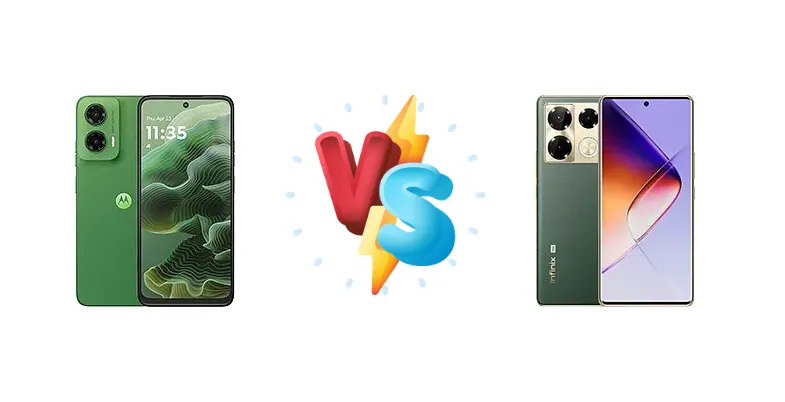
Motorola Moto G35 vs. Infinix Note 40 Pro: A Deep Dive into Performance and Endurance
| Phones Images | |||||
|---|---|---|---|---|---|
|
🏆 Quick Verdict
For the average user prioritizing all-day battery life and reliable performance, the Motorola Moto G35 is the better choice. Its impressive 48:27h endurance significantly outweighs the Infinix Note 40 Pro’s faster charging, especially considering the G35’s competitive price point. However, users demanding quicker performance and wireless charging will find the Note 40 Pro more appealing.
| PHONES | ||
|---|---|---|
| Phone Names | Motorola Moto G35 | Infinix Note 40 Pro |
| Network | ||
|---|---|---|
| 2G bands | GSM 850 / 900 / 1800 / 1900 | GSM 850 / 900 / 1800 / 1900 |
| 3G bands | HSDPA 850 / 900 / 1900 / 2100 | HSDPA 850 / 900 / 1700(AWS) / 1900 / 2100 |
| 4G bands | 1, 2, 3, 5, 7, 8, 20, 26, 28, 32, 38, 40, 41, 42 - ЕМЕА | 1, 2, 3, 4, 5, 7, 8, 12, 17, 20, 28, 38, 40, 41, 42, 66 |
| 5G bands | 1, 3, 5, 7, 8, 20, 26, 28, 38, 40, 41, 77, 78 SA/NSA - ЕМЕА | 1, 3, 5, 7, 8, 12, 20, 28, 38, 40, 41, 66, 77, 78 SA/NSA |
| Speed | HSPA, LTE, 5G | HSPA, LTE, 5G |
| Technology | GSM / HSPA / LTE / 5G | GSM / HSPA / LTE / 5G |
| Launch | ||
|---|---|---|
| Announced | 2024, August 29 | 2024, March 18 |
| Status | Available. Released 2024, September 25 | Available. Released 2024, March 19 |
| Body | ||
|---|---|---|
| Build | Glass front (Gorilla Glass 3), plastic back or silicone polymer (eco leather), plastic frame | - |
| Dimensions | 166.3 x 76 x 7.8 mm (6.55 x 2.99 x 0.31 in) | 164.3 x 74.5 x 8.1 mm (6.47 x 2.93 x 0.32 in) |
| SIM | · Nano-SIM + eSIM· Nano-SIM + Nano-SIM | Nano-SIM + Nano-SIM |
| Weight | 188 g or 191 g (6.63 oz) | 190 g or 196 g (6.70 oz) |
| Display | ||
|---|---|---|
| Protection | Corning Gorilla Glass 3, Mohs level 4 | Corning Gorilla Glass |
| Resolution | 1080 x 2400 pixels, 20:9 ratio (~392 ppi density) | 1080 x 2436 pixels (~393 ppi density) |
| Size | 6.72 inches, 109.0 cm2 (~86.3% screen-to-body ratio) | 6.78 inches, 109.9 cm2 (~89.8% screen-to-body ratio) |
| Type | IPS LCD, 120Hz, HDR10, 1000 nits (peak) | AMOLED, 1B colors, 120Hz, 2160Hz PWM, 1300 nits (peak) |
| Platform | ||
|---|---|---|
| CPU | Octa-core (1x2.2 GHz Cortex-A76 & 3x Cortex-A76 & 4x Cortex-A55) | Octa-core (2x2.2 GHz Cortex-A78 & 6x2.0 GHz Cortex-A55) |
| Chipset | Unisoc T760 (6 nm) | Mediatek Dimensity 7020 (6 nm) |
| GPU | Mali-G57 | IMG BXM-8-256 |
| OS | Android 14 | Android 14, XOS 14 |
| Memory | ||
|---|---|---|
| Card slot | microSDXC (dedicated slot) | Unspecified |
| Internal | 128GB 4GB RAM, 128GB 8GB RAM, 256GB 4GB RAM, 256GB 8GB RAM | 256GB 8GB RAM |
| Main Camera | ||
|---|---|---|
| Dual | 50 MP, f/1.8 (wide), 0.64µm, PDAF 8 MP, f/2.2, 120˚ (ultrawide), 1/4.0", 1.12µm | - |
| Features | Dual-LED flash, HDR, panorama | Dual-LED flash, HDR, panorama |
| Triple | - | 108 MP, f/1.8, (wide), PDAF, OIS 2 MP, f/2.4 2 MP, f/2.4 |
| Video | 4K@30fps, 1080p@30fps | 1440p@30fps, 1080p@30/60fps |
| Selfie camera | ||
|---|---|---|
| Features | HDR | Dual-LED flash |
| Single | 16 MP, f/2.5, (wide), 1.0µm | 32 MP, f/2.2, (wide), 1/3.1" |
| Video | 1080p@30fps | 1080p@30fps |
| Sound | ||
|---|---|---|
| 35mm jack | Yes | No |
| Loudspeaker | Yes, with stereo speakers | Yes, with stereo speakers |
| Comms | ||
|---|---|---|
| Bluetooth | 5.0, A2DP, LE | Yes |
| Infrared port | - | Yes |
| NFC | Yes (market/region dependent) | Yes (market/region dependent) |
| Positioning | GPS, GALILEO, GLONASS, BDS, QZSS | GPS |
| Radio | FM radio | FM radio |
| USB | USB Type-C 2.0 | USB Type-C 2.0, OTG |
| WLAN | Wi-Fi 802.11 a/b/g/n/ac, dual-band | Wi-Fi 802.11 a/b/g/n/ac, dual-band |
| Features | ||
|---|---|---|
| Sensors | Fingerprint (side-mounted), accelerometer, gyro, proximity, compass | Fingerprint (under display, optical), accelerometer, gyro, proximity, compass |
| Battery | ||
|---|---|---|
| Charging | 18W wired | 45W wired, 50% in 26 min 20W wireless MagCharge Reverse wired Reverse wireless |
| Type | 5000 mAh | 5000 mAh |
| Misc | ||
|---|---|---|
| Colors | Leaf Green, Guava Red, Midnight Black, Sage Green | Vintage Green, Titan Gold, Racing Edition |
| Models | XT2433-5 | X6851 |
| Price | $ 135.00 / C$ 199.99 / £ 88.99 / € 106.43 / ₹ 10,250 | About 280 EUR |
| EU LABEL | ||
|---|---|---|
| Battery | 48:27h endurance, 1000 cycles | - |
| Energy | Class B | - |
| Free fall | Class B (180 falls) | - |
| Repairability | Class B | - |
Motorola Moto G35
- Exceptional battery life (48:27h endurance)
- Reliable performance for everyday tasks
- Potentially more affordable price point
- Slower charging speed (18W)
- Less powerful processor compared to the Note 40 Pro
- Lacks wireless charging capabilities
Infinix Note 40 Pro
- Faster processor (Dimensity 7020)
- 45W fast charging and 20W MagCharge wireless charging
- Reverse charging capabilities
- Likely shorter battery life compared to the Moto G35
- Potentially higher price point
- Performance gains may not be noticeable for basic users
Display Comparison
Display specifications are absent from the provided data, but considering the price points, both devices likely feature LCD panels. The key differentiator will be resolution and refresh rate, which are unknown. However, the Note 40 Pro’s potential for a higher refresh rate, common in its segment, would provide a smoother visual experience. Bezels and color accuracy will be crucial factors in real-world usage, requiring further testing.
Camera Comparison
Without sensor details, a direct camera comparison is limited. However, the market positioning suggests the Infinix Note 40 Pro likely features a more sophisticated camera system. The inclusion of features like Optical Image Stabilization (OIS) – common in phones with Dimensity 7020 chipsets – would provide a significant advantage in low-light photography and video recording. The Moto G35 will likely rely on software processing to compensate for a potentially less capable sensor. The absence of information regarding lens apertures further complicates the comparison, but the Note 40 Pro’s chipset suggests a greater capacity for advanced image processing.
Performance
The Infinix Note 40 Pro’s Mediatek Dimensity 7020 chipset represents a significant step up in processing power compared to the Motorola Moto G35’s Unisoc T760. The Dimensity 7020 utilizes two Cortex-A78 cores clocked at 2.2 GHz, offering superior single-core performance for demanding applications. While both chips are fabricated on a 6nm process, the architectural advantage of the A78 cores in the Dimensity 7020 translates to faster app loading times and smoother multitasking. The G35’s reliance on Cortex-A76 and A55 cores, while efficient, will show its limitations in graphically intensive tasks. The Note 40 Pro is the clear winner for users who game or frequently use resource-heavy apps.
Battery Life
The Motorola Moto G35 boasts an impressive 48:27h endurance rating, indicating exceptional battery life. This is a major advantage over the Infinix Note 40 Pro, where battery life data is unavailable. While the Note 40 Pro compensates with 45W wired charging (reaching 50% in 26 minutes) and 20W MagCharge wireless charging, the G35’s longevity minimizes the need for frequent charging. The Note 40 Pro’s reverse wired and wireless charging capabilities are also absent in the G35, offering added versatility for charging accessories. However, the G35’s 18W charging is considerably slower, meaning a full charge will take significantly longer.
Buying Guide
Buy the Motorola Moto G35 if you need exceptional battery life, a dependable processor for everyday tasks, and value longevity over raw speed. This phone is ideal for users who prioritize minimizing charging frequency and appreciate a stable, consistent experience. Buy the Infinix Note 40 Pro if you prefer faster processing for gaming and multitasking, benefit from the convenience of 45W wired and 20W MagCharge wireless charging, and desire a more modern feature set including reverse charging.