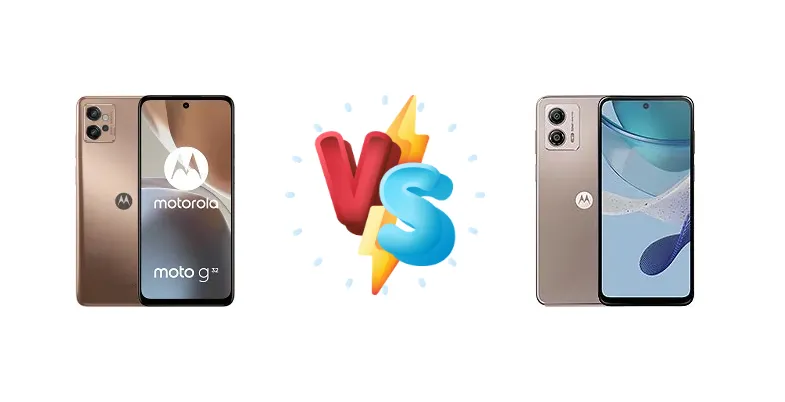
Motorola consistently delivers excellent value in the budget phone market. The Moto G32 and G53 are two strong contenders, but which one reigns supreme? This comprehensive comparison will delve into their key features to help you make the right choice.
🏆 Quick Verdict
The Moto G53 edges out the G32 thanks to its brighter display, 5G connectivity, and impressive battery life. While the G32 offers a slightly more powerful chipset, the G53's overall package provides a better user experience for most users.
| Network |
|---|
| 2G bands | GSM 850 / 900 / 1800 / 1900 | GSM 850 / 900 / 1800 / 1900 |
| 3G bands | HSDPA 850 / 900 / 1900 / 2100 | HSDPA 850 / 900 / 1900 / 2100 - EMEA & AP, China |
| 4G bands | 1, 3, 5, 7, 8, 20, 28, 38, 40, 41 | 1, 2, 3, 5, 7, 8, 18, 19, 20, 26, 28, 32, 38, 40, 41, 42 - EMEA & AP |
| 5G bands | - | 1, 3, 5, 7, 8, 20, 28, 38, 40, 41, 77, 78 SA/NSA - EMEA & AP |
| Speed | HSPA, LTE | HSPA, LTE, 5G |
| Technology | GSM / HSPA / LTE | GSM / CDMA / HSPA / LTE / 5G |
| | - | 1, 5, 8, 28, 41, 78 SA/NSA - China |
| Launch |
|---|
| Announced | 2022, July 28 | 2022, December 15 |
| Status | Available. Released 2022, August 16 | Available. Released 2022, December 15 |
| Body |
|---|
| Build | Glass front, plastic frame, plastic back | Glass front, plastic back, plastic frame |
| Dimensions | 161.8 x 73.8 x 8.5 mm (6.37 x 2.91 x 0.33 in) | 162.7 x 74.7 x 8.2 mm (6.41 x 2.94 x 0.32 in) |
| SIM | · Nano-SIM· Nano-SIM + Nano-SIM | · Nano-SIM + eSIM· Nano-SIM + Nano-SIM |
| Weight | 184 g (6.49 oz) | 183 g (6.46 oz) |
| | Water-repellent design | Water-resistant design |
| Display |
|---|
| Resolution | 1080 x 2400 pixels, 20:9 ratio (~405 ppi density) | 720 x 1600 pixels, 20:9 ratio (~270 ppi density) |
| Size | 6.5 inches, 102.0 cm2 (~85.4% screen-to-body ratio) | 6.5 inches, 102.0 cm2 (~83.9% screen-to-body ratio) |
| Type | IPS LCD, 90Hz | IPS LCD, 120Hz |
| Platform |
|---|
| CPU | Octa-core (4x2.4 GHz Kryo 265 Gold & 4x1.9 GHz Kryo 265 Silver) | Octa-core (2x2.2 GHz Kryo 460 & 6x1.8 GHz Kryo 460) |
| Chipset | Qualcomm SM6225 Snapdragon 680 4G (6 nm) | Qualcomm SM4350-AC Snapdragon 480+ 5G (8 nm) |
| GPU | Adreno 610 | Adreno 619 |
| OS | Android 12, upgradable to Android 13 | Android 13, planned upgrade to Android 14 |
| Memory |
|---|
| Card slot | microSDXC (dedicated slot) | microSDXC (uses shared SIM slot) |
| Internal | 64GB 4GB RAM, 128GB 4GB RAM, 128GB 6GB RAM, 128GB 8GB RAM, 256GB 8GB RAM | 64GB 4GB RAM, 128GB 4GB RAM, 128GB 6GB RAM, 128GB 8GB RAM |
| Main Camera |
|---|
| Dual | - | 50 MP, f/1.8 (wide), 1/2.76", 0.64µm, PDAF
2 MP (macro) |
| Features | LED flash, HDR, panorama | LED flash, HDR, panorama |
| Triple | 50 MP, f/1.8 (wide), 1/2.76", 0.64µm, PDAF
8 MP, f/2.2, 118˚ (ultrawide), 1/4.0", 1.12µm
2 MP, f/2.4, (macro/depth) | - |
| Video | 1080p@30fps | 1080p@30fps |
| Selfie camera |
|---|
| Single | 16 MP, f/2.4, (wide), 1.0µm | 8 MP, f/2.0, (wide), 1/4.0", 1.12µm
or
16 MP, f/2.2, (wide), 1.0µm |
| Video | 1080p@30fps | 1080p@30fps |
| Sound |
|---|
| 3.5mm jack | Yes | Yes |
| 35mm jack | Yes | Yes |
| Loudspeaker | Yes, with stereo speakers | Yes, with stereo speakers |
| Comms |
|---|
| Bluetooth | 5.2, A2DP, LE | 5.1, A2DP, LE |
| NFC | Yes (market/region dependent) | Yes (market/region dependent) |
| Positioning | GPS, GLONASS, GALILEO | GPS, GLONASS, GALILEO, BDS |
| Radio | FM radio | FM radio (market/region dependent) |
| USB | USB Type-C 2.0 | USB Type-C 2.0, OTG |
| WLAN | Wi-Fi 802.11 a/b/g/n/ac, dual-band, Wi-Fi Direct | Wi-Fi 802.11 a/b/g/n/ac, dual-band |
| Features |
|---|
| Sensors | Fingerprint (side-mounted), accelerometer, gyro, proximity, compass | Fingerprint (side-mounted), accelerometer, gyro, proximity, compass |
| Battery |
|---|
| Charging | 30W wired | 18W wired (China, LATAM)
10W wired (International)
Reverse wired |
| Type | Li-Po 5000 mAh | Li-Po 5000 mAh |
| Misc |
|---|
| Colors | Mineral Grey, Satin Silver, Rose Gold | Ink Blue, Arctic Silver, Pale Pink |
| Models | XT2235-2, XT2235-3 | XT2335-2 |
| Price | ₹ 8,990 | $ 295.00 / £ 143.15 |
| Tests |
|---|
| Battery life | - |
Endurance rating 123h
|
| Camera | - |
Photo / Video |
| Display | - |
Contrast ratio: 1746:1 (nominal) |
| Loudspeaker | - |
-26.0 LUFS (Very good)
|
| Performance | - |
AnTuTu: 314195 (v9)
GeekBench: 1594 (v5.1), 1797 (v6.0)
GFXBench: 29fps (ES 3.1 onscreen) |
Motorola Moto G32
- Slightly more powerful chipset
- 30W fast charging
- Compact design
- Less bright display
- No 5G connectivity
- Potentially shorter battery life
Motorola Moto G53
- Brighter and more vibrant display
- 5G connectivity
- Exceptional battery life
- Reverse wired charging
- Slightly slower processor
- Variable charging speeds (10W/18W)
- Larger size
Display Comparison
The Moto G53 boasts a significantly brighter display (599 nits vs. G32's estimated 450-500 nits) and a high contrast ratio (1746:1), resulting in a more vibrant and enjoyable viewing experience. Both phones feature similar FHD+ resolution, but the G53's brightness advantage is noticeable, especially outdoors. The G32's display is adequate, but not as impressive.
Camera Comparison
Camera performance is generally comparable between the two. Both offer decent image quality in good lighting conditions. Low-light performance is likely similar, with both relying on software processing to compensate. Specific camera specs are not detailed, but both are expected to offer standard features like portrait mode and HDR.
Performance
The Moto G32's Snapdragon 680 offers a slight edge in raw processing power compared to the G53's Snapdragon 480+ 5G. However, in real-world usage, the difference is minimal for everyday tasks. The G53's 8nm process may contribute to slightly better power efficiency despite the less powerful chip. Both phones handle multitasking and light gaming well.
Battery Life
The Moto G53 shines in battery life, boasting an endurance rating of 123h, significantly exceeding what's expected from the G32. While the G32's battery capacity is similar, the G53's more efficient chipset and potentially optimized software contribute to its superior longevity. The G32's 30W charging is faster than the G53's varying charging speeds (10W/18W).
Buying Guide
The Motorola Moto G32 is ideal for users prioritizing a slightly faster processor for basic tasks and gaming, and who don't need 5G. The Motorola Moto G53 is a better choice for those seeking a vibrant display, extended battery life, and the future-proofing of 5G connectivity, even with a slightly slower processor.
Frequently Asked Questions
❓ Is the Moto G53 worth the extra money?
Yes, if you value a brighter display, 5G connectivity, and longer battery life, the Moto G53 is a worthwhile upgrade over the G32.
❓ Which phone is better for gaming?
The Moto G32 has a slightly more powerful chipset, but both phones are suitable for casual gaming. Demanding games may require lower graphics settings on both devices.