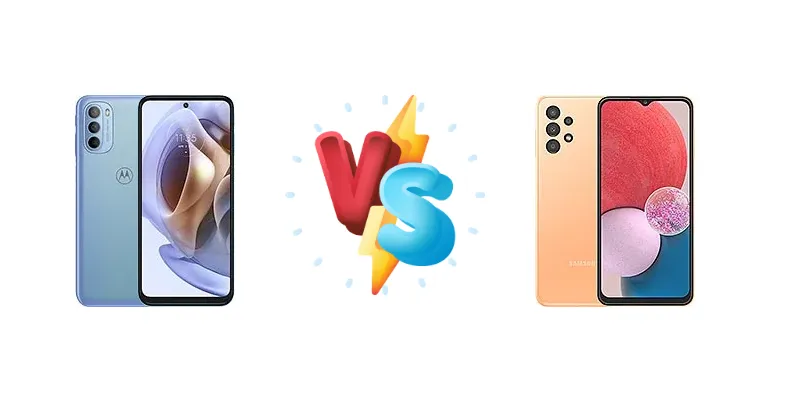
The budget smartphone market is fiercely competitive, and the Motorola Moto G31 and Samsung Galaxy A13 are two strong contenders. Both offer compelling features at affordable prices, but which one reigns supreme? This comprehensive comparison will break down every aspect, helping you make the right choice.
🏆 Quick Verdict
The Samsung Galaxy A13 edges out the Moto G31 thanks to its brighter display, faster charging, and generally smoother performance. While the Moto G31 offers a slightly more powerful chipset on paper, the A13's optimizations and overall package make it the better value.
| Network |
|---|
| 2G bands | GSM 850 / 900 / 1800 / 1900 | GSM 850 / 900 / 1800 / 1900 |
| 3G bands | HSDPA 800 / 850 / 900 / 1900 / 2100 | HSDPA 850 / 900 / 2100 |
| 4G bands | 1, 2, 3, 5, 7, 8, 18, 19, 20, 26, 28, 38, 40, 41 | 1, 3, 5, 7, 8, 20, 28, 38, 40, 41 |
| Speed | HSPA 42.2/5.76 Mbps, LTE Cat7 300/150 Mbps | HSPA, LTE |
| Technology | GSM / HSPA / LTE | GSM / HSPA / LTE |
| Launch |
|---|
| Announced | 2021, November 18 | 2022, March 04 |
| Status | Available. Released 2021, December 06 | Available. Released 2022, March 23 |
| Body |
|---|
| Build | - | Glass front (Gorilla Glass 5), plastic frame, plastic back |
| Dimensions | 161.9 x 73.9 x 8.6 mm (6.37 x 2.91 x 0.34 in) | 165.1 x 76.4 x 8.8 mm (6.5 x 3.01 x 0.35 in) |
| SIM | · Nano-SIM· Nano-SIM + Nano-SIM | · Nano-SIM· Nano-SIM + Nano-SIM |
| Weight | 181 g (6.38 oz) | 195 g (6.88 oz) |
| | Water-repellent design | - |
| Display |
|---|
| Protection | - | Corning Gorilla Glass 5 |
| Resolution | 1080 x 2400 pixels, 20:9 ratio (~411 ppi density) | 1080 x 2408 pixels, 20:9 ratio (~400 ppi density) |
| Size | 6.4 inches, 98.9 cm2 (~82.7% screen-to-body ratio) | 6.6 inches, 104.9 cm2 (~83.2% screen-to-body ratio) |
| Type | AMOLED | PLS LCD |
| Platform |
|---|
| CPU | Octa-core (2x2.0 GHz Cortex-A75 & 6x1.8 GHz Cortex-A55) | Octa-core (4x2.0 GHz Cortex-A55 & 4x2.0 GHz Cortex-A55) |
| Chipset | Mediatek MT6769Z Helio G85 (12 nm) | Exynos 850 (8 nm) |
| GPU | Mali-G52 MC2 | Mali-G52 |
| OS | Android 11, upgradable to Android 12 | Android 12, upgradable to Android 14, One UI 6.1 |
| Memory |
|---|
| Card slot | microSDXC (uses shared SIM slot) | microSDXC (dedicated slot) |
| Internal | 64GB 4GB RAM, 128GB 4GB RAM, 128GB 6GB RAM | 32GB 3GB RAM, 32GB 4GB RAM, 64GB 4GB RAM, 128GB 3GB RAM, 128GB 4GB RAM, 128GB 6GB RAM |
| | - | eMMC 5.1 |
| Main Camera |
|---|
| Features | LED flash, HDR, panorama | LED flash, panorama, HDR |
| Quad | - | 50 MP, f/1.8, (wide), PDAF
5 MP, f/2.2, 123˚ (ultrawide), 1/5.0", 1.12µm
2 MP (macro)
Auxiliary lens |
| Single | - | 8 MP, f/2.2, (wide) |
| Triple | 50 MP, f/1.8, (wide), 0.64µm, PDAF
8 MP, f/2.2, 118˚ (ultrawide), 1/4.0", 1.12µm
2 MP (macro) | - |
| Video | 1080p@30fps | 1080p@30fps |
| Selfie camera |
|---|
| Single | 13 MP, f/2.2, (wide), 1.12µm | 8 MP, f/2.2, (wide) |
| Video | 1080p@30fps | 1080p@30fps |
| Sound |
|---|
| 3.5mm jack | Yes | Yes |
| 35mm jack | Yes | Yes |
| Loudspeaker | Yes | Yes |
| Comms |
|---|
| Bluetooth | 5.0, A2DP, LE | 5.0, A2DP, LE |
| NFC | Yes | Yes (market/region dependent) |
| Positioning | GPS, GLONASS, GALILEO | GPS, GLONASS, GALILEO, BDS |
| Radio | FM radio | No |
| USB | USB Type-C 2.0 | USB Type-C 2.0, OTG |
| WLAN | Wi-Fi 802.11 a/b/g/n/ac, dual-band, Wi-Fi Direct | Wi-Fi 802.11 a/b/g/n/ac, dual-band, Wi-Fi Direct |
| Features |
|---|
| Sensors | Fingerprint (side-mounted), accelerometer, gyro, proximity, compass | Fingerprint (side-mounted), accelerometer, compass |
| | - | Virtual proximity sensing |
| Battery |
|---|
| Charging | 10W wired | 15W wired |
| Type | Li-Po 5000 mAh | Li-Po 5000 mAh |
| Misc |
|---|
| Colors | Mineral Grey, Baby Blue | Black, White, Peach, Blue |
| Models | XT2173-3 | SM-A135F, SM-A135F/DS, SM-A135M, SM-A135U, SM-A135U1, SM-A135N |
| Price | About 120 EUR | € 94.99 / $ 129.99 / £ 89.00 |
| SAR | - | 0.49 W/kg (head) |
| SAR EU | - | 0.37 W/kg (head) 1.39 W/kg (body) |
| Tests |
|---|
| Battery life | - |
Endurance rating 114h
|
| Camera | - |
Photo / Video |
| Display | - |
Contrast ratio: 1324:1 (nominal) |
| Loudspeaker | - |
-29.7 LUFS (Average)
|
| Performance | - |
AnTuTu: 122822 (v8), 136286 (v9)
GeekBench: 588 (v5.1)
GFXBench: 5.2fps (ES 3.1 onscreen) |
Motorola Moto G31
- Slightly more powerful chipset (on paper)
- Near-stock Android experience
- Decent display
- Dimmer display
- Slower charging (10W)
- Camera can be inconsistent
Samsung Galaxy A13
- Brighter display
- Faster charging (15W)
- Smoother performance (due to optimizations)
- Reliable Samsung ecosystem
- Chipset not as powerful on paper
- Samsung's One UI can be divisive
Display Comparison
The Samsung Galaxy A13 boasts a significant advantage with its measured 587 nits max brightness, making it much easier to view outdoors. The 1324:1 contrast ratio is excellent on both, but the A13's brightness elevates the viewing experience. The Moto G31's display is adequate but noticeably dimmer.
Camera Comparison
Both phones offer decent camera systems for their price range. The Galaxy A13 generally produces more consistent and pleasing images, particularly in well-lit conditions. The Moto G31's camera can sometimes struggle with dynamic range and color accuracy. Video recording quality is similar on both.
Performance
The Moto G31's Helio G85 chipset has a theoretical edge with its dual Cortex-A75 cores. However, the Exynos 850 in the Galaxy A13 benefits from Samsung's software optimizations, often resulting in smoother day-to-day performance and better efficiency. Gaming performance is comparable, but the A13's stability might be slightly better.
Battery Life
Both phones boast impressive endurance ratings (114h), indicating excellent battery life. Real-world usage will likely yield a full day of moderate use on either device. The Galaxy A13's 15W charging is faster than the Moto G31's 10W, reducing charging times.
Buying Guide
The Motorola Moto G31 is ideal for users prioritizing a slightly more powerful processor for gaming and those who prefer a near-stock Android experience. The Samsung Galaxy A13 is a better choice for those who value a brighter, more vibrant display, faster charging, and the reliability of the Samsung ecosystem.
Frequently Asked Questions
❓ Which phone has better gaming performance?
While the Moto G31 has a slightly more powerful chipset, the Samsung Galaxy A13's optimizations often lead to a smoother and more stable gaming experience.
❓ Is the Samsung Galaxy A13 worth the extra money?
Generally, yes. The brighter display, faster charging, and smoother performance make it a more well-rounded package, justifying the slight price difference.