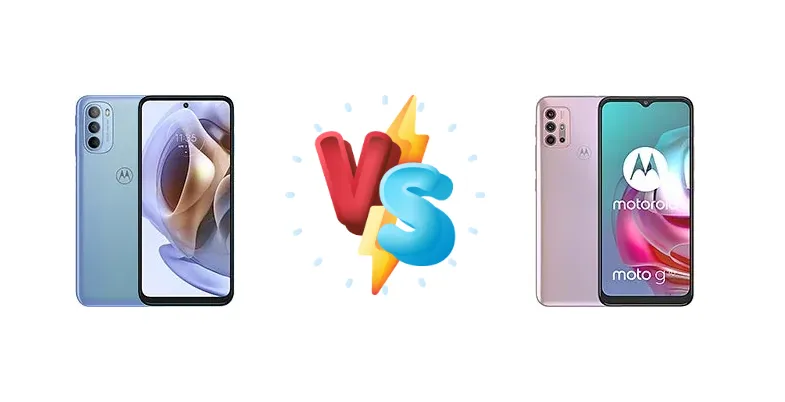
The Motorola Moto G series consistently delivers excellent value in the budget smartphone market. The Moto G31 and Moto G30 are two popular contenders, offering compelling features at affordable prices. But which one reigns supreme? Let's dive into a detailed comparison to help you decide.
🏆 Quick Verdict
The Moto G30 edges out the G31 thanks to its superior Snapdragon 662 chipset, slightly better display brightness, and faster charging capabilities. While the G31 boasts a higher refresh rate display, the G30's overall performance and battery efficiency make it the more well-rounded choice.
| Network |
|---|
| 2G bands | GSM 850 / 900 / 1800 / 1900 | GSM 850 / 900 / 1800 / 1900 |
| 3G bands | HSDPA 800 / 850 / 900 / 1900 / 2100 | HSDPA 850 / 900 / 1700(AWS) / 1900 / 2100 |
| 4G bands | 1, 2, 3, 5, 7, 8, 18, 19, 20, 26, 28, 38, 40, 41 | 1, 2, 3, 5, 7, 8, 18, 19, 20, 26, 28, 38, 40, 41 - International |
| Speed | HSPA 42.2/5.76 Mbps, LTE Cat7 300/150 Mbps | HSPA 42.2/5.76 Mbps, LTE Cat4 150/50 Mbps |
| Technology | GSM / HSPA / LTE | GSM / HSPA / LTE |
| | - | 1, 2, 3, 4, 5, 7, 8, 20, 38, 40, 41 - India |
| Launch |
|---|
| Announced | 2021, November 18 | 2021, February 16 |
| Status | Available. Released 2021, December 06 | Available. Released 2021, March 17 |
| Body |
|---|
| Build | - | Glass front, plastic back, plastic frame |
| Dimensions | 161.9 x 73.9 x 8.6 mm (6.37 x 2.91 x 0.34 in) | 165.2 x 75.7 x 9.1 mm (6.50 x 2.98 x 0.36 in) |
| SIM | · Nano-SIM· Nano-SIM + Nano-SIM | · Nano-SIM· Nano-SIM + Nano-SIM |
| Weight | 181 g (6.38 oz) | 200 g (7.05 oz) |
| | Water-repellent design | Water-repellent design |
| Display |
|---|
| Resolution | 1080 x 2400 pixels, 20:9 ratio (~411 ppi density) | 720 x 1600 pixels, 20:9 ratio (~269 ppi density) |
| Size | 6.4 inches, 98.9 cm2 (~82.7% screen-to-body ratio) | 6.5 inches, 102.8 cm2 (~82.2% screen-to-body ratio) |
| Type | AMOLED | IPS LCD, 90Hz |
| Platform |
|---|
| CPU | Octa-core (2x2.0 GHz Cortex-A75 & 6x1.8 GHz Cortex-A55) | Octa-core (4x2.0 GHz Kryo 260 Gold & 4x1.8 GHz Kryo 260 Silver) |
| Chipset | Mediatek MT6769Z Helio G85 (12 nm) | Qualcomm SM6115 Snapdragon 662 (11 nm) |
| GPU | Mali-G52 MC2 | Adreno 610 |
| OS | Android 11, upgradable to Android 12 | Android 11, upgradable to Android 12 |
| Memory |
|---|
| Card slot | microSDXC (uses shared SIM slot) | microSDXC (uses shared SIM slot) |
| Internal | 64GB 4GB RAM, 128GB 4GB RAM, 128GB 6GB RAM | 64GB 4GB RAM, 128GB 4GB RAM, 128GB 6GB RAM |
| | - | eMMC 5.1 |
| Main Camera |
|---|
| Features | LED flash, HDR, panorama | LED flash, HDR, panorama |
| Quad | - | 64 MP, f/1.7, 26mm (wide), 1/1.97", 0.7µm, PDAF
8 MP, f/2.2, 118˚ (ultrawide), 1/4.0", 1.12µm
2 MP (macro)
Auxiliary lens |
| Triple | 50 MP, f/1.8, (wide), 0.64µm, PDAF
8 MP, f/2.2, 118˚ (ultrawide), 1/4.0", 1.12µm
2 MP (macro) | - |
| Video | 1080p@30fps | 1080p@30/60fps |
| Selfie camera |
|---|
| Features | - | HDR |
| Single | 13 MP, f/2.2, (wide), 1.12µm | 13 MP, f/2.2, (wide), 1/3.1", 1.12µm |
| Video | 1080p@30fps | 1080p@30fps |
| Sound |
|---|
| 3.5mm jack | Yes | Yes |
| 35mm jack | Yes | Yes |
| Loudspeaker | Yes | Yes |
| Comms |
|---|
| Bluetooth | 5.0, A2DP, LE | 5.0, A2DP, LE |
| NFC | Yes | Yes (market/region dependent) |
| Positioning | GPS, GLONASS, GALILEO | GPS, GLONASS, GALILEO |
| Radio | FM radio | FM radio, RDS, recording |
| USB | USB Type-C 2.0 | USB Type-C 2.0, OTG |
| WLAN | Wi-Fi 802.11 a/b/g/n/ac, dual-band, Wi-Fi Direct | Wi-Fi 802.11 a/b/g/n/ac, dual-band, Wi-Fi Direct |
| Features |
|---|
| Sensors | Fingerprint (side-mounted), accelerometer, gyro, proximity, compass | Fingerprint (rear-mounted), accelerometer, gyro, proximity |
| Battery |
|---|
| Charging | 10W wired | 15W / 20W wired (market dependent) |
| Type | Li-Po 5000 mAh | Li-Po 5000 mAh |
| Misc |
|---|
| Colors | Mineral Grey, Baby Blue | Phantom Black (Dark Pearl), Pastel Sky |
| Models | XT2173-3 | XT2129-1, XT2129-2, PAML0000IN |
| Price | About 120 EUR | About 170 EUR |
| SAR | - | 1.11 W/kg (head) 1.32 W/kg (body) |
| Tests |
|---|
| Battery life | - |
Endurance rating 131h
|
| Camera | - |
Photo / Video |
| Display | - |
Contrast ratio: 1984:1 (nominal) |
| Loudspeaker | - |
-28.7 LUFS (Average)
|
| Performance | - |
AnTuTu: 170968 (v8)
GeekBench: 1265 (v5.1)
GFXBench: 13fps (ES 3.1 onscreen) |
Motorola Moto G31
- 120Hz Refresh Rate Display
- Decent Camera System
- Affordable Price
- Less Powerful Chipset
- Slower Charging
- Potentially Lower Image Processing Quality
Motorola Moto G30
- More Powerful Snapdragon 662 Chipset
- Excellent Battery Life
- Faster Charging (Market Dependent)
- Slightly Brighter Display
- Standard 60Hz Refresh Rate
- Potentially Less Vibrant Colors (depending on calibration)
Display Comparison
Both phones feature large 6.5-inch FHD+ displays. The Moto G30 boasts a slightly higher measured brightness of 468 nits and a nominal contrast ratio of 1984:1. The Moto G31 offers a 120Hz refresh rate, providing a smoother scrolling and gaming experience, while the G30 has a standard 60Hz refresh rate. This is a key differentiator.
Camera Comparison
Both phones offer versatile camera setups, but the G30 generally produces slightly better image quality due to the more efficient processor handling image processing. The G31's camera is capable, but the G30's image processing often results in more vibrant and detailed photos. Specific camera specs are not detailed in the provided data, so a full camera comparison would require further testing.
Performance
The Moto G30's Qualcomm Snapdragon 662 chipset is noticeably more powerful than the Moto G31's Mediatek Helio G85. The Snapdragon 662 offers better overall performance and efficiency, resulting in smoother multitasking and app loading times. The G31's Helio G85 is adequate for everyday tasks but may struggle with more demanding games.
Battery Life
The Moto G30 shines in this category, boasting an impressive endurance rating of 131 hours. While the G31's battery capacity is likely similar, the G30's more efficient chipset contributes to its exceptional battery life. The G30 also supports faster charging (15W/20W depending on market) compared to the G31's 10W wired charging.
Buying Guide
The Motorola Moto G31 is a good choice for users prioritizing a smoother display experience with its 120Hz refresh rate and those who don't mind slightly slower charging. The Motorola Moto G30 is ideal for users seeking a more powerful processor, better overall performance, and faster charging, especially if battery life is a top priority.
Frequently Asked Questions
❓ Is the 120Hz display on the Moto G31 worth it?
The 120Hz refresh rate provides a noticeably smoother experience, but the less powerful chipset might limit its benefits in demanding applications. It's a trade-off.
❓ Which phone is better for gaming?
The Moto G30 is generally better for gaming due to its more powerful Snapdragon 662 chipset, which provides smoother performance and better frame rates.