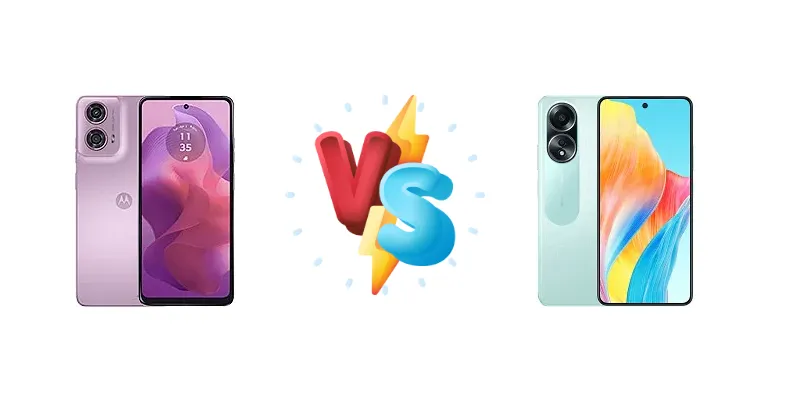
The Motorola Moto G24 and Oppo A58 4G represent compelling options in the crowded sub-$200 smartphone market. Both leverage the Mediatek Helio G85 chipset, but diverge in charging speeds and subtle CPU clock differences, creating a nuanced choice for budget-conscious consumers. This comparison dissects these differences to determine which device delivers the most value.
🏆 Quick Verdict
For most users, the Oppo A58 4G emerges as the better choice. Its 33W charging capability significantly reduces downtime, reaching 56% charge in just 30 minutes, a substantial advantage over the Moto G24’s slower 15W charging. While the CPU clock speed difference is minimal, the faster charging makes the A58 4G more practical for daily use.
| Network |
|---|
| 2G bands | GSM 850 / 900 / 1800 / 1900 | GSM 900 / 1800 |
| 3G bands | HSDPA 850 / 900 / 1900 / 2100 | HSDPA 900 / 2100 |
| 4G bands | 1, 2, 3, 5, 7, 8, 20, 28, 38, 40, 41 | 1, 3, 5, 8, 40 |
| Speed | HSPA, LTE | HSPA, LTE |
| Technology | GSM / HSPA / LTE | GSM / HSPA / LTE |
| Launch |
|---|
| Announced | 2024, January 18 | 2023, July 26 |
| Status | Available. Released 2024, February 06 | Available. Released 2023, July 28 |
| Body |
|---|
| Build | Glass front, plastic back, plastic frame | Glass front, plastic frame, plastic back |
| Dimensions | 163.5 x 74.5 x 8 mm (6.44 x 2.93 x 0.31 in) | 165.7 x 76 x 8 mm (6.52 x 2.99 x 0.31 in) |
| SIM | · Nano-SIM· Nano-SIM + Nano-SIM | Nano-SIM + Nano-SIM |
| Weight | 181 g (6.38 oz) | 192 g (6.77 oz) |
| Display |
|---|
| Resolution | 720 x 1612 pixels, 20:9 ratio (~269 ppi density) | 1080 x 2400 pixels, 20:9 ratio (~392 ppi density) |
| Size | 6.56 inches, 103.4 cm2 (~84.9% screen-to-body ratio) | 6.72 inches, 109.0 cm2 (~86.6% screen-to-body ratio) |
| Type | IPS LCD, 90Hz, 537 nits (peak) | IPS LCD, 550 nits (typ), 680 nits (HBM) |
| Platform |
|---|
| CPU | Octa-core (2x2.0 GHz Cortex-A75 & 6x1.7 GHz Cortex-A55) | Octa-core (2x2.0 GHz Cortex-A75 & 6x1.8 GHz Cortex-A55) |
| Chipset | Mediatek MT6769Z Helio G85 (12 nm) | Mediatek MT6769 Helio G85 (12 nm) |
| GPU | Mali-G52 MC2 | Mali-G52 MC2 |
| OS | Android 14 | Android 13, upgradable to Android 15, ColorOS 15 |
| Memory |
|---|
| Card slot | microSDXC | microSDXC |
| Internal | 128GB 4GB RAM, 128GB 8GB RAM, 256GB 4GB RAM, 256GB 8GB RAM | 128GB 6GB RAM, 128GB 8GB RAM, 256GB 8GB RAM |
| Main Camera |
|---|
| Dual | 50 MP, f/1.8 (wide), 0.64µm, PDAF
2 MP (macro) | 50 MP, f/1.8, (wide), AF
Auxiliary lens |
| Features | LED flash, HDR, panorama | LED flash, HDR, panorama |
| Video | 1080p@30fps | 1080p@30fps |
| Selfie camera |
|---|
| Features | HDR | Panorama |
| Single | 8 MP, f/2.0, (wide), 1.12µm | 8 MP, f/2.0, (wide) |
| Video | 1080p@30fps | 1080p@30fps |
| Sound |
|---|
| 35mm jack | Yes | Yes |
| Loudspeaker | Yes, with stereo speakers | Yes, with stereo speakers |
| Comms |
|---|
| Bluetooth | 5.0, A2DP, LE | 5.3, A2DP, LE, aptX HD |
| Infrared port | - | Yes |
| NFC | Yes (market/region dependent) | Yes |
| Positioning | GPS, GALILEO, GLONASS | GPS, GALILEO, GLONASS, BDS, QZSS |
| Radio | FM radio | No |
| USB | USB Type-C 2.0 | USB Type-C 2.0, OTG |
| WLAN | Wi-Fi 802.11 a/b/g/n/ac, dual-band | Wi-Fi 802.11 a/b/g/n/ac, dual-band |
| Features |
|---|
| Sensors | Fingerprint (side-mounted), accelerometer, gyro, proximity, compass | Fingerprint (side-mounted), accelerometer, proximity, compass |
| Battery |
|---|
| Charging | 15W wired | 33W wired, 56% in 30 min |
| Type | 5000 mAh | Li-Po 5000 mAh |
| Misc |
|---|
| Colors | Matte Charcoal, Ice Green, Blueberry, Pink Lavender | Glowing Black, Dazzling Green |
| Models | XT2423-1 | CPH2577 |
| Price | £ 74.99 / € 101.62 | About 150 EUR |
Motorola Moto G24
- Potentially cleaner software experience (Motorola's near-stock Android)
- May offer slightly longer battery life if equipped with a larger capacity battery
- Competitive price point
- Significantly slower 15W charging
- CPU clock speed marginally slower than Oppo A58 4G
- Limited information on display quality
Oppo A58 4G
- 33W fast charging (56% in 30 minutes)
- Slightly faster CPU clock speed (0.1 GHz on A55 cores)
- Potentially better optimized software for the chipset
- Software experience may include more bloatware
- May have a slightly smaller battery capacity
- Limited information on display quality
Display Comparison
Neither Motorola nor Oppo provide display specifications beyond the basic panel type. Given the price point, both likely utilize LCD panels. The absence of details like peak brightness (nits) or color gamut coverage suggests a focus on cost reduction. Bezels are expected to be noticeable on both devices, and color accuracy will likely be standard for this segment. Without further data, a clear winner cannot be determined.
Camera Comparison
Detailed camera specifications are absent. However, given the market segment, both phones likely feature a primary camera alongside depth and macro sensors (the usefulness of the latter is questionable). Without knowing sensor sizes, lens apertures, or image processing algorithms, a direct comparison is impossible. The quality of the main sensor will be the determining factor, but this information is currently unavailable. Expect image processing to lean towards vibrant colors and boosted contrast to appeal to a wider audience.
Performance
Both the Moto G24 and Oppo A58 4G are powered by the Mediatek Helio G85 (12 nm) chipset, featuring an octa-core CPU configuration with 2x2.0 GHz Cortex-A75 and 6x1.7 GHz Cortex-A55 cores in the Moto G24, and 2x2.0 GHz Cortex-A75 and 6x1.8 GHz Cortex-A55 cores in the Oppo A58 4G. The 0.1 GHz increase in the A55 core speed on the Oppo A58 4G translates to a negligible real-world performance difference. The Helio G85 is a capable chip for everyday tasks and light gaming, but will struggle with demanding titles. Thermal management will likely be passive on both devices, meaning sustained performance may be limited during prolonged gaming sessions.
Battery Life
Battery capacity is not specified for either device. However, the key differentiator is charging speed. The Oppo A58 4G boasts 33W wired charging, capable of reaching 56% charge in 30 minutes. This is a significant advantage over the Moto G24’s 15W charging, which will require considerably longer to fully charge the battery. Even if the Moto G24 has a slightly larger battery capacity, the faster charging of the Oppo A58 4G provides a more convenient user experience.
Buying Guide
Buy the Motorola Moto G24 if you prioritize a potentially cleaner software experience and are less concerned with rapid charging. It’s a solid option for users who primarily use their phone for basic tasks and can tolerate longer charging times. Buy the Oppo A58 4G if you value convenience and fast charging above all else. Its 33W charging is a game-changer for users who need to quickly top up their battery throughout the day, and the slightly faster Cortex-A55 cores offer a marginal performance boost.
Frequently Asked Questions
❓ Will the Helio G85 in the Oppo A58 4G overheat during prolonged gaming sessions?
The Helio G85 is a capable but not high-end chipset. Expect some thermal throttling during extended gaming, especially with graphically demanding titles. Neither phone is likely to have advanced cooling solutions, so managing expectations is key. Lowering graphics settings will help mitigate overheating.
❓ Is the 33W charging on the Oppo A58 4G compatible with Power Delivery (PD) chargers?
While Oppo's VOOC charging is proprietary, many modern PD chargers are backward compatible. However, to achieve the full 33W charging speed, it's recommended to use the charger included in the box or a charger specifically certified for Oppo VOOC charging. Using a standard PD charger may result in slower charging speeds.
❓ How does the software experience differ between Motorola and Oppo?
Motorola generally offers a near-stock Android experience with minimal bloatware, focusing on simplicity and timely updates. Oppo's ColorOS is more heavily customized, offering a wider range of features but potentially including pre-installed apps and a different user interface. Preference here is subjective.
❓ Does either phone support microSD card expansion?
This information is not provided in the specifications. However, given the budget nature of these devices, it's likely that at least one, if not both, offer microSD card support for expandable storage. Check the official product pages for confirmation.