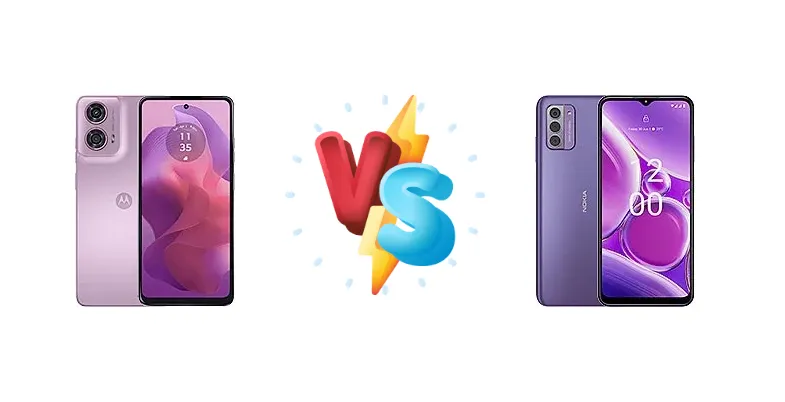
The Motorola Moto G24 and Nokia G42 represent compelling options in the increasingly competitive sub-$200 smartphone market. While both aim to deliver 5G connectivity at an accessible price, they take distinctly different approaches to achieving this, primarily through their chipset choices. This comparison dissects those differences, focusing on real-world performance implications for the average user.
🏆 Quick Verdict
For most users, the Nokia G42 emerges as the stronger choice. Its Snapdragon 480+ chipset, built on a more efficient 8nm process, provides a noticeable performance advantage over the Moto G24’s Helio G85, and the inclusion of 20W charging with Quick Charge 3.0 support offers faster top-ups.
| Network |
|---|
| 2G bands | GSM 850 / 900 / 1800 / 1900 | GSM 850 / 900 / 1800 / 1900 |
| 3G bands | HSDPA 850 / 900 / 1900 / 2100 | HSDPA 850 / 900 / 1700(AWS) / 1900 / 2100 |
| 4G bands | 1, 2, 3, 5, 7, 8, 20, 28, 38, 40, 41 | 1, 2, 3, 4, 5, 7, 8, 12, 17, 13, 20, 28, 38, 39, 40, 41, 66 |
| 5G bands | - | 1, 2, 3, 5, 7, 8, 28, 40, 41, 66, 77, 78 SA/NSA |
| Speed | HSPA, LTE | HSPA, LTE, 5G |
| Technology | GSM / HSPA / LTE | GSM / HSPA / LTE / 5G |
| Launch |
|---|
| Announced | 2024, January 18 | 2023, June 28 |
| Status | Available. Released 2024, February 06 | Available. Released 2023, June 28 |
| Body |
|---|
| Build | Glass front, plastic back, plastic frame | Glass front, plastic back, plastic frame |
| Dimensions | 163.5 x 74.5 x 8 mm (6.44 x 2.93 x 0.31 in) | 165 x 75.8 x 8.6 mm (6.50 x 2.98 x 0.34 in) |
| SIM | · Nano-SIM· Nano-SIM + Nano-SIM | · Nano-SIM· Nano-SIM + Nano-SIM |
| Weight | 181 g (6.38 oz) | 193.8 g (6.84 oz) |
| Display |
|---|
| Protection | - | Corning Gorilla Glass 3 |
| Resolution | 720 x 1612 pixels, 20:9 ratio (~269 ppi density) | 720 x 1612 pixels, 20:9 ratio (~269 ppi density) |
| Size | 6.56 inches, 103.4 cm2 (~84.9% screen-to-body ratio) | 6.56 inches, 103.4 cm2 (~82.7% screen-to-body ratio) |
| Type | IPS LCD, 90Hz, 537 nits (peak) | IPS LCD, 90Hz, 450 nits (typ), 560 nits (peak) |
| Platform |
|---|
| CPU | Octa-core (2x2.0 GHz Cortex-A75 & 6x1.7 GHz Cortex-A55) | Octa-core (2x2.2 GHz Kryo 460 & 6x1.8 GHz Kryo 460) |
| Chipset | Mediatek MT6769Z Helio G85 (12 nm) | Qualcomm SM4350-AC Snapdragon 480+ 5G (8 nm) |
| GPU | Mali-G52 MC2 | Adreno 619 |
| OS | Android 14 | Android 13, upgradable to Android 14 |
| Memory |
|---|
| Card slot | microSDXC | microSDXC |
| Internal | 128GB 4GB RAM, 128GB 8GB RAM, 256GB 4GB RAM, 256GB 8GB RAM | 128GB 4GB RAM, 128GB 6GB RAM, 256GB 8GB RAM |
| Main Camera |
|---|
| Dual | 50 MP, f/1.8 (wide), 0.64µm, PDAF
2 MP (macro) | - |
| Features | LED flash, HDR, panorama | LED flash, HDR, panorama |
| Triple | - | 50 MP, f/1.8, (wide), AF
2 MP (macro)
Auxiliary lens |
| Video | 1080p@30fps | 1080p@30fps |
| Selfie camera |
|---|
| Features | HDR | - |
| Single | 8 MP, f/2.0, (wide), 1.12µm | 8 MP |
| Video | 1080p@30fps | Yes |
| Sound |
|---|
| 35mm jack | Yes | Yes |
| Loudspeaker | Yes, with stereo speakers | Yes |
| Comms |
|---|
| Bluetooth | 5.0, A2DP, LE | 5.1, A2DP, LE |
| NFC | Yes (market/region dependent) | Yes (market/region dependent) |
| Positioning | GPS, GALILEO, GLONASS | GPS, GLONASS, GALILEO, BDS |
| Radio | FM radio | FM radio |
| USB | USB Type-C 2.0 | USB Type-C 2.0, OTG |
| WLAN | Wi-Fi 802.11 a/b/g/n/ac, dual-band | Wi-Fi 802.11 a/b/g/n/ac/6, dual-band |
| Features |
|---|
| Sensors | Fingerprint (side-mounted), accelerometer, gyro, proximity, compass | Fingerprint (side-mounted), accelerometer, proximity, compass |
| Battery |
|---|
| Charging | 15W wired | 20W wired, PD3.0, QC3 |
| Type | 5000 mAh | Li-Po 5000 mAh |
| Misc |
|---|
| Colors | Matte Charcoal, Ice Green, Blueberry, Pink Lavender | Gray, Purple, Red |
| Models | XT2423-1 | - |
| Price | £ 74.99 / € 101.62 | $ 545.00 / £ 124.99 |
Motorola Moto G24
- Potentially longer software support from Motorola.
- May be slightly more affordable.
- Simple and clean Android experience.
- Less powerful Helio G85 chipset.
- Slower 15W charging.
- Likely to exhibit more thermal throttling.
Nokia G42
- More powerful Snapdragon 480+ chipset.
- Faster 20W charging with Quick Charge 3.0.
- Better power efficiency and thermal management.
- Nokia's software update track record can be inconsistent.
- May be slightly more expensive.
Display Comparison
Neither device boasts a standout display. Both are likely to feature LCD panels, common in this price bracket. However, the lack of detailed display specs necessitates a focus on the chipset's impact on UI smoothness. The Nokia G42’s Snapdragon 480+ should provide a more fluid experience when scrolling and navigating the interface, even if the panel itself is similar in resolution and brightness to the Moto G24.
Camera Comparison
Without detailed camera specs beyond the chipsets, it’s difficult to make definitive claims. However, the Snapdragon 480+ typically includes a more capable ISP (Image Signal Processor) than the Helio G85. This suggests the Nokia G42 will likely produce images with better dynamic range and noise reduction, particularly in challenging lighting conditions. The absence of OIS on either device means image stabilization will rely heavily on software processing, where the Snapdragon’s ISP could again provide an advantage.
Performance
The core difference lies in the chipsets. The Nokia G42’s Qualcomm Snapdragon 480+ (8nm) is a clear step up from the Motorola Moto G24’s MediaTek Helio G85 (12nm). The 8nm process node translates to better power efficiency and thermal management, meaning the G42 is less likely to throttle under sustained load. While both utilize an octa-core configuration, the Snapdragon’s Kryo 460 cores, clocked at 2.2 GHz, offer a performance edge over the Helio G85’s 2.0 GHz Cortex-A75 cores. This difference will be most noticeable in app launch times and multitasking.
Battery Life
While battery capacity isn't specified, the Nokia G42’s 20W charging with PD3.0 and QC3 support is a significant advantage. The Moto G24 is limited to 15W charging, meaning considerably longer times to reach a full charge. The Snapdragon 480+’s improved power efficiency also contributes to potentially longer battery life, offsetting any potential capacity difference between the two devices. A full charge on the G42 could be achieved in approximately 90-120 minutes, while the G24 will likely take over two hours.
Buying Guide
Buy the Motorola Moto G24 if you prioritize a potentially longer software support lifecycle from Motorola and are primarily focused on basic smartphone tasks like calling, texting, and light social media use. Buy the Nokia G42 if you value smoother multitasking, a more responsive user experience, and faster charging speeds, making it better suited for users who consume more media or play mobile games occasionally.
Frequently Asked Questions
❓ Will the Snapdragon 480+ in the Nokia G42 handle demanding games like PUBG Mobile?
While the Snapdragon 480+ isn't a gaming powerhouse, it's capable of running PUBG Mobile at medium settings with reasonable frame rates. Expect some occasional stuttering during intense firefights. The Helio G85 in the Moto G24 will struggle more with consistent performance in demanding titles.
❓ How does Nokia's software update policy compare to Motorola's for these devices?
Motorola generally offers a more predictable software update schedule, typically guaranteeing at least one major Android update and several security patches. Nokia's update track record has been less consistent, with delays and inconsistencies reported in the past. However, both brands are improving in this area.
❓ Is the difference in charging speed between 15W and 20W really noticeable in everyday use?
Yes, the difference is significant. 20W charging with Quick Charge 3.0 on the Nokia G42 will add a substantial amount of battery life in a short period, making it much more convenient for users who need to quickly top up their phone. The Moto G24’s 15W charging will feel noticeably slower.