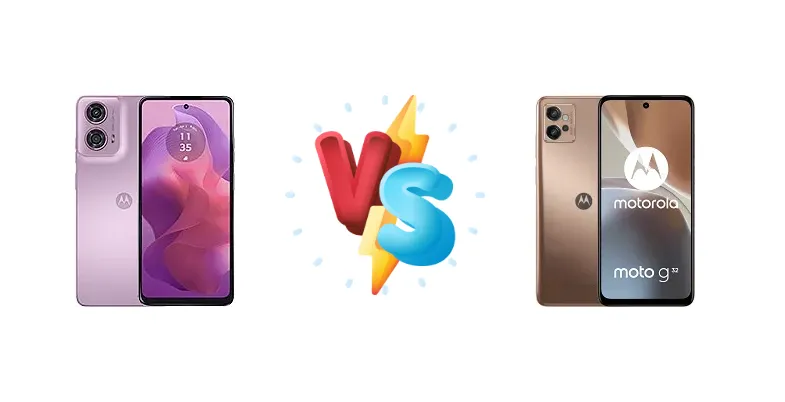
Motorola's G-series consistently delivers compelling value in the budget smartphone space. The Moto G32 and G24 represent two distinct approaches: the G32, released earlier, leverages Qualcomm's efficiency, while the newer G24 opts for MediaTek's Helio G85. This comparison dissects their key differences to determine which phone best suits your needs.
🏆 Quick Verdict
For most users, the Motorola Moto G32 emerges as the better choice. Its Snapdragon 680, built on a 6nm process, provides a more efficient and generally smoother experience than the Moto G24’s Helio G85, despite the G24’s slightly higher CPU clock speeds. The G32’s 30W charging is a significant advantage over the G24’s 15W.
| Network |
|---|
| 2G bands | GSM 850 / 900 / 1800 / 1900 | GSM 850 / 900 / 1800 / 1900 |
| 3G bands | HSDPA 850 / 900 / 1900 / 2100 | HSDPA 850 / 900 / 1900 / 2100 |
| 4G bands | 1, 2, 3, 5, 7, 8, 20, 28, 38, 40, 41 | 1, 3, 5, 7, 8, 20, 28, 38, 40, 41 |
| Speed | HSPA, LTE | HSPA, LTE |
| Technology | GSM / HSPA / LTE | GSM / HSPA / LTE |
| Launch |
|---|
| Announced | 2024, January 18 | 2022, July 28 |
| Status | Available. Released 2024, February 06 | Available. Released 2022, August 16 |
| Body |
|---|
| Build | Glass front, plastic back, plastic frame | Glass front, plastic frame, plastic back |
| Dimensions | 163.5 x 74.5 x 8 mm (6.44 x 2.93 x 0.31 in) | 161.8 x 73.8 x 8.5 mm (6.37 x 2.91 x 0.33 in) |
| SIM | · Nano-SIM· Nano-SIM + Nano-SIM | · Nano-SIM· Nano-SIM + Nano-SIM |
| Weight | 181 g (6.38 oz) | 184 g (6.49 oz) |
| | - | Water-repellent design |
| Display |
|---|
| Resolution | 720 x 1612 pixels, 20:9 ratio (~269 ppi density) | 1080 x 2400 pixels, 20:9 ratio (~405 ppi density) |
| Size | 6.56 inches, 103.4 cm2 (~84.9% screen-to-body ratio) | 6.5 inches, 102.0 cm2 (~85.4% screen-to-body ratio) |
| Type | IPS LCD, 90Hz, 537 nits (peak) | IPS LCD, 90Hz |
| Platform |
|---|
| CPU | Octa-core (2x2.0 GHz Cortex-A75 & 6x1.7 GHz Cortex-A55) | Octa-core (4x2.4 GHz Kryo 265 Gold & 4x1.9 GHz Kryo 265 Silver) |
| Chipset | Mediatek MT6769Z Helio G85 (12 nm) | Qualcomm SM6225 Snapdragon 680 4G (6 nm) |
| GPU | Mali-G52 MC2 | Adreno 610 |
| OS | Android 14 | Android 12, upgradable to Android 13 |
| Memory |
|---|
| Card slot | microSDXC | microSDXC (dedicated slot) |
| Internal | 128GB 4GB RAM, 128GB 8GB RAM, 256GB 4GB RAM, 256GB 8GB RAM | 64GB 4GB RAM, 128GB 4GB RAM, 128GB 6GB RAM, 128GB 8GB RAM, 256GB 8GB RAM |
| Main Camera |
|---|
| Dual | 50 MP, f/1.8 (wide), 0.64µm, PDAF
2 MP (macro) | - |
| Features | LED flash, HDR, panorama | LED flash, HDR, panorama |
| Triple | - | 50 MP, f/1.8 (wide), 1/2.76", 0.64µm, PDAF
8 MP, f/2.2, 118˚ (ultrawide), 1/4.0", 1.12µm
2 MP, f/2.4, (macro/depth) |
| Video | 1080p@30fps | 1080p@30fps |
| Selfie camera |
|---|
| Features | HDR | - |
| Single | 8 MP, f/2.0, (wide), 1.12µm | 16 MP, f/2.4, (wide), 1.0µm |
| Video | 1080p@30fps | 1080p@30fps |
| Sound |
|---|
| 3.5mm jack | - | Yes |
| 35mm jack | Yes | Yes |
| Loudspeaker | Yes, with stereo speakers | Yes, with stereo speakers |
| Comms |
|---|
| Bluetooth | 5.0, A2DP, LE | 5.2, A2DP, LE |
| NFC | Yes (market/region dependent) | Yes (market/region dependent) |
| Positioning | GPS, GALILEO, GLONASS | GPS, GLONASS, GALILEO |
| Radio | FM radio | FM radio |
| USB | USB Type-C 2.0 | USB Type-C 2.0 |
| WLAN | Wi-Fi 802.11 a/b/g/n/ac, dual-band | Wi-Fi 802.11 a/b/g/n/ac, dual-band, Wi-Fi Direct |
| Features |
|---|
| Sensors | Fingerprint (side-mounted), accelerometer, gyro, proximity, compass | Fingerprint (side-mounted), accelerometer, gyro, proximity, compass |
| Battery |
|---|
| Charging | 15W wired | 30W wired |
| Type | 5000 mAh | Li-Po 5000 mAh |
| Misc |
|---|
| Colors | Matte Charcoal, Ice Green, Blueberry, Pink Lavender | Mineral Grey, Satin Silver, Rose Gold |
| Models | XT2423-1 | XT2235-2, XT2235-3 |
| Price | £ 74.99 / € 101.62 | ₹ 8,990 |
Motorola Moto G24
- More efficient Snapdragon 680 chipset
- Faster 30W wired charging
- Potentially better image processing
- May be slightly more expensive than the G24
- Likely similar display quality to the G24
Motorola Moto G32
- Lower upfront cost
- Decent performance for basic tasks
- Likely similar battery capacity to the G32
- Less efficient Helio G85 chipset
- Slower 15W wired charging
- Potential for more thermal throttling
Display Comparison
Neither Motorola provides detailed display specs beyond resolution. However, the display is likely a key area where cost-cutting occurred. We can infer that both utilize LCD panels, common in this price bracket. The lack of high refresh rates is expected. The real difference lies in the underlying efficiency of the chipsets powering them, which impacts how efficiently the display is driven.
Camera Comparison
Without detailed camera specs, a direct comparison is difficult. Both phones likely feature a primary camera and multiple secondary sensors (depth, macro). The image signal processor (ISP) within the Snapdragon 680 is generally more advanced, potentially leading to better image processing, especially in low-light conditions. The 6nm process also allows for more efficient image processing, reducing noise and improving dynamic range. The G24’s ISP will likely be adequate for basic photography, but won’t match the G32’s capabilities.
Performance
The core difference here is the chipset architecture. The Moto G32’s Qualcomm Snapdragon 680 (6nm) utilizes a Kryo CPU with a split core design – 4x2.4 GHz performance cores (Kryo 265 Gold) and 4x1.9 GHz efficiency cores (Kryo 265 Silver). This contrasts with the Moto G24’s MediaTek Helio G85 (12nm), featuring 2x2.0 GHz Cortex-A75 cores and 6x1.7 GHz Cortex-A55 cores. The 6nm process of the Snapdragon 680 is a significant advantage, offering superior power efficiency and thermal performance. While the G24’s Cortex-A75 cores have a higher peak clock speed, the Snapdragon 680’s architecture and process node will likely translate to smoother multitasking and sustained performance under load. The G85 is known to throttle more aggressively.
Battery Life
The battery capacity is not specified, but both phones likely fall in the 5000mAh range, typical for this segment. However, the charging speeds are drastically different. The Moto G32 supports 30W wired charging, allowing for a significantly faster 0-100% charge time compared to the Moto G24’s 15W charging. The Snapdragon 680’s superior power efficiency also contributes to longer battery life on the G32, even with similar battery capacities. Users who frequently top up their phones will greatly benefit from the G32’s faster charging.
Buying Guide
Buy the Motorola Moto G24 if you prioritize a lower upfront cost and are primarily focused on basic smartphone tasks like calling, texting, and light social media use. Buy the Motorola Moto G32 if you value a more responsive user experience, better battery efficiency, and significantly faster charging speeds, even if it means a slightly higher initial investment.
Frequently Asked Questions
❓ Will the Helio G85 in the Moto G24 struggle with demanding games like PUBG Mobile?
The Helio G85 can run PUBG Mobile, but you’ll likely need to lower graphics settings to maintain a stable frame rate. The chip is prone to thermal throttling, meaning performance will decrease during extended gaming sessions. The Snapdragon 680 in the G32 offers a more consistent gaming experience, even at similar settings.
❓ How long does it realistically take to fully charge the Moto G32 with the 30W charger?
While Motorola doesn't provide exact figures, a 30W charger should fully charge the Moto G32 from 0% to 100% in approximately 60-75 minutes, depending on usage during charging. This is a substantial improvement over the Moto G24’s 15W charging, which could take over two hours.
❓ Is the difference in chipset performance noticeable for everyday tasks like browsing and social media?
Yes, the Snapdragon 680’s efficiency translates to a smoother and more responsive experience even during everyday tasks. App loading times will be quicker, and multitasking will feel less sluggish compared to the Moto G24’s Helio G85.