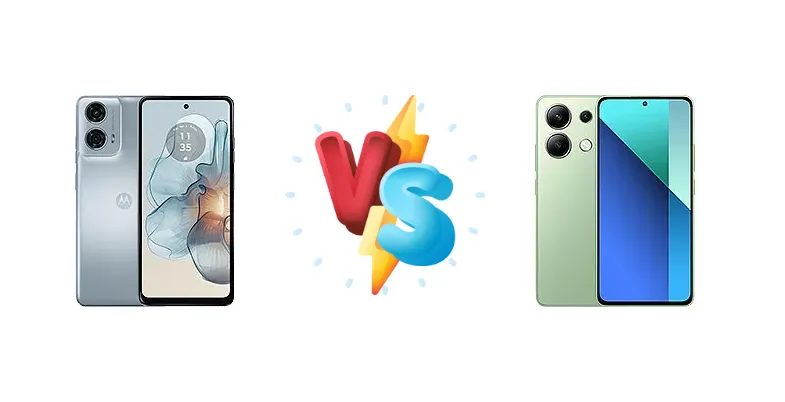
The sub-$200 smartphone market is fiercely competitive. The Motorola Moto G24 Power and Xiaomi Redmi Note 13 4G both aim to deliver a compelling experience without breaking the bank. However, they take different approaches: Motorola prioritizes power efficiency and potentially longer software support, while Xiaomi focuses on a brighter display and a more modern chipset architecture. This comparison dissects their strengths and weaknesses to help you choose.
🏆 Quick Verdict
For the average user prioritizing a vibrant display and slightly faster performance, the Xiaomi Redmi Note 13 4G is the better choice. Its Snapdragon 685, built on a 6nm process, offers a performance edge and superior efficiency. However, the Moto G24 Power remains a strong contender for those who value potentially longer battery life and Motorola’s clean software experience.
| Network |
|---|
| 2G bands | GSM 850 / 900 / 1800 / 1900 | GSM 850 / 900 / 1800 / 1900 |
| 3G bands | HSDPA 850 / 900 / 1900 / 2100 | HSDPA 850 / 900 / 2100 |
| 4G bands | 1, 2, 3, 5, 7, 8, 20, 28, 38, 40, 41 | 1, 3, 5, 7, 8, 20, 28, 38, 40, 41 |
| Speed | HSPA, LTE | HSPA, LTE |
| Technology | GSM / HSPA / LTE | GSM / HSPA / LTE |
| Launch |
|---|
| Announced | 2024, January 30 | 2024, January 15 |
| Status | Available. Released 2024, February 07 | Available. Released 2024, January 15 |
| Body |
|---|
| Build | Glass front, plastic back, plastic frame | Glass front (Gorilla Glass 3), plastic frame, plastic back |
| Dimensions | 163.5 x 74.5 x 9 mm (6.44 x 2.93 x 0.35 in) | 162.3 x 75.6 x 8 mm (6.39 x 2.98 x 0.31 in) |
| SIM | Nano-SIM + Nano-SIM | Nano-SIM + Nano-SIM |
| Weight | 197 g (6.95 oz) | 188.5 g (6.67 oz) |
| Display |
|---|
| Protection | - | Corning Gorilla Glass 3 |
| Resolution | 720 x 1612 pixels, 20:9 ratio (~269 ppi density) | 1080 x 2400 pixels, 20:9 ratio (~395 ppi density) |
| Size | 6.56 inches, 103.4 cm2 (~84.9% screen-to-body ratio) | 6.67 inches, 107.4 cm2 (~87.5% screen-to-body ratio) |
| Type | IPS LCD, 90Hz, 537 nits (peak) | AMOLED, 120Hz, 960Hz PWM, 1800 nits (peak) |
| Platform |
|---|
| CPU | Octa-core (2x2.0 GHz Cortex-A75 & 6x1.7 GHz Cortex-A55) | Octa-core (4x2.8 GHz Cortex-A73 & 4x1.9 GHz Cortex-A53) |
| Chipset | Mediatek MT6769Z Helio G85 (12 nm) | Qualcomm SM6225 Snapdragon 685 (6 nm) |
| GPU | Mali-G52 MC2 | Adreno 610 |
| OS | Android 14 | Android 13, upgradable to Android 15, up to 3 major Android upgrades, HyperOS 2 |
| Memory |
|---|
| Card slot | microSDXC (dedicated slot) | microSDXC (uses shared SIM slot) |
| Internal | 128GB 4GB RAM, 128GB 8GB RAM, 256GB 4GB RAM, 256GB 8GB RAM | 128GB 6GB RAM, 128GB 8GB RAM, 256GB 6GB RAM, 256GB 8GB RAM, 512GB 8GB RAM |
| Main Camera |
|---|
| Dual | 50 MP, f/1.8 (wide), 0.64µm, PDAF
2 MP (macro) | - |
| Features | LED flash, HDR, panorama | LED flash, HDR, panorama |
| Triple | - | 108 MP, f/1.8, 24mm (wide), 1/1.67", 0.64µm, PDAF
8 MP, f/2.2, 120˚, (ultrawide)
2 MP (macro) |
| Video | 1080p@30fps | 1080p@30fps |
| Selfie camera |
|---|
| Single | 8 MP, f/2.0, (wide), 1.12µm - International version
16 MP, f/2.5, (wide), 1.0µm - India version | 16 MP, f/2.4, (wide) |
| Video | 1080p@30fps | 1080p@30fps |
| Sound |
|---|
| 35mm jack | Yes | Yes |
| Loudspeaker | Yes, with stereo speakers | Yes, with stereo speakers |
| Comms |
|---|
| Bluetooth | 5.0, A2DP, LE | 5.1, A2DP, LE |
| Infrared port | - | Yes |
| NFC | Yes (market/region dependent) | Yes (market/region dependent) |
| Positioning | GPS, GALILEO, GLONASS | GPS, GLONASS, GALILEO, BDS |
| Radio | FM radio (market/region dependent) | Unspecified |
| USB | USB Type-C 2.0 | USB Type-C 2.0, OTG |
| WLAN | Wi-Fi 802.11 a/b/g/n/ac, dual-band | Wi-Fi 802.11 a/b/g/n/ac, dual-band |
| Features |
|---|
| Sensors | Fingerprint (side-mounted), accelerometer, gyro, proximity, compass | Fingerprint (under display, optical), accelerometer, gyro, proximity, compass |
| Battery |
|---|
| Charging | 30W wired | 33W wired, 50% in 29 min, 100% in 70 min |
| Type | 6000 mAh | 5000 mAh |
| Misc |
|---|
| Colors | Glacier Blue, Ink Blue | Midnight Black, Mint Green, Ice Blue, Ocean Sunset |
| Models | - | 23129RAA4G, 23124RA7EO, 23129RA5FL |
| Price | € 132.29 | $ 199.99 / £ 119.99 / € 135.52 |
| SAR | - | 0.98 W/kg (head) 0.49 W/kg (body) |
| SAR EU | - | 0.77 W/kg (head) 0.98 W/kg (body) |
Motorola Moto G24 Power
- Potentially longer battery life due to efficient chipset.
- Clean and bloatware-free Motorola software experience.
- Competitive price point.
- Older chipset architecture (Helio G85).
- Likely less vibrant display compared to the Redmi Note 13 4G.
- Slower charging speed.
Xiaomi Redmi Note 13 4G
- Brighter and more vibrant display (1313 nits).
- More powerful and efficient Snapdragon 685 chipset.
- Faster charging (33W).
- Xiaomi’s MIUI software can be cluttered with bloatware.
- Battery life, while good, may not match the Moto G24 Power’s potential.
- Potential for more aggressive background app management.
Display Comparison
The Xiaomi Redmi Note 13 4G boasts a significantly brighter display, reaching a measured 1313 nits. This is a substantial advantage over what we’d expect from the Moto G24 Power, making it far more usable outdoors under direct sunlight. While the Moto G24 Power’s panel specifics are unknown, the Redmi Note 13 4G’s brightness translates to a more vivid and engaging viewing experience. The Redmi Note 13 4G’s brightness also suggests a more modern panel technology, potentially with better color accuracy and viewing angles.
Camera Comparison
Without detailed camera specs for the Moto G24 Power, a direct comparison is limited. However, the Redmi Note 13 4G likely benefits from Qualcomm’s image signal processor (ISP) within the Snapdragon 685, potentially offering better image processing and noise reduction. The Redmi Note 13 4G’s camera system is likely to deliver more consistent results in various lighting conditions. It's reasonable to assume the Redmi Note 13 4G will have a more refined camera experience, even if sensor sizes are similar.
Performance
The core difference lies in the chipsets. The Redmi Note 13 4G’s Qualcomm Snapdragon 685 (6nm) utilizes newer Cortex-A73 cores clocked at 2.8 GHz, offering a clear architectural advantage over the Moto G24 Power’s MediaTek Helio G85 (12nm) with its Cortex-A75 cores at 2.0 GHz. The 6nm process of the Snapdragon 685 also contributes to better thermal efficiency, reducing the likelihood of performance throttling during sustained tasks. While both are octa-core CPUs, the Snapdragon 685’s architecture and fabrication process provide a noticeable performance boost in real-world usage, particularly in app loading times and multitasking.
Battery Life
The Redmi Note 13 4G achieves an impressive 11:52h of active use, demonstrating excellent battery optimization despite its faster processor. The Moto G24 Power, while likely offering good battery life, hasn’t provided a comparable active use score. The Redmi Note 13 4G’s 33W charging is also faster, reaching 50% in 29 minutes and 100% in 70 minutes, compared to the Moto G24 Power’s 30W charging. This faster charging speed minimizes downtime and provides greater convenience.
Buying Guide
Buy the Motorola Moto G24 Power if you need maximum battery endurance and prefer a simpler, less cluttered Android experience. It’s ideal for users who primarily browse, message, and make calls. Buy the Xiaomi Redmi Note 13 4G if you prefer a brighter, more visually appealing display and demand slightly snappier performance for social media, light gaming, and multitasking. It’s a better fit for users who consume a lot of video content.
Frequently Asked Questions
❓ Does the Snapdragon 685 in the Redmi Note 13 4G struggle with demanding games like PUBG Mobile?
While the Snapdragon 685 isn't a gaming powerhouse, it can handle PUBG Mobile at medium settings with reasonable frame rates. Expect some occasional frame drops during intense firefights. The Helio G85 in the Moto G24 Power will likely offer similar performance, but the Snapdragon 685’s thermal efficiency may lead to more consistent frame rates over longer gaming sessions.
❓ How does Xiaomi’s MIUI software affect the user experience on the Redmi Note 13 4G?
MIUI is a heavily customized Android skin. It offers a wide range of features and customization options, but it also comes with pre-installed apps (bloatware) and can be more resource-intensive than stock Android. Motorola’s software is closer to stock Android, providing a cleaner and more streamlined experience.
❓ Is the 30W charging on the Moto G24 Power significantly slower than the 33W charging on the Redmi Note 13 4G?
Yes, the Redmi Note 13 4G’s 33W charging is noticeably faster, reaching 50% in 29 minutes and 100% in 70 minutes. While 30W is still respectable, it will take longer to fully charge the Moto G24 Power. This difference is particularly noticeable for users who frequently need to top up their battery quickly.