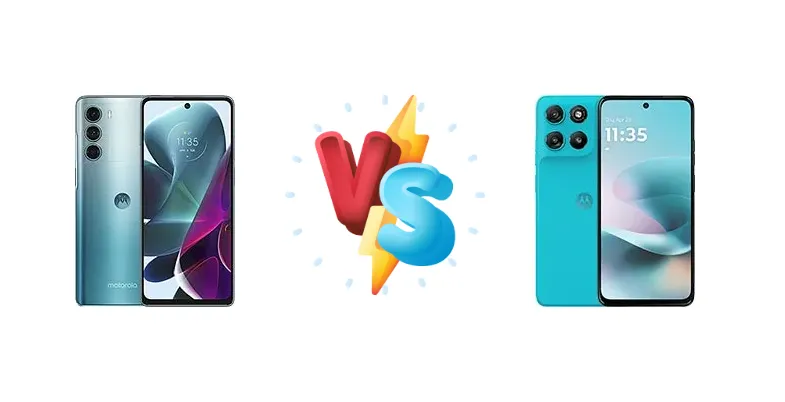
Motorola's G-series consistently delivers impressive value, but choosing between the G200 5G and G100 can be tricky. Both offer large displays and solid features, but significant differences exist under the hood. This comprehensive comparison will help you decide which phone best suits your needs.
🏆 Quick Verdict
The Moto G200 5G edges out the G100 thanks to its significantly more powerful Snapdragon 888+ chipset and brighter display. While the G100 remains a capable device, the G200 provides a noticeable performance boost, making it the better choice for demanding users.
| Network |
|---|
| 2G bands | GSM 850 / 900 / 1800 / 1900 | GSM 850 / 900 / 1800 / 1900 |
| 3G bands | HSDPA 850 / 900 / 1700(AWS) / 1900 / 2100 | HSDPA 850 / 900 / 1900 / 2100 |
| 4G bands | 1, 2, 3, 4, 5, 7, 8, 12, 13, 17, 18, 19, 20, 26, 28, 32, 38, 39, 40, 41, 42, 43, 66 | LTE |
| 5G bands | 1, 3, 5, 7, 8, 20, 28, 38, 40, 41, 66, 77, 78 SA/NSA/Sub6 | SA/NSA |
| Speed | HSPA 42.2/5.76 Mbps, LTE Cat20 2000/150 Mbps, 5G | HSPA, LTE, 5G |
| Technology | GSM / HSPA / LTE / 5G | GSM / HSPA / LTE / 5G |
| Launch |
|---|
| Announced | 2021, November 18 | 2025, October 14 |
| Status | Available. Released 2022, February 10 | Available. Released 2025, October 20 |
| Body |
|---|
| Build | Glass front, plastic frame, plastic back | Glass front, plastic frame, silicone polymer (eco leather) back |
| Dimensions | 168.1 x 75.5 x 8.9 mm (6.62 x 2.97 x 0.35 in) | 166.2 x 76.5 x 8.6 mm (6.54 x 3.01 x 0.34 in) |
| SIM | · Nano-SIM· Nano-SIM + Nano-SIM | Nano-SIM + Nano-SIM |
| Weight | 202 g (7.13 oz) | 210 g (7.41 oz) |
| | Water-repellent design | Water repellent design |
| Display |
|---|
| Resolution | 1080 x 2460 pixels (~395 ppi density) | 1080 x 2400 pixels, 20:9 ratio (~392 ppi density) |
| Size | 6.8 inches, 109.8 cm2 (~86.5% screen-to-body ratio) | 6.72 inches, 109.0 cm2 (~85.8% screen-to-body ratio) |
| Type | LCD, 144Hz, HDR10 | IPS LCD, 120Hz, 1050 nits (peak) |
| Platform |
|---|
| CPU | Octa-core (1x2.99 GHz Cortex-X1 & 3x2.42 GHz Cortex-A78 & 4x1.80 GHz Cortex-A55) | Octa-core (4x2.40 GHz Cortex-A78 & 4x1.95 GHz Cortex-A55) |
| Chipset | Qualcomm SM8350 Snapdragon 888+ 5G (5 nm) | Qualcomm SM7435-AB Snapdragon 7s Gen 2 (4 nm) |
| GPU | Adreno 660 | Adreno 710 |
| OS | Android 11, upgradable to Android 12 | Android 15 |
| Memory |
|---|
| Card slot | No | No |
| Internal | 128GB 8GB RAM, 256GB 8GB RAM | 256GB 8GB RAM, 256GB 12GB RAM, 512GB 12GB RAM |
| | UFS 3.1 | UFS 3.1 |
| Main Camera |
|---|
| Dual | - | 50 MP, f/1.9 (wide), 1/1.95", 0.8µm, PDAF
8 MP, f/2.2, 118˚ (ultrawide), 1/4.0", 1.12µm |
| Features | Dual-LED dual-tone flash, HDR, panorama | Dual-LED flash, HDR, panorama |
| Triple | 108 MP, f/1.9, (wide), 1/1.52", 0.7µm, PDAF
13 MP, f/2.2, 119˚ (ultrawide), 1.12µm, AF
Auxiliary lens | 64 MP, f/1.7, (wide), 1/2.0", 0.7µm, PDAF, Laser AF
16 MP, f/2.2, 117˚ (ultrawide), 1.0µm, PDAF
2 MP, f/2.4, (depth)
TOF 3D |
| Video | 8K@24fps, 4K@30fps, 1080p@30/60/120/240fps, 1080p@960fps, gyro-EIS | 4K@30fps, 1080p@30fps |
| Selfie camera |
|---|
| Dual | - | 16 MP, f/2.2, (wide), 1.0µm
8 MP, f/2.4, 118˚ (ultrawide), 1.12µm |
| Features | - | HDR |
| Single | 16 MP, f/2.2, (wide), 1.0µm | 32 MP, f/2.2, (wide), 0.7µm |
| Video | 1080p@30fps | 4K@30fps, 1080p@30/60fps |
| Sound |
|---|
| 3.5mm jack | No | Yes |
| 35mm jack | No | Yes |
| Loudspeaker | Yes | Yes, with stereo speakers |
| Comms |
|---|
| Bluetooth | 5.2, A2DP, LE, aptX HD, aptX Adaptive | 5.1, A2DP, LE |
| NFC | Yes | Yes |
| Positioning | GPS, GLONASS, GALILEO | GPS, GALILEO, GLONASS, BDS, QZSS |
| Radio | No | No |
| USB | USB Type-C 3.1 | USB Type-C 2.0, OTG |
| WLAN | Wi-Fi 802.11 a/b/g/n/ac/6e, dual-band, Wi-Fi Direct | Wi-Fi 802.11 a/b/g/n/ac, dual-band |
| Features |
|---|
| Sensors | Fingerprint (side-mounted), accelerometer, gyro, proximity, compass | Fingerprint (side-mounted), accelerometer, gyro, proximity, compass |
| | Ready For support | Ready For support |
| Battery |
|---|
| Charging | 33W wired | 30W wired |
| Type | Li-Po 5000 mAh | Si/C Li-Ion 7000 mAh |
| Misc |
|---|
| Colors | Stellar Blue, Glacier Green | Black, Blue, Green |
| Models | - | XT2533-4 |
| Price | About 290 EUR | About 170 EUR |
| Tests |
|---|
| Battery life |
Endurance rating 102h
|
Endurance rating 100h
|
| Camera |
Photo / Video |
Photo / Video |
| Display |
Contrast ratio: 1633:1 (nominal) |
Contrast ratio: 1427:1 (nominal) |
| Loudspeaker |
-26.7 LUFS (Good)
|
-29.4 LUFS (Average)
|
| Performance |
AnTuTu: 682346 (v8), 811124 (v9)
GeekBench: 3319 (v5.1)
GFXBench: 60fps (ES 3.1 onscreen) |
AnTuTu: 556137 (v8)
GeekBench: 2860 (v5.1)
GFXBench: 47fps (ES 3.1 onscreen) |
Motorola Moto G200 5G
- Significantly faster processor
- Brighter and better display
- Slightly faster charging
- 5G Connectivity
- Potentially higher price
- Design may not appeal to everyone
Motorola Moto G100
- More affordable
- Large display
- Reliable performance for everyday tasks
- Good battery life
- Slower processor
- Less bright display
- Slightly slower charging
Display Comparison
Both phones feature large 6.8-inch displays, but the G200 5G boasts a measured peak brightness of 558 nits, significantly brighter than the G100. The G200 also has a slightly better contrast ratio (1633:1 vs 1427:1), resulting in more vibrant colors and deeper blacks. Both use an IPS LCD panel.
Camera Comparison
Both phones offer versatile camera setups, typically including a main sensor, ultrawide, and macro lens. While specific megapixel counts may vary, the G200 5G's more powerful processor generally allows for better image processing and video stabilization. Both phones likely offer decent image quality in good lighting conditions, but low-light performance may be a weakness.
Performance
This is where the G200 5G truly shines. Its Snapdragon 888+ chipset is a substantial upgrade over the G100's Snapdragon 7s Gen 2. Expect smoother multitasking, faster app loading times, and significantly better gaming performance on the G200. The G100 is still capable, but it won't handle demanding tasks as effortlessly.
Battery Life
Battery life is remarkably similar, with both phones achieving an endurance rating of around 100-102 hours. Both devices should easily last a full day of moderate use. The G200 5G has 33W wired charging, slightly faster than the G100's 30W.
Buying Guide
The Motorola Moto G200 5G is ideal for gamers, power users, and anyone who prioritizes performance and a vibrant display. The Motorola Moto G100 is a great option for those seeking a large screen, reliable performance for everyday tasks, and a slightly more budget-friendly price point.
Frequently Asked Questions
❓ Is the Moto G200 5G worth the extra money?
If you prioritize performance and a better display, the G200 5G is worth the investment. However, if you're on a tighter budget and primarily use your phone for basic tasks, the G100 remains a solid choice.
❓ Which phone has better 5G connectivity?
The Moto G200 5G is designed with a more advanced 5G modem and chipset, potentially offering faster and more reliable 5G speeds depending on your carrier and location.