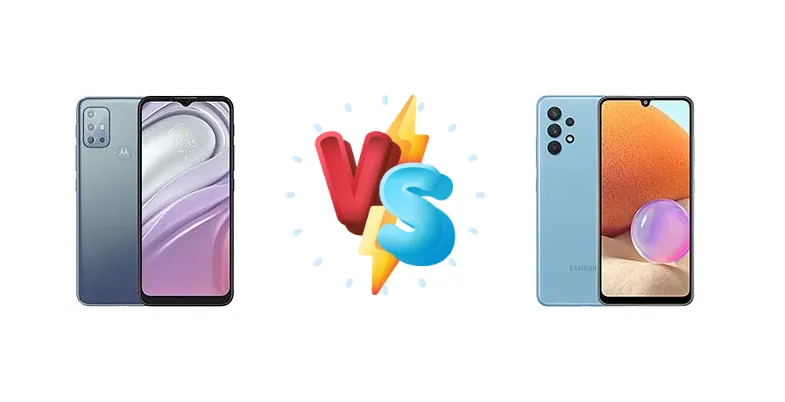
The Motorola Moto G20 and Samsung Galaxy A32 represent compelling options in the ultra-budget smartphone segment. Both aim to deliver essential features at a low price point, but they take different approaches to achieving this. The G20 prioritizes a lower entry cost, while the A32 attempts to offer a more refined experience with a superior display and faster charging.
🏆 Quick Verdict
For most users, the Samsung Galaxy A32 is the better choice. Its significantly brighter 814 nit display and 15W charging offer a more enjoyable and practical experience, outweighing the Moto G20’s lower price. The Helio G80 chipset also provides a noticeable performance edge.
| Network |
|---|
| 2G bands | GSM 850 / 900 / 1800 / 1900 | GSM 850 / 900 / 1800 / 1900 |
| 3G bands | HSDPA 850 / 900 / 1900 / 2100 | HSDPA 850 / 900 / 1900 / 2100 |
| 4G bands | 1, 2, 3, 5, 7, 8, 18, 19, 20, 26, 28, 38, 40, 41 | 1, 2, 3, 5, 7, 8, 20, 28, 38, 40, 41 |
| Speed | HSPA 42.2/5.76 Mbps, LTE Cat4 150/50 Mbps | HSPA, LTE |
| Technology | GSM / HSPA / LTE | GSM / HSPA / LTE |
| Launch |
|---|
| Announced | 2021, April 26 | 2021, February 25 |
| Status | Available. Released 2021, June 09 | Available. Released 2021, February 25 |
| Body |
|---|
| Build | Glass front, plastic frame, plastic back | Glass front (Gorilla Glass 5), plastic frame, plastic back |
| Dimensions | 165.2 x 75.7 x 9.1 mm (6.50 x 2.98 x 0.36 in) | 158.9 x 73.6 x 8.4 mm (6.26 x 2.90 x 0.33 in) |
| SIM | · Nano-SIM· Nano-SIM + Nano-SIM | · Nano-SIM· Nano-SIM + Nano-SIM |
| Weight | 200 g (7.05 oz) | 184 g (6.49 oz) |
| | Water-repellent design | - |
| Display |
|---|
| Protection | - | Corning Gorilla Glass 5 |
| Resolution | 720 x 1600 pixels, 20:9 ratio (~270 ppi density) | 1080 x 2400 pixels, 20:9 ratio (~411 ppi density) |
| Size | 6.5 inches, 102.0 cm2 (~81.6% screen-to-body ratio) | 6.4 inches, 98.9 cm2 (~84.6% screen-to-body ratio) |
| Type | IPS LCD, 90Hz | Super AMOLED, 90Hz, 800 nits (HBM) |
| Platform |
|---|
| CPU | Octa-core 1.8 GHz | Octa-core (2x2.0 GHz Cortex-A75 & 6x1.8 GHz Cortex-A55) |
| Chipset | Unisoc T700 | Mediatek MT6769V/CU Helio G80 (12 nm) |
| GPU | Mali G52 | Mali-G52 MC2 |
| OS | Android 11 | Android 11, upgradable to Android 13, One UI 5 |
| Memory |
|---|
| Card slot | microSDXC (uses shared SIM slot) | microSDXC (dedicated slot) |
| Internal | 64GB 4GB RAM, 128GB 4GB RAM | 64GB 4GB RAM, 64GB 6GB RAM, 128GB 4GB RAM, 128GB 6GB RAM, 128GB 8GB RAM |
| Main Camera |
|---|
| Features | LED flash, HDR, panorama | LED flash, panorama, HDR |
| Quad | 48 MP, f/1.7, (wide), 1/2.0", 0.8µm, PDAF
8 MP, f/2.2, 118˚ (ultrawide), 1/4.0", 1.12µm
2 MP (macro)
Auxiliary lens | 64 MP, f/1.8, 26mm (wide), PDAF
8 MP, f/2.2, 123˚, (ultrawide), 1/4.0", 1.12µm
5 MP (macro)
Auxiliary lens |
| Single | - | 20 MP, f/2.2, (wide) |
| Video | 1080p@30fps | 1080p@30fps |
| Selfie camera |
|---|
| Features | HDR | - |
| Single | 13 MP, f/2.2, (wide), 1/3.1", 1.12µm | 20 MP, f/2.2, (wide) |
| Video | 1080p@30fps | 1080p@30fps |
| Sound |
|---|
| 3.5mm jack | Yes | Yes |
| 35mm jack | Yes | Yes |
| Loudspeaker | Yes | Yes |
| Comms |
|---|
| Bluetooth | 5.0, A2DP, LE | 5.0, A2DP, LE |
| NFC | Yes | Yes (market/region dependent) |
| Positioning | GPS, GLONASS, GALILEO | GPS, GLONASS, BDS, GALILEO |
| Radio | FM radio | FM radio, RDS, recording |
| USB | USB Type-C 2.0 | USB Type-C 2.0, OTG |
| WLAN | Wi-Fi 802.11 a/b/g/n/ac, dual-band, Wi-Fi Direct | Wi-Fi 802.11 a/b/g/n/ac, dual-band, Wi-Fi Direct |
| Features |
|---|
| Sensors | Fingerprint (rear-mounted), accelerometer, gyro, proximity | Fingerprint (under display, optical), accelerometer, gyro, compass |
| | - | Virtual proximity sensing |
| Battery |
|---|
| Charging | 10W wired | 15W wired |
| Type | Li-Po 5000 mAh | Li-Ion 5000 mAh |
| Misc |
|---|
| Colors | Breeze Blue, Flamingo Pink | Awesome Black, Awesome White, Awesome Blue, Awesome Violet |
| Models | XT2128-1, XT2128-2 | SM-A325F, SM-A325F/DS, SM-A325M, SM-A325N |
| Price | About 160 EUR | € 124.99 / £ 89.38 |
| SAR EU | - | 0.45 W/kg (head) 1.30 W/kg (body) |
| Tests |
|---|
| Battery life | - |
Endurance rating 119h
|
| Camera | - |
Photo / Video |
| Display | - |
Contrast ratio: Infinite (nominal) |
| Loudspeaker | - |
-30.3 LUFS (Below average)
|
| Performance | - |
AnTuTu: 286666 (v8)
GeekBench: 1277 (v5.1)
GFXBench: 8.1fps (ES 3.1 onscreen) |
Motorola Moto G20
- Potentially lower price point
- Acceptable battery endurance
- Functional for basic tasks
- Significantly weaker performance
- Likely inferior display quality
- Slower charging speed
Samsung Galaxy A32
- Brighter and more visible display
- Faster charging (15W)
- More powerful Helio G80 chipset
- Slightly higher price
- May include unnecessary 2MP macro lens
- Similar battery endurance to G20
Display Comparison
The Samsung Galaxy A32 boasts a substantial advantage in display quality, achieving a measured peak brightness of 814 nits. This is crucial for outdoor visibility, a common pain point for budget phones. While the Moto G20’s display specifications are not provided, it’s safe to assume it falls significantly short of this figure. The A32’s 'Infinite' contrast ratio (nominal) suggests a typical IPS panel, offering decent color reproduction, but the G20’s panel characteristics remain unknown. The brighter screen of the A32 will be particularly beneficial for users who consume media outdoors or in brightly lit environments.
Camera Comparison
Both devices offer 'Photo / Video' capabilities, but detailed camera specifications are lacking. Without sensor size or aperture information, a direct comparison is difficult. However, the market positioning suggests the A32 likely features a more capable main sensor. The prevalence of 2MP macro lenses on both devices suggests these are largely marketing features and offer limited practical benefit. Image processing algorithms will also play a significant role, and Samsung generally offers more refined image processing than Motorola in this price bracket. Users prioritizing camera quality should lean towards the A32, assuming a more capable primary sensor.
Performance
The Samsung Galaxy A32’s Mediatek Helio G80 (12nm) chipset represents a clear step up in performance compared to the Motorola Moto G20’s Unisoc T700. The Helio G80’s octa-core configuration, featuring 2x2.0 GHz Cortex-A75 and 6x1.8 GHz Cortex-A55 cores, provides a more balanced and powerful processing experience. The Cortex-A75 cores offer significantly better single-core performance, impacting app launch speeds and general responsiveness. While both phones feature an octa-core CPU, the architectural differences and manufacturing process (12nm vs. unknown for Unisoc) give the A32 a distinct edge, especially in multitasking and light gaming. The G20’s 1.8 GHz clock speed across all cores suggests a focus on efficiency over raw power.
Battery Life
Both the Motorola Moto G20 and Samsung Galaxy A32 achieve an endurance rating of 119 hours, indicating similar overall battery life. However, the charging speeds differ significantly. The A32 supports 15W wired charging, while the G20 is limited to 10W. This translates to a faster 0-100% charge time for the A32, reducing downtime. While both phones offer comparable battery capacity (implied by the endurance rating), the faster charging of the A32 provides a more convenient user experience, especially for those who frequently need to top up their battery.
Buying Guide
Buy the Motorola Moto G20 if your absolute top priority is minimizing upfront cost and you primarily need a phone for basic communication and light tasks. Buy the Samsung Galaxy A32 if you value a brighter, more visible screen for outdoor use, faster charging to reduce downtime, and a slightly more responsive overall experience, even if it means spending a bit more.
Frequently Asked Questions
❓ Is the Unisoc T700 chipset in the Moto G20 capable of running popular games like PUBG Mobile?
While the Unisoc T700 can technically run PUBG Mobile, expect to play at lower graphics settings and potentially experience frame drops. The Helio G80 in the Galaxy A32 offers a significantly smoother gaming experience, allowing for higher settings and more consistent performance.
❓ Does the Samsung Galaxy A32’s 15W charging significantly reduce charging time compared to the Moto G20’s 10W charging?
Yes, the 15W charging on the A32 will noticeably reduce charging time. While exact figures depend on the charger and battery level, you can expect a 30-60 minute reduction in a full 0-100% charge compared to the Moto G20.
❓ Are there any known overheating issues with the Mediatek Helio G80 in the Samsung Galaxy A32 during prolonged use?
The Helio G80 is generally well-managed in terms of thermals. While it can get warm during extended gaming sessions, it’s unlikely to experience significant throttling or overheating issues under normal usage conditions. The 12nm process helps with thermal efficiency.
❓ Is the 2MP macro camera on either phone worth using?
Generally, no. 2MP macro cameras on budget phones typically produce low-resolution, soft images. They are often included as a marketing feature rather than offering a significant photographic benefit. The main camera on either phone will produce far superior results for close-up shots.