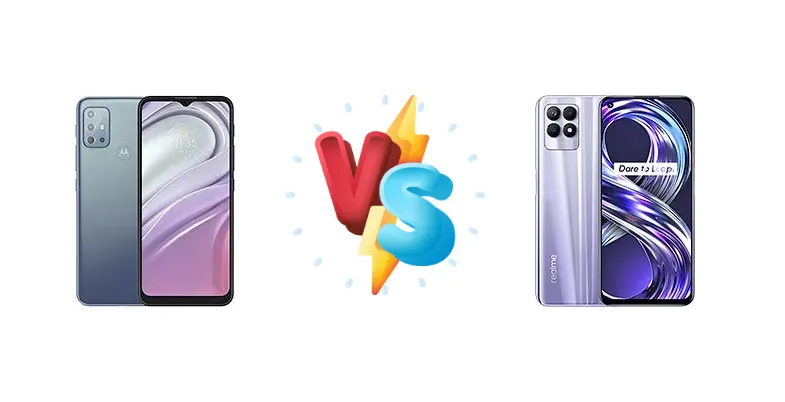
The Motorola Moto G20 and Realme 8i represent two compelling options in the ultra-budget smartphone space. While both aim to deliver essential smartphone functionality at a low price, they take distinctly different approaches to achieving this. The G20 prioritizes a simple experience, while the 8i attempts to offer more performance and features. This comparison will dissect their key differences to help you determine which device best suits your needs.
🏆 Quick Verdict
For most users, the Realme 8i is the superior choice. Its Mediatek Helio G96 chipset delivers significantly better performance than the Moto G20’s Unisoc T700, making it more capable for gaming and demanding applications. While both phones offer similar battery endurance, the 8i’s faster 18W charging is a welcome addition.
| Network |
|---|
| 2G bands | GSM 850 / 900 / 1800 / 1900 | GSM 850 / 900 / 1800 / 1900 |
| 3G bands | HSDPA 850 / 900 / 1900 / 2100 | HSDPA 850 / 900 / 2100 |
| 4G bands | 1, 2, 3, 5, 7, 8, 18, 19, 20, 26, 28, 38, 40, 41 | 1, 3, 5, 8, 38, 40, 41 |
| Speed | HSPA 42.2/5.76 Mbps, LTE Cat4 150/50 Mbps | HSPA, LTE |
| Technology | GSM / HSPA / LTE | GSM / HSPA / LTE |
| Launch |
|---|
| Announced | 2021, April 26 | 2021, September 09 |
| Status | Available. Released 2021, June 09 | Available. Released 2021, September 14 |
| Body |
|---|
| Build | Glass front, plastic frame, plastic back | Glass front, plastic frame, plastic back |
| Dimensions | 165.2 x 75.7 x 9.1 mm (6.50 x 2.98 x 0.36 in) | 164.1 x 75.5 x 8.5 mm (6.46 x 2.97 x 0.33 in) |
| SIM | · Nano-SIM· Nano-SIM + Nano-SIM | Nano-SIM + Nano-SIM |
| Weight | 200 g (7.05 oz) | 194 g (6.84 oz) |
| | Water-repellent design | - |
| Display |
|---|
| Resolution | 720 x 1600 pixels, 20:9 ratio (~270 ppi density) | 1080 x 2412 pixels, 20:9 ratio (~400 ppi density) |
| Size | 6.5 inches, 102.0 cm2 (~81.6% screen-to-body ratio) | 6.6 inches, 104.8 cm2 (~84.6% screen-to-body ratio) |
| Type | IPS LCD, 90Hz | IPS LCD, 120Hz, 600 nits (peak) |
| Platform |
|---|
| CPU | Octa-core 1.8 GHz | Octa-core (2x2.05 GHz Cortex-A76 & 6x2.0 GHz Cortex-A55) |
| Chipset | Unisoc T700 | Mediatek MT6781 Helio G96 (12 nm) |
| GPU | Mali G52 | Mali-G57 MC2 |
| OS | Android 11 | Android 11, Realme UI 2.0 |
| Memory |
|---|
| Card slot | microSDXC (uses shared SIM slot) | microSDXC (dedicated slot) |
| Internal | 64GB 4GB RAM, 128GB 4GB RAM | 64GB 4GB RAM, 128GB 4GB RAM, 128GB 6GB RAM |
| | - | UFS 2.1 |
| Main Camera |
|---|
| Features | LED flash, HDR, panorama | LED flash, HDR, panorama |
| Quad | 48 MP, f/1.7, (wide), 1/2.0", 0.8µm, PDAF
8 MP, f/2.2, 118˚ (ultrawide), 1/4.0", 1.12µm
2 MP (macro)
Auxiliary lens | - |
| Single | - | 16 MP, f/2.1, (wide), 1/3.0", 1.0µm |
| Triple | - | 50 MP, f/1.8, 26mm (wide), 1/2.76", 0.64µm, PDAF
2 MP (macro)
Auxiliary lens |
| Video | 1080p@30fps | 1080p@30fps |
| Selfie camera |
|---|
| Features | HDR | Panorama |
| Single | 13 MP, f/2.2, (wide), 1/3.1", 1.12µm | 16 MP, f/2.1, (wide), 1/3.0", 1.0µm |
| Video | 1080p@30fps | 1080p@30fps |
| Sound |
|---|
| 3.5mm jack | Yes | Yes |
| 35mm jack | Yes | Yes |
| Loudspeaker | Yes | Yes |
| Comms |
|---|
| Bluetooth | 5.0, A2DP, LE | 5.1, A2DP, LE |
| NFC | Yes | Yes (market/region dependent) |
| Positioning | GPS, GLONASS, GALILEO | GPS, GLONASS, GALILEO, BDS |
| Radio | FM radio | No |
| USB | USB Type-C 2.0 | USB Type-C 2.0, OTG |
| WLAN | Wi-Fi 802.11 a/b/g/n/ac, dual-band, Wi-Fi Direct | Wi-Fi 802.11 a/b/g/n/ac, dual-band |
| Features |
|---|
| Sensors | Fingerprint (rear-mounted), accelerometer, gyro, proximity | Fingerprint (side-mounted), accelerometer, gyro, proximity, compass |
| Battery |
|---|
| Charging | 10W wired | 18W wired |
| Type | Li-Po 5000 mAh | 5000 mAh |
| Misc |
|---|
| Colors | Breeze Blue, Flamingo Pink | Space Black, Space Purple |
| Models | XT2128-1, XT2128-2 | RMX3151 |
| Price | About 160 EUR | About 440 EUR |
| Tests |
|---|
| Battery life | - |
Endurance rating 131h
|
| Camera | - |
Photo / Video |
| Loudspeaker | - |
-28.4 LUFS (Average)
|
Motorola Moto G20
- Potentially lower price point
- Simple and straightforward user experience
- Decent battery endurance
- Significantly weaker performance
- Slow 10W charging
- Less detailed display specifications
Realme 8i
- Faster and more capable Helio G96 chipset
- Faster 18W charging
- Brighter and higher contrast display
- May be slightly more expensive
- Realme’s UI can be polarizing
- Camera performance relies heavily on software optimization
Display Comparison
The Realme 8i boasts a brighter display, measured at 540 nits, compared to the Moto G20’s unspecified brightness. This difference is noticeable in outdoor visibility. While both likely utilize IPS LCD panels, the 8i’s 1244:1 contrast ratio suggests deeper blacks and a more vibrant image. The Moto G20’s display specifications are less detailed, suggesting a more basic panel aimed at cost reduction. Neither phone is expected to offer high refresh rates, focusing instead on power efficiency.
Camera Comparison
Both devices feature 'Photo / Video' capabilities, but detailed camera specifications are lacking. Without sensor size or aperture information, a direct comparison is difficult. However, the Realme 8i’s chipset generally supports more advanced image processing features, potentially leading to better image quality in various lighting conditions. The presence of a dedicated ISP (Image Signal Processor) within the Helio G96 is a key advantage. It's likely both phones include a standard macro lens, but these are often of limited utility due to their low resolution.
Performance
The Realme 8i’s Mediatek Helio G96 (12nm) is a substantial upgrade over the Motorola Moto G20’s Unisoc T700. The G96 features a more modern CPU architecture – specifically, two Cortex-A76 cores clocked at 2.05 GHz alongside six Cortex-A55 cores at 2.0 GHz – compared to the G20’s octa-core 1.8 GHz setup. This translates to significantly faster application loading times and smoother multitasking. The G96’s Mali-G57 MC2 GPU also provides a considerable boost in graphics performance, making the 8i a more viable option for casual gaming. The Unisoc T700, while adequate for basic tasks, will struggle with more demanding games and applications.
Battery Life
Both the Motorola Moto G20 and Realme 8i achieve an endurance rating of 131 hours, indicating similar overall battery life. However, the Realme 8i’s 18W wired charging is a significant advantage over the Moto G20’s slow 10W charging. This means the 8i can be topped up much faster, reducing downtime. While battery capacity isn’t specified for either device, the faster charging speed of the 8i provides a more convenient user experience.
Buying Guide
Buy the Motorola Moto G20 if you prioritize simplicity and a basic smartphone experience with minimal performance demands. It’s suitable for users who primarily make calls, send texts, and browse social media. Buy the Realme 8i if you want a more responsive device capable of handling moderate gaming, multitasking, and streaming video without significant lag. It’s the better option for users who want a bit more future-proofing and versatility.
Frequently Asked Questions
❓ Is the Unisoc T700 in the Moto G20 sufficient for playing PUBG Mobile?
While PUBG Mobile may be playable on the Moto G20, expect significant compromises in graphics settings and frame rates. The Unisoc T700 lacks the processing power and GPU capabilities to deliver a smooth and enjoyable gaming experience at higher settings. The Realme 8i’s Helio G96 is far better suited for gaming.
❓ Does the Realme 8i support fast charging protocols beyond 18W, like Power Delivery?
While the Realme 8i supports 18W charging, it doesn't officially support Power Delivery (PD) or Quick Charge. Using a higher wattage charger won't necessarily result in faster charging speeds, as the phone is limited to 18W input. It's best to use the included charger or a compatible 18W charger.
❓ How does Realme's UI compare to Motorola's near-stock Android experience?
Motorola offers a near-stock Android experience with minimal bloatware, prioritizing simplicity and speed. Realme UI, on the other hand, is more heavily customized with additional features and a different visual style. Some users prefer Realme UI's customization options, while others find it cluttered compared to Motorola's approach.