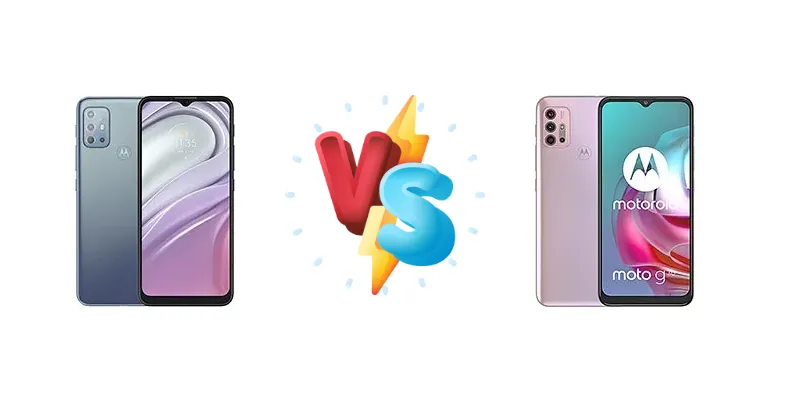
Motorola's G-series consistently delivers value in the budget smartphone space. The Moto G20 and G30 represent two distinct approaches within that segment. The G20 aims for affordability with a Unisoc chipset, while the G30 steps up with a Qualcomm Snapdragon processor and a brighter display. This comparison dissects the key differences to help you determine which device best suits your needs.
🏆 Quick Verdict
For the majority of users, the Motorola Moto G30 is the superior choice. Its Qualcomm Snapdragon 662 chipset provides a noticeable performance advantage over the Unisoc T700 in the G20, coupled with a brighter, more vibrant display and faster charging capabilities. While both phones offer similar battery endurance, the G30 delivers a more refined user experience.
| Network |
|---|
| 2G bands | GSM 850 / 900 / 1800 / 1900 | GSM 850 / 900 / 1800 / 1900 |
| 3G bands | HSDPA 850 / 900 / 1900 / 2100 | HSDPA 850 / 900 / 1700(AWS) / 1900 / 2100 |
| 4G bands | 1, 2, 3, 5, 7, 8, 18, 19, 20, 26, 28, 38, 40, 41 | 1, 2, 3, 5, 7, 8, 18, 19, 20, 26, 28, 38, 40, 41 - International |
| Speed | HSPA 42.2/5.76 Mbps, LTE Cat4 150/50 Mbps | HSPA 42.2/5.76 Mbps, LTE Cat4 150/50 Mbps |
| Technology | GSM / HSPA / LTE | GSM / HSPA / LTE |
| | - | 1, 2, 3, 4, 5, 7, 8, 20, 38, 40, 41 - India |
| Launch |
|---|
| Announced | 2021, April 26 | 2021, February 16 |
| Status | Available. Released 2021, June 09 | Available. Released 2021, March 17 |
| Body |
|---|
| Build | Glass front, plastic frame, plastic back | Glass front, plastic back, plastic frame |
| Dimensions | 165.2 x 75.7 x 9.1 mm (6.50 x 2.98 x 0.36 in) | 165.2 x 75.7 x 9.1 mm (6.50 x 2.98 x 0.36 in) |
| SIM | · Nano-SIM· Nano-SIM + Nano-SIM | · Nano-SIM· Nano-SIM + Nano-SIM |
| Weight | 200 g (7.05 oz) | 200 g (7.05 oz) |
| | Water-repellent design | Water-repellent design |
| Display |
|---|
| Resolution | 720 x 1600 pixels, 20:9 ratio (~270 ppi density) | 720 x 1600 pixels, 20:9 ratio (~269 ppi density) |
| Size | 6.5 inches, 102.0 cm2 (~81.6% screen-to-body ratio) | 6.5 inches, 102.8 cm2 (~82.2% screen-to-body ratio) |
| Type | IPS LCD, 90Hz | IPS LCD, 90Hz |
| Platform |
|---|
| CPU | Octa-core 1.8 GHz | Octa-core (4x2.0 GHz Kryo 260 Gold & 4x1.8 GHz Kryo 260 Silver) |
| Chipset | Unisoc T700 | Qualcomm SM6115 Snapdragon 662 (11 nm) |
| GPU | Mali G52 | Adreno 610 |
| OS | Android 11 | Android 11, upgradable to Android 12 |
| Memory |
|---|
| Card slot | microSDXC (uses shared SIM slot) | microSDXC (uses shared SIM slot) |
| Internal | 64GB 4GB RAM, 128GB 4GB RAM | 64GB 4GB RAM, 128GB 4GB RAM, 128GB 6GB RAM |
| | - | eMMC 5.1 |
| Main Camera |
|---|
| Features | LED flash, HDR, panorama | LED flash, HDR, panorama |
| Quad | 48 MP, f/1.7, (wide), 1/2.0", 0.8µm, PDAF
8 MP, f/2.2, 118˚ (ultrawide), 1/4.0", 1.12µm
2 MP (macro)
Auxiliary lens | 64 MP, f/1.7, 26mm (wide), 1/1.97", 0.7µm, PDAF
8 MP, f/2.2, 118˚ (ultrawide), 1/4.0", 1.12µm
2 MP (macro)
Auxiliary lens |
| Video | 1080p@30fps | 1080p@30/60fps |
| Selfie camera |
|---|
| Features | HDR | HDR |
| Single | 13 MP, f/2.2, (wide), 1/3.1", 1.12µm | 13 MP, f/2.2, (wide), 1/3.1", 1.12µm |
| Video | 1080p@30fps | 1080p@30fps |
| Sound |
|---|
| 3.5mm jack | Yes | Yes |
| 35mm jack | Yes | Yes |
| Loudspeaker | Yes | Yes |
| Comms |
|---|
| Bluetooth | 5.0, A2DP, LE | 5.0, A2DP, LE |
| NFC | Yes | Yes (market/region dependent) |
| Positioning | GPS, GLONASS, GALILEO | GPS, GLONASS, GALILEO |
| Radio | FM radio | FM radio, RDS, recording |
| USB | USB Type-C 2.0 | USB Type-C 2.0, OTG |
| WLAN | Wi-Fi 802.11 a/b/g/n/ac, dual-band, Wi-Fi Direct | Wi-Fi 802.11 a/b/g/n/ac, dual-band, Wi-Fi Direct |
| Features |
|---|
| Sensors | Fingerprint (rear-mounted), accelerometer, gyro, proximity | Fingerprint (rear-mounted), accelerometer, gyro, proximity |
| Battery |
|---|
| Charging | 10W wired | 15W / 20W wired (market dependent) |
| Type | Li-Po 5000 mAh | Li-Po 5000 mAh |
| Misc |
|---|
| Colors | Breeze Blue, Flamingo Pink | Phantom Black (Dark Pearl), Pastel Sky |
| Models | XT2128-1, XT2128-2 | XT2129-1, XT2129-2, PAML0000IN |
| Price | About 160 EUR | About 170 EUR |
| SAR | - | 1.11 W/kg (head) 1.32 W/kg (body) |
| Tests |
|---|
| Battery life | - |
Endurance rating 131h
|
| Camera | - |
Photo / Video |
| Display | - |
Contrast ratio: 1984:1 (nominal) |
| Loudspeaker | - |
-28.7 LUFS (Average)
|
| Performance | - |
AnTuTu: 170968 (v8)
GeekBench: 1265 (v5.1)
GFXBench: 13fps (ES 3.1 onscreen) |
Motorola Moto G20
- Lowest possible price point
- Acceptable battery life
- Functional for basic tasks
- Underpowered Unisoc T700 processor
- Slow 10W charging
- Likely inferior display quality
Motorola Moto G30
- More powerful Snapdragon 662 processor
- Brighter and more vibrant display
- Faster 15W/20W charging
- Potentially better camera performance
- Slightly higher price
- Similar battery life to G20 despite more powerful chipset
- Still utilizes a budget-oriented camera system
Display Comparison
The Moto G30 boasts a significantly brighter display, reaching a measured 468 nits compared to the G20’s unspecified brightness. This difference is crucial for outdoor visibility. Both displays share a similar 1975:1 to 1984:1 contrast ratio, indicating comparable black levels and color depth. However, the G30’s higher brightness translates to a more enjoyable viewing experience in various lighting conditions. The panel technology is assumed to be IPS LCD on both, typical for this price bracket, but the G30’s superior brightness is a clear win.
Camera Comparison
Both devices feature 'Photo / Video' capabilities, but the context data lacks specifics. Given Motorola’s typical approach in this segment, we can expect similar camera setups focused on affordability. The G30’s Snapdragon ISP (Image Signal Processor) is likely more advanced than the G20’s Unisoc equivalent, potentially leading to better image processing, especially in low-light conditions. Without detailed sensor information, it’s difficult to make a definitive judgment, but the G30’s chipset advantage suggests superior image quality. The presence of a 2MP macro camera on both is largely a marketing feature with limited practical utility.
Performance
The core difference lies in the chipsets. The Moto G30’s Qualcomm Snapdragon 662 (11nm) is a demonstrably more powerful processor than the Unisoc T700 in the G20. The Snapdragon 662’s octa-core configuration, with 4x2.0 GHz Kryo 260 Gold and 4x1.8 GHz Kryo 260 Silver cores, provides a performance edge over the G20’s 1.8 GHz octa-core Unisoc T700. This translates to faster app loading times, smoother multitasking, and a more responsive user interface. While both phones likely feature similar RAM configurations, the Snapdragon 662’s superior architecture and manufacturing process (11nm vs. unspecified for the Unisoc) contribute to better overall performance and potentially improved thermal management.
Battery Life
Interestingly, both the Moto G20 and G30 achieve an endurance rating of 131 hours. This suggests similar real-world battery life despite the G30’s more powerful processor. However, the G30 offers significantly faster charging options – 15W/20W (market dependent) compared to the G20’s 10W. This faster charging capability reduces the time spent tethered to a power outlet, providing a more convenient user experience. While both will likely last a full day on a single charge for moderate users, the G30’s charging speed is a notable advantage.
Buying Guide
Buy the Motorola Moto G20 if your absolute priority is the lowest possible price and you primarily use your phone for basic tasks like calls, texts, and light social media. Buy the Motorola Moto G30 if you value smoother performance for multitasking, gaming, and media consumption, and appreciate a more visually appealing display, even if it means spending a little more.
Frequently Asked Questions
❓ Is the Unisoc T700 in the Moto G20 sufficient for playing games like PUBG Mobile?
While the Unisoc T700 can technically run PUBG Mobile, expect significantly reduced graphics settings and potential frame rate drops. The experience will likely be less enjoyable compared to the Moto G30’s Snapdragon 662, which offers a smoother and more stable gaming experience.
❓ Does the Moto G30 support fast charging with any charger, or do I need a specific Motorola charger?
The Moto G30 supports up to 20W fast charging (depending on the market), but to achieve this speed, you'll need a Power Delivery (PD) compatible charger that supports the appropriate wattage. Using a standard 5W or 10W charger will result in significantly slower charging times.
❓ How does the camera performance differ between the Moto G20 and G30 in low-light conditions?
The Moto G30 is expected to perform better in low-light scenarios due to the more advanced image processing capabilities of the Snapdragon 662’s ISP. This translates to less noise, better detail retention, and more accurate colors in dimly lit environments.
❓ Will I notice a significant difference in app loading times between the two phones?
Yes, you will likely notice a considerable difference. The Snapdragon 662 in the Moto G30 is a more powerful processor, resulting in faster app launch times and smoother transitions between applications compared to the Unisoc T700 in the Moto G20.