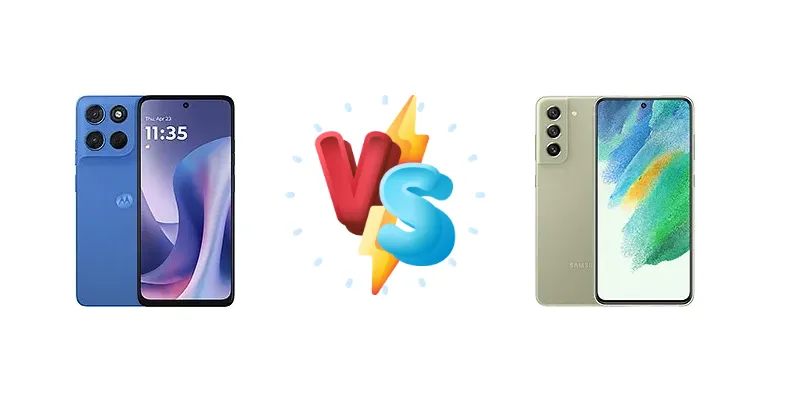
The Motorola Moto G100S and Samsung Galaxy S21 FE 5G represent distinct approaches to the mid-to-high range smartphone market. The G100S aims for strong performance at a more accessible price point, while the S21 FE attempts to deliver a flagship experience with a slightly more restrained budget. This comparison dissects their key differences to help you choose the right device.
🏆 Quick Verdict
For most users, the Samsung Galaxy S21 FE 5G emerges as the superior choice. Its Snapdragon 888 (or Exynos 2100) chipset provides significantly more processing power, and the brighter, higher-quality display enhances the overall user experience. While the Moto G100S offers good value, the S21 FE’s refinement and performance justify the price difference.
| Network |
|---|
| 2G bands | GSM 850 / 900 / 1800 / 1900 | GSM 850 / 900 / 1800 / 1900 |
| 3G bands | HSDPA 850 / 900 / 1900 / 2100 | HSDPA 850 / 900 / 1700(AWS) / 1900 / 2100 |
| 4G bands | LTE | 1, 2, 3, 4, 5, 7, 8, 12, 17, 20, 26, 28, 32, 38, 40, 41, 66 - International |
| 5G bands | SA/NSA | 1, 3, 5, 8, 20, 28, 38, 40, 41, 66, 78 SA/NSA/Sub6 - International |
| Speed | HSPA, LTE, 5G | HSPA 42.2/5.76 Mbps, LTE (5CA) Cat19 1600/200 Mbps, 5G |
| Technology | GSM / HSPA / LTE / 5G | GSM / CDMA / HSPA / EVDO / LTE / 5G |
| | - | 41, 66, 71, 260, 261 SA/NSA/Sub6/mmWave - USA |
| Launch |
|---|
| Announced | 2025, November 03 | 2022, January 04 |
| Status | Available. Released 2025, November 03 | Available. Released 2022, January 07 |
| Body |
|---|
| Build | Glass front, plastic frame, silicone polymer (eco leather) back | Glass front (Gorilla Glass Victus), plastic back, aluminum frame |
| Dimensions | 166.2 x 76.5 x 8.6 mm (6.54 x 3.01 x 0.34 in) | 155.7 x 74.5 x 7.9 mm (6.13 x 2.93 x 0.31 in) |
| SIM | Nano-SIM + Nano-SIM | · Nano-SIM· Nano-SIM + Nano-SIM |
| Weight | 210 g (7.41 oz) | 177 g (6.24 oz) |
| | - | IP68 dust/water resistant (up to 1.5m for 30 min) |
| Display |
|---|
| Protection | - | Corning Gorilla Glass Victus |
| Resolution | 1080 x 2400 pixels, 20:9 ratio (~392 ppi density) | 1080 x 2340 pixels, 19.5:9 ratio (~403 ppi density) |
| Size | 6.72 inches, 109.0 cm2 (~85.8% screen-to-body ratio) | 6.4 inches, 100.5 cm2 (~86.7% screen-to-body ratio) |
| Type | IPS LCD, 120Hz, 1050 nits (peak) | Dynamic AMOLED 2X, 120Hz, HDR10+ |
| | - | Always-on display |
| Platform |
|---|
| CPU | Octa-core (4x2.4 GHz Cortex-A78 & 4x1.8 GHz Cortex-A55) | Octa-core (1x2.84 GHz Cortex-X1 & 3x2.42 GHz Cortex-A78 & 4x1.80 GHz Cortex-A55) - Version 1Octa-core (1x2.9 GHz Cortex-X1 & 3x2.80 GHz Cortex-A78 & 4x2.2 GHz Cortex-A55) - Version 2 |
| Chipset | Qualcomm SM6435-AA Snapdragon 6s Gen 4 (4 nm) | Qualcomm SM8350 Snapdragon 888 5G (5 nm) - Version 1Exynos 2100 (5 nm) - Version 2 |
| GPU | Adreno | Adreno 660 - Version 1Mali-G78 MP14 - Version 2 |
| OS | Android 15 | Android 12, up to 4 major Android upgrades, One UI 8 |
| Memory |
|---|
| Card slot | No | No |
| Internal | 128GB 8GB RAM, 256GB 8GB RAM | 128GB 6GB RAM, 128GB 8GB RAM, 256GB 6GB RAM, 256GB 8GB RAM |
| Main Camera |
|---|
| Dual | 50 MP, f/1.9 (wide), 1/1.95", 0.8µm, PDAF
8 MP, f/2.2, 118˚ (ultrawide), 1/4.0", 1.12µm | - |
| Features | LED flash, HDR, panorama | LED flash, auto-HDR, panorama |
| Single | - | 32 MP, f/2.2, 26mm (wide), 1/2.74", 0.8µm |
| Triple | - | 12 MP, f/1.8, 26mm (wide), 1/1.76", 1.8µm, dual pixel PDAF, OIS
8 MP, f/2.4, 76mm (telephoto), 1/4.5", 1.0µm, PDAF, OIS, 3x optical zoom
12 MP, f/2.2, 13mm, 123˚ (ultrawide), 1/3.0", 1.12µm |
| Video | 1440p@30fps, 1080p@30fps | 4K@30/60fps, 1080p@30/60/120/240fps, HDR10+, gyro-EIS |
| Selfie camera |
|---|
| Features | HDR | HDR |
| Single | 8 MP, f/2.2, (wide), 1/4.0", 1.12µm | 32 MP, f/2.2, 26mm (wide), 1/2.74", 0.8µm |
| Video | 1440p@30fps, 1080p@30fps | 4K@30/60fps, 1080p@30/60fps, gyro-EIS |
| Sound |
|---|
| 3.5mm jack | - | No |
| 35mm jack | Yes | No |
| Loudspeaker | Yes, with stereo speakers | Yes, with stereo speakers |
| | - | 32-bit/384kHz audio |
| Comms |
|---|
| Bluetooth | 5.1, A2DP, LE | 5.0, A2DP, LE |
| NFC | Yes | Yes |
| Positioning | GPS, GALILEO, GLONASS, BDS, QZSS | GPS, GLONASS, BDS, GALILEO |
| Radio | No | Unspecified |
| USB | USB Type-C 2.0, OTG | USB Type-C, OTG |
| WLAN | Wi-Fi 802.11 a/b/g/n/ac, dual-band | Wi-Fi 802.11 a/b/g/n/ac/6, dual-band, Wi-Fi Direct |
| Features |
|---|
| Sensors | Fingerprint (side-mounted), accelerometer, gyro, proximity, compass | Fingerprint (under display, optical), accelerometer, gyro, proximity, compass |
| | - | Bixby natural language commands and dictation
Samsung Pay (Visa, MasterCard certified)
Samsung DeX (desktop experience support) |
| Battery |
|---|
| Charging | 30W wired | 25W wired, PD3.0, 50% in 30 min
15W wireless
Reverse wireless |
| Type | Si/C Li-Ion 7000 mAh | Li-Ion 4500 mAh |
| Misc |
|---|
| Colors | Black, Blue | White, Graphite, Lavender, Olive |
| Models | - | SM-G990B, SM-G990B/DS, SM-G990U, SM-G990U1, SM-G990W, SM-G990E, SM-G9900, SM-G990B2, SM-G990U2, SM-G990W2, SM-G990U3 |
| Price | About 120 EUR | € 199.00 / $ 143.95 / £ 154.99 / ₹ 29,990 |
| SAR | - | 0.77 W/kg (head) 0.90 W/kg (body) |
| SAR EU | - | 0.95 W/kg (head) 1.48 W/kg (body) |
| Tests |
|---|
| Battery life | - |
Endurance rating 92h
|
| Camera | - |
Photo / Video |
| Display | - |
Contrast ratio: Infinite (nominal) |
| Loudspeaker | - |
-26.9 LUFS (Good)
|
| Performance | - |
AnTuTu: 566529 (v8), 719696 (v9)
GeekBench: 3049 (v5.1)
GFXBench: 56fps (ES 3.1 onscreen) |
Motorola Moto G100S
- More affordable price point
- Potentially better thermal management due to 4nm process
- Faster wired charging (30W)
- Significantly less powerful processor
- Inferior display quality
- Less refined camera system
Samsung Galaxy S21 FE 5G
- Superior processing power (Snapdragon 888/Exynos 2100)
- Brighter and higher-quality display
- Wireless and reverse wireless charging
- Higher price
- Potential for Exynos overheating (depending on version)
- Slightly slower wired charging (25W)
Display Comparison
The Samsung Galaxy S21 FE 5G boasts a significantly brighter display, reaching a measured 792 nits, compared to an unspecified brightness for the Moto G100S. This higher peak brightness translates to better visibility in direct sunlight. While both displays have an 'infinite' (nominal) contrast ratio, the S21 FE’s panel is likely to offer superior color accuracy and viewing angles, typical of Samsung’s flagship displays. The G100S’s display specs are less detailed, suggesting a more budget-oriented panel.
Camera Comparison
Both phones feature capable camera systems, but the S21 FE likely holds an edge. While both are listed as having 'Photo / Video' capabilities, the S21 FE benefits from Samsung’s advanced image processing algorithms and potentially larger sensor sizes (specs not provided). The G100S’s camera system is likely more focused on providing a versatile set of features at a lower cost, potentially sacrificing some image quality in challenging lighting conditions. The inclusion of a 2MP macro camera on the G100S is a common cost-cutting measure, offering limited practical benefit.
Performance
The performance gap is substantial. The Samsung Galaxy S21 FE 5G, equipped with either the Snapdragon 888 (5nm) or Exynos 2100 (5nm), offers a considerable leap in processing power over the Motorola Moto G100S’s Snapdragon 6s Gen 4 (4nm). The S21 FE’s Cortex-X1 prime core, clocked up to 2.9 GHz in some versions, provides a significant advantage in single-core tasks. While the G100S’s 4nm process is efficient, it can’t compensate for the architectural superiority and higher clock speeds of the Snapdragon 888/Exynos 2100. The S21 FE also benefits from potentially faster LPDDR5 RAM, further enhancing responsiveness.
Battery Life
Both devices achieve an endurance rating of 92 hours, suggesting comparable real-world battery life despite differing charging speeds. The S21 FE offers 25W wired charging with PD3.0 and 50% charge in 30 minutes, alongside 15W wireless and reverse wireless charging. The Moto G100S is limited to 30W wired charging. The S21 FE’s wireless charging capabilities and faster partial charging provide added convenience, offsetting the slightly lower wired charging wattage.
Buying Guide
Buy the Motorola Moto G100S if you prioritize maximizing performance-per-dollar and frequently engage in tasks that benefit from a larger core count, like video editing or multitasking. Buy the Samsung Galaxy S21 FE 5G if you value a more polished software experience, a superior display, and a more capable camera system, even if it means spending a bit more.
Frequently Asked Questions
❓ Does the Exynos 2100 version of the S21 FE suffer from overheating issues?
Early reports indicated that the Exynos 2100 variant of the S21 FE could experience more thermal throttling under sustained load compared to the Snapdragon 888 version. However, software updates have mitigated these issues to a large extent. While it may still run slightly warmer, it's generally not a significant problem for most users.
❓ Is the 2MP macro camera on the Moto G100S actually useful?
Generally, 2MP macro cameras offer limited practical benefit. The low resolution results in images lacking detail and sharpness. While it can be fun to experiment with, don't expect professional-quality macro photography from the Moto G100S.
❓ Can the Samsung Galaxy S21 FE 5G run demanding games like PUBG at 90fps?
Yes, the S21 FE 5G can achieve 90fps in PUBG Mobile, but it depends on the graphics settings and the specific version of the game. You may need to lower the graphics settings to 'Smooth' or 'Balanced' to consistently maintain 90fps. The Snapdragon 888 version will likely handle this more consistently than the Exynos 2100.
❓ How does the Snapdragon 6s Gen 4 in the Moto G100S handle multitasking?
The Snapdragon 6s Gen 4 is capable of handling moderate multitasking, but it may struggle with extremely demanding applications or a large number of apps running simultaneously. The S21 FE's Snapdragon 888/Exynos 2100 offers a significantly smoother multitasking experience.