
Moto G100S vs Google Pixel 6a: Which Mid-Range Phone Reigns Supreme?
| Phones Images | |||||
|---|---|---|---|---|---|
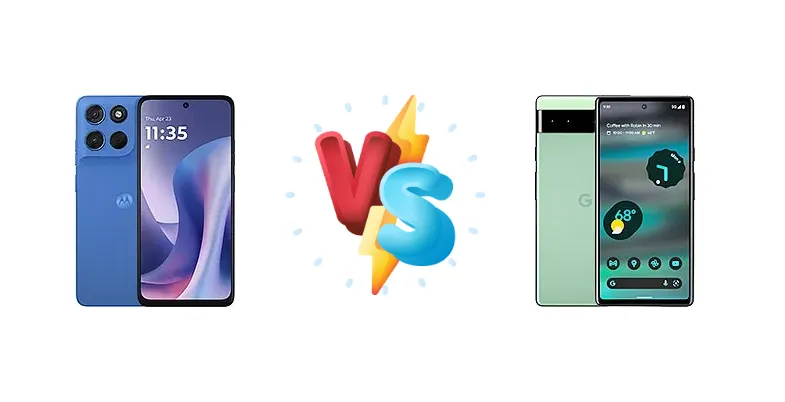
|
🏆 Quick Verdict
For the average user prioritizing camera quality and software experience, the Google Pixel 6a is the clear winner. Its Tensor chip, combined with Google’s computational photography, delivers superior image processing. However, the Moto G100S offers a compelling alternative for those who value faster CPU performance and quicker charging.
| PHONES | ||
|---|---|---|
| Phone Names | Motorola Moto G100S | Google Pixel 6a |
| Network | ||
|---|---|---|
| 2G bands | GSM 850 / 900 / 1800 / 1900 | GSM 850 / 900 / 1800 / 1900 |
| 3G bands | HSDPA 850 / 900 / 1900 / 2100 | HSDPA 800 / 850 / 900 / 1700(AWS) / 1900 / 2100 |
| 4G bands | LTE | 1, 2, 3, 4, 5, 7, 8, 12, 13, 14, 17, 18, 19, 20, 25, 26, 28, 29, 30, 38, 39, 40, 41, 42, 48, 66, 71 - GX7AS, GB62Z (USA/Canada) |
| 5G bands | SA/NSA | 1, 2, 3, 5, 7, 8, 12, 20, 25, 28, 30, 38, 40, 41, 48, 66, 71, 77, 78 SA/NSA/Sub6 - GX7AS (USA/Canada) |
| Speed | HSPA, LTE, 5G | HSPA, LTE, 5G |
| Technology | GSM / HSPA / LTE / 5G | GSM / HSPA / LTE / 5G |
| - | 1, 2, 3, 5, 7, 8, 12, 20, 25, 28, 30, 40, 48, 66, 71, 77, 78 SA/NSA/Sub6 - G1AZG (International) | |
| Launch | ||
|---|---|---|
| Announced | 2025, November 03 | 2022, May 11 |
| Status | Available. Released 2025, November 03 | Available. Released 2022, July 21 |
| Body | ||
|---|---|---|
| Build | Glass front, plastic frame, silicone polymer (eco leather) back | Glass front (Gorilla Glass 3), aluminum frame, plastic back |
| Dimensions | 166.2 x 76.5 x 8.6 mm (6.54 x 3.01 x 0.34 in) | 152.2 x 71.8 x 8.9 mm (5.99 x 2.83 x 0.35 in) |
| SIM | Nano-SIM + Nano-SIM | Nano-SIM + eSIM |
| Weight | 210 g (7.41 oz) | 178 g (6.28 oz) |
| - | IP67 dust/water resistant (up to 1m for 30 min) | |
| Display | ||
|---|---|---|
| Protection | - | Corning Gorilla Glass 3 |
| Resolution | 1080 x 2400 pixels, 20:9 ratio (~392 ppi density) | 1080 x 2400 pixels, 20:9 ratio (~429 ppi density) |
| Size | 6.72 inches, 109.0 cm2 (~85.8% screen-to-body ratio) | 6.1 inches, 90.7 cm2 (~83.0% screen-to-body ratio) |
| Type | IPS LCD, 120Hz, 1050 nits (peak) | OLED, HDR |
| - | Always-on display | |
| Platform | ||
|---|---|---|
| CPU | Octa-core (4x2.4 GHz Cortex-A78 & 4x1.8 GHz Cortex-A55) | Octa-core (2x2.80 GHz Cortex-X1 & 2x2.25 GHz Cortex-A76 & 4x1.80 GHz Cortex-A55) |
| Chipset | Qualcomm SM6435-AA Snapdragon 6s Gen 4 (4 nm) | Google Tensor (5 nm) |
| GPU | Adreno | Mali-G78 MP20 |
| OS | Android 15 | Android 12, upgradable to Android 15, up to 5 major Android upgrades |
| Memory | ||
|---|---|---|
| Card slot | No | No |
| Internal | 128GB 8GB RAM, 256GB 8GB RAM | 128GB 6GB RAM |
| - | UFS 3.1 | |
| Main Camera | ||
|---|---|---|
| Dual | 50 MP, f/1.9 (wide), 1/1.95", 0.8µm, PDAF 8 MP, f/2.2, 118˚ (ultrawide), 1/4.0", 1.12µm | 12.2 MP, f/1.7, 27mm, (wide), 1/2.55", 1.4µm, dual pixel PDAF, OIS 12 MP, f/2.2, 17mm, 114˚ (ultrawide), 1.25µm |
| Features | LED flash, HDR, panorama | Dual-LED flash, Pixel Shift, Auto-HDR, panorama |
| Single | - | 8 MP, f/2.0, 24mm (wide), 1.12µm |
| Video | 1440p@30fps, 1080p@30fps | 4K@30/60fps, 1080p@30/60/120/240fps; gyro-EIS, OIS |
| Selfie camera | ||
|---|---|---|
| Features | HDR | HDR, panorama |
| Single | 8 MP, f/2.2, (wide), 1/4.0", 1.12µm | 8 MP, f/2.0, 24mm (wide), 1.12µm |
| Video | 1440p@30fps, 1080p@30fps | 1080p@30fps |
| Sound | ||
|---|---|---|
| 3.5mm jack | - | No |
| 35mm jack | Yes | No |
| Loudspeaker | Yes, with stereo speakers | Yes, with stereo speakers |
| Comms | ||
|---|---|---|
| Bluetooth | 5.1, A2DP, LE | 5.2, A2DP, LE |
| NFC | Yes | Yes |
| Positioning | GPS, GALILEO, GLONASS, BDS, QZSS | GPS, GLONASS, GALILEO, QZSS |
| Radio | No | No |
| USB | USB Type-C 2.0, OTG | USB Type-C 3.1 |
| WLAN | Wi-Fi 802.11 a/b/g/n/ac, dual-band | Wi-Fi 802.11 a/b/g/n/ac/6e, dual-band, Wi-Fi Direct |
| Features | ||
|---|---|---|
| Sensors | Fingerprint (side-mounted), accelerometer, gyro, proximity, compass | Fingerprint (under display, optical), accelerometer, gyro, proximity, compass, barometer |
| Battery | ||
|---|---|---|
| Charging | 30W wired | 18W wired, PD3.0 |
| Type | Si/C Li-Ion 7000 mAh | Li-Po 4410 mAh |
| Misc | ||
|---|---|---|
| Colors | Black, Blue | Chalk, Charcoal, Sage |
| Models | - | GX7AS, GB62Z, G1AZG, GB17L |
| Price | About 120 EUR | $ 138.99 / C$ 228.74 / ₹ 23,999 |
| Tests | ||
|---|---|---|
| Battery life | - | Endurance rating 94h |
| Display | - | Contrast ratio: Infinite (nominal) |
Motorola Moto G100S
- Faster 30W wired charging
- Potentially better multitasking due to CPU core count
- More affordable price point (likely)
- Less refined software experience
- Inferior camera image processing
- Less powerful GPU
Google Pixel 6a
- Superior camera quality and image processing
- Smoother software experience with guaranteed updates
- More powerful CPU for AI tasks
- Slower 18W charging
- Higher price
- Potentially less RAM for multitasking
Display Comparison
The Pixel 6a boasts a significantly brighter display, reaching 876 nits measured, compared to the Moto G100S’s unspecified peak brightness. This translates to better visibility outdoors. While the Moto G100S’s display specs are less detailed, the Pixel 6a’s ‘Infinite’ contrast ratio (nominal) suggests a superior OLED panel. The Pixel 6a’s smaller 6.1-inch screen also contributes to a higher pixel density, potentially resulting in a sharper image, though the G100S’s larger screen may be preferable for media consumption.
Camera Comparison
The Pixel 6a’s camera prowess is largely attributed to Google’s computational photography, powered by the Tensor chip. While specific sensor details are missing for both phones, the Pixel 6a’s image processing excels in dynamic range and low-light performance. The Moto G100S’s camera system is likely more reliant on hardware, and without detailed sensor information, it’s difficult to assess its capabilities. The Pixel 6a’s focus on software optimization gives it a significant edge in image quality, even with potentially similar hardware.
Performance
The Google Pixel 6a’s Tensor chip, built on a 5nm process, represents a more advanced architecture than the Motorola Moto G100S’s Snapdragon 6s Gen 4 (4nm). While both are octa-core CPUs, the Pixel 6a features two high-performance Cortex-X1 cores clocked at 2.80 GHz, alongside two Cortex-A76 cores, offering a substantial advantage in single-core performance. The G100S relies on four Cortex-A78 cores at 2.4 GHz. This architectural difference means the Pixel 6a will likely handle demanding tasks and AI-driven features more efficiently. The 4nm process of the Snapdragon 6s Gen 4 in the G100S does offer improved efficiency over older nodes, but doesn't match the Tensor's overall performance.
Battery Life
Both the Motorola Moto G100S and Google Pixel 6a achieve an endurance rating of 94 hours, indicating comparable battery life under similar usage conditions. However, the charging speeds differ significantly. The Moto G100S supports 30W wired charging, allowing for a faster 0-100% charge compared to the Pixel 6a’s 18W charging with PD3.0. While the Pixel 6a’s software optimization likely contributes to efficient power management, the G100S offers a quicker top-up when needed.
Buying Guide
Buy the Motorola Moto G100S if you need a phone for demanding multitasking, enjoy faster charging speeds, and prioritize raw CPU performance for applications beyond typical smartphone use. Buy the Google Pixel 6a if you prefer a streamlined software experience, exceptional camera capabilities, and long-term software support, even if it means sacrificing some raw processing speed.