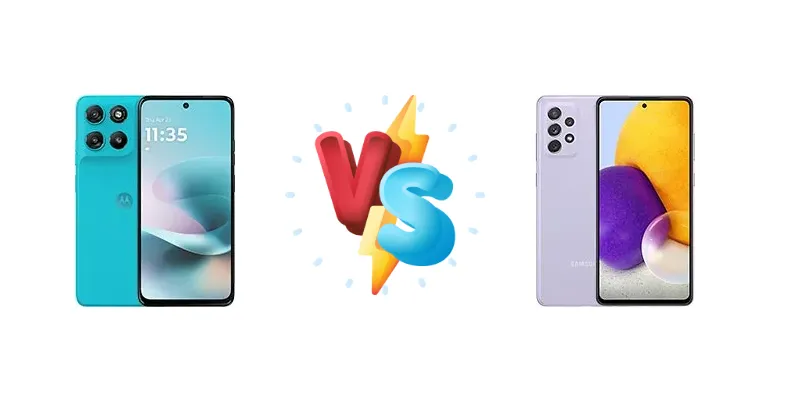
The Motorola Moto G100 and Samsung Galaxy A72 represent distinct approaches to the mid-range smartphone market. The G100, leveraging a newer Snapdragon 7s Gen 2 chipset, aims for performance gains, while the A72 prioritizes a vibrant display and refined Samsung experience. This comparison dissects their key differences to determine which device best suits your needs.
🏆 Quick Verdict
For users prioritizing raw processing power and future-proofing, the Motorola Moto G100 is the better choice, thanks to its Snapdragon 7s Gen 2. However, the Samsung Galaxy A72 counters with a significantly brighter display and slightly better battery endurance, making it ideal for media consumption and everyday use.
| Network |
|---|
| 2G bands | GSM 850 / 900 / 1800 / 1900 | GSM 850 / 900 / 1800 / 1900 |
| 3G bands | HSDPA 850 / 900 / 1900 / 2100 | HSDPA 850 / 900 / 1700(AWS) / 1900 / 2100 |
| 4G bands | LTE | 1, 2, 3, 4, 5, 7, 8, 12, 17, 20, 26, 28, 32, 38, 40, 41, 66 |
| 5G bands | SA/NSA | - |
| Speed | HSPA, LTE, 5G | HSPA, LTE |
| Technology | GSM / HSPA / LTE / 5G | GSM / HSPA / LTE |
| Launch |
|---|
| Announced | 2025, October 14 | 2021, March 17 |
| Status | Available. Released 2025, October 20 | Available. Released 2021, March 26 |
| Body |
|---|
| Build | Glass front, plastic frame, silicone polymer (eco leather) back | Glass front (Gorilla Glass 5), plastic frame, plastic back |
| Dimensions | 166.2 x 76.5 x 8.6 mm (6.54 x 3.01 x 0.34 in) | 165 x 77.4 x 8.4 mm (6.50 x 3.05 x 0.33 in) |
| SIM | Nano-SIM + Nano-SIM | · Nano-SIM· Nano-SIM + Nano-SIM |
| Weight | 210 g (7.41 oz) | 203 g (7.16 oz) |
| | Water repellent design | IP67 dust/water resistant (up to 1m for 30 min) |
| Display |
|---|
| Protection | - | Corning Gorilla Glass 5 |
| Resolution | 1080 x 2400 pixels, 20:9 ratio (~392 ppi density) | 1080 x 2400 pixels, 20:9 ratio (~394 ppi density) |
| Size | 6.72 inches, 109.0 cm2 (~85.8% screen-to-body ratio) | 6.7 inches, 107.8 cm2 (~84.4% screen-to-body ratio) |
| Type | IPS LCD, 120Hz, 1050 nits (peak) | Super AMOLED, 90Hz, 800 nits (HBM) |
| | - | Always-on display |
| Platform |
|---|
| CPU | Octa-core (4x2.40 GHz Cortex-A78 & 4x1.95 GHz Cortex-A55) | Octa-core (2x2.3 GHz Kryo 465 Gold & 6x1.8 GHz Kryo 465 Silver) |
| Chipset | Qualcomm SM7435-AB Snapdragon 7s Gen 2 (4 nm) | Qualcomm SM7125 Snapdragon 720G (8 nm) |
| GPU | Adreno 710 | Adreno 618 |
| OS | Android 15 | Android 11, upgradable to Android 12, One UI 4.1 |
| Memory |
|---|
| Card slot | No | microSDXC (uses shared SIM slot) |
| Internal | 256GB 8GB RAM, 256GB 12GB RAM, 512GB 12GB RAM | 128GB 6GB RAM, 128GB 8GB RAM, 256GB 6GB RAM, 256GB 8GB RAM |
| | UFS 3.1 | - |
| Main Camera |
|---|
| Dual | 50 MP, f/1.9 (wide), 1/1.95", 0.8µm, PDAF
8 MP, f/2.2, 118˚ (ultrawide), 1/4.0", 1.12µm | - |
| Features | Dual-LED flash, HDR, panorama | LED flash, panorama, HDR |
| Quad | - | 64 MP, f/1.8, 26mm (wide), 1/1.7", 0.8µm, PDAF, OIS
8 MP, f/2.4, (telephoto), 1.0µm, PDAF, OIS, 3x optical zoom
12 MP, f/2.2, 123˚ (ultrawide), 1.12µm
5 MP (macro) |
| Triple | 64 MP, f/1.7, (wide), 1/2.0", 0.7µm, PDAF, Laser AF
16 MP, f/2.2, 117˚ (ultrawide), 1.0µm, PDAF
2 MP, f/2.4, (depth)
TOF 3D | - |
| Video | 4K@30fps, 1080p@30fps | 4K@30fps, 1080p@30/60fps; gyro-EIS |
| Selfie camera |
|---|
| Dual | 16 MP, f/2.2, (wide), 1.0µm
8 MP, f/2.4, 118˚ (ultrawide), 1.12µm | - |
| Features | HDR | HDR |
| Single | 32 MP, f/2.2, (wide), 0.7µm | 32 MP, f/2.2, 26mm (wide), 1/2.8", 0.8µm |
| Video | 4K@30fps, 1080p@30/60fps | 4K@30fps, 1080p@30fps |
| Sound |
|---|
| 3.5mm jack | Yes | Yes |
| 35mm jack | Yes | Yes |
| Loudspeaker | Yes, with stereo speakers | Yes, with stereo speakers |
| Comms |
|---|
| Bluetooth | 5.1, A2DP, LE | 5.0, A2DP, LE |
| NFC | Yes | Yes (market/region dependent) |
| Positioning | GPS, GALILEO, GLONASS, BDS, QZSS | GPS, GLONASS, GALILEO, BDS |
| Radio | No | FM radio |
| USB | USB Type-C 2.0, OTG | USB Type-C 2.0, OTG |
| WLAN | Wi-Fi 802.11 a/b/g/n/ac, dual-band | Wi-Fi 802.11 a/b/g/n/ac, dual-band, Wi-Fi Direct |
| Features |
|---|
| Sensors | Fingerprint (side-mounted), accelerometer, gyro, proximity, compass | Fingerprint (under display, optical), accelerometer, gyro, compass |
| | Ready For support | Virtual proximity sensing |
| Battery |
|---|
| Charging | 30W wired | 25W wired |
| Type | Si/C Li-Ion 7000 mAh | Li-Ion 5000 mAh |
| Misc |
|---|
| Colors | Black, Blue, Green | Awesome Black, Awesome White, Awesome Violet, Awesome Blue |
| Models | XT2533-4 | SM-A725F, SM-A725F/DS, SM-A725M, SM-A725M/DS |
| Price | About 170 EUR | £ 174.89 / € 359.99 |
| SAR EU | - | 0.23 W/kg (head) 1.17 W/kg (body) |
| Tests |
|---|
| Battery life |
Endurance rating 100h
|
Endurance rating 117h
|
| Camera |
Photo / Video |
Photo / Video |
| Display |
Contrast ratio: 1427:1 (nominal) |
Contrast ratio: Infinite (nominal) |
| Loudspeaker |
-29.4 LUFS (Average)
|
-26.4 LUFS (Good)
|
| Performance |
AnTuTu: 556137 (v8)
GeekBench: 2860 (v5.1)
GFXBench: 47fps (ES 3.1 onscreen) |
AnTuTu: 279342 (v8)
GeekBench: 6483 (v4.4), 1627 (v5.1)
GFXBench: 15fps (ES 3.1 onscreen) |
Motorola Moto G100
- More powerful Snapdragon 7s Gen 2 chipset
- Faster 30W wired charging
- Potentially better thermal management due to 4nm process
- Lower battery endurance rating
- Display brightness not specified, likely lower than A72
Samsung Galaxy A72
- Brighter display (825 nits)
- Slightly better battery endurance (117h)
- Established Samsung software experience
- Older Snapdragon 720G chipset
- Slower 25W wired charging
Display Comparison
The Samsung Galaxy A72 immediately stands out with its measured peak brightness of 825 nits, offering superior visibility outdoors compared to the Moto G100, whose contrast ratio of 1427:1 (nominal) doesn't specify peak brightness. While the G100's contrast ratio suggests good black levels, the A72's higher brightness is a tangible benefit for outdoor users. Both devices utilize nominally 'infinite' contrast ratios, a common marketing term that doesn't necessarily translate to superior real-world performance. The A72's panel is likely tuned for vibrant colors, typical of Samsung's displays, while the G100's display characteristics are less defined in the provided data.
Camera Comparison
Both phones feature 'Photo / Video' capabilities, but the provided data lacks specifics to draw definitive conclusions. Without sensor size, aperture, or image processing details, it's difficult to assess camera quality. However, given Samsung's established camera expertise, the A72 likely benefits from more refined image processing algorithms. The absence of details regarding OIS (Optical Image Stabilization) on either device makes it impossible to determine low-light performance advantages. It's reasonable to assume both phones include standard features like HDR and portrait modes, but the quality of these features will depend on the underlying hardware and software.
Performance
The Motorola Moto G100's Qualcomm SM7435-AB Snapdragon 7s Gen 2 (4nm) represents a significant architectural leap over the Samsung Galaxy A72's Snapdragon 720G (8nm). The 4nm process node of the 7s Gen 2 translates to improved power efficiency and thermal performance, allowing for sustained performance under load. The G100's CPU, with its Cortex-A78 cores clocked at 2.40 GHz, offers a noticeable performance advantage over the A72's Kryo 465 Gold cores at 2.3 GHz. This difference will be most apparent in demanding tasks like video editing or graphically intensive games. The G100's newer architecture also benefits from improved AI processing capabilities.
Battery Life
The Samsung Galaxy A72 boasts an endurance rating of 117 hours, slightly exceeding the Motorola Moto G100's 100-hour rating. However, this difference is partially offset by the G100's more efficient Snapdragon 7s Gen 2 chipset. The A72 supports 25W wired charging, while the G100 offers 30W, suggesting faster charging speeds for the Motorola device. In real-world usage, the A72's slightly larger battery capacity will likely translate to a longer screen-on time for moderate users, but the G100's efficiency could close the gap with heavier workloads.
Buying Guide
Buy the Motorola Moto G100 if you need a phone capable of handling demanding applications, multitasking, and occasional gaming, and value a more modern chipset. Buy the Samsung Galaxy A72 if you prefer a phone with a brighter, more visible screen in direct sunlight, a longer-established software ecosystem, and slightly longer battery life for typical daily usage.
Frequently Asked Questions
❓ Will the Snapdragon 7s Gen 2 in the Moto G100 handle demanding games like Genshin Impact?
The Snapdragon 7s Gen 2 is a capable chipset, and should handle Genshin Impact at medium settings with reasonable frame rates. However, sustained performance may be limited by thermal throttling, especially during extended gaming sessions. The A72's Snapdragon 720G will struggle more with this title.
❓ How much faster is the 30W charging on the Moto G100 compared to the 25W charging on the Galaxy A72?
While a 5W difference may not seem significant, the G100's 30W charging will likely result in a noticeably faster 0-100% charge time. Expect approximately 15-20% faster charging speeds on the G100, reducing downtime.
❓ Does the Samsung Galaxy A72 have a high refresh rate display?
The provided data does not specify a refresh rate for the Galaxy A72's display. However, based on market positioning, it is likely a standard 60Hz panel. The Moto G100's display refresh rate is also not specified.