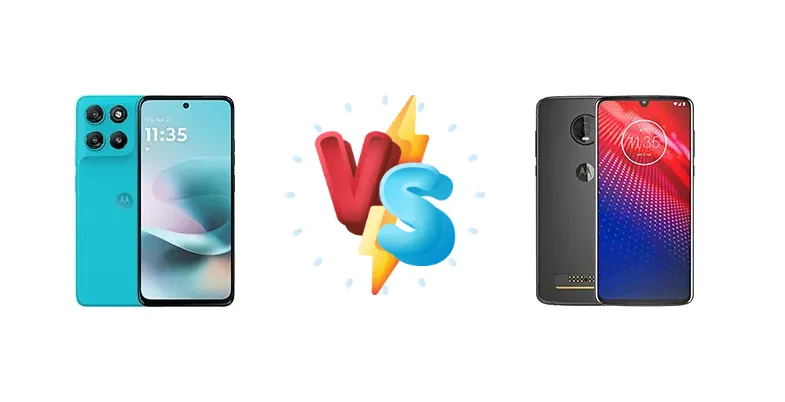
Motorola has a long history of producing reliable smartphones, but choosing between models can be tricky. We're pitting the Motorola Moto G100 against the Moto Z4 to see which offers the best value and performance. This comparison will break down everything from display quality to battery life, helping you make an informed decision.
🏆 Quick Verdict
The Moto G100 is the clear winner, boasting a significantly faster processor, improved camera capabilities, and a larger battery. While the Moto Z4 offers a more compact design and modularity, the G100's superior specs and performance make it the better overall choice for most users.
| Network |
|---|
| 2G bands | GSM 850 / 900 / 1800 / 1900 | GSM 850 / 900 / 1800 / 1900 |
| 3G bands | HSDPA 850 / 900 / 1900 / 2100 | HSDPA 850 / 900 / 1700(AWS) / 1900 / 2100 - USA |
| 4G bands | LTE | 1, 2, 3, 4, 7, 8, 12, 13, 17, 18, 19, 20, 25, 26, 28, 30, 38, 40, 41, 66, 71 - USA |
| 5G bands | SA/NSA | - |
| Speed | HSPA, LTE, 5G | HSPA, LTE |
| Technology | GSM / HSPA / LTE / 5G | GSM / CDMA / HSPA / LTE |
| | - | CDMA 800 / 1900 |
| Launch |
|---|
| Announced | 2025, October 14 | 2019, May. Released 2019, June |
| Status | Available. Released 2025, October 20 | Discontinued |
| Body |
|---|
| Build | Glass front, plastic frame, silicone polymer (eco leather) back | Glass front (Gorilla Glass 3), glass back, aluminum frame |
| Dimensions | 166.2 x 76.5 x 8.6 mm (6.54 x 3.01 x 0.34 in) | 158 x 75 x 7.4 mm (6.22 x 2.95 x 0.29 in) |
| SIM | Nano-SIM + Nano-SIM | · Nano-SIM· Nano-SIM + Nano-SIM |
| Weight | 210 g (7.41 oz) | 165 g (5.82 oz) |
| | Water repellent design | Splash and dust resistant |
| Display |
|---|
| Protection | - | Corning Gorilla Glass 3 |
| Resolution | 1080 x 2400 pixels, 20:9 ratio (~392 ppi density) | 1080 x 2340 pixels, 19.5:9 ratio (~403 ppi density) |
| Size | 6.72 inches, 109.0 cm2 (~85.8% screen-to-body ratio) | 6.4 inches, 100.5 cm2 (~84.8% screen-to-body ratio) |
| Type | IPS LCD, 120Hz, 1050 nits (peak) | OLED |
| Platform |
|---|
| CPU | Octa-core (4x2.40 GHz Cortex-A78 & 4x1.95 GHz Cortex-A55) | Octa-core (2x2.0 GHz Kryo 460 Gold & 6x1.7 GHz Kryo 460 Silver) |
| Chipset | Qualcomm SM7435-AB Snapdragon 7s Gen 2 (4 nm) | Qualcomm SDM675 Snapdragon 675 (11 nm) |
| GPU | Adreno 710 | Adreno 612 |
| OS | Android 15 | Android 9.0 (Pie), upgradable to Android 10 |
| Memory |
|---|
| Card slot | No | microSDXC (uses shared SIM slot) |
| Internal | 256GB 8GB RAM, 256GB 12GB RAM, 512GB 12GB RAM | 128GB 4GB RAM |
| | UFS 3.1 | UFS 2.1 |
| Main Camera |
|---|
| Dual | 50 MP, f/1.9 (wide), 1/1.95", 0.8µm, PDAF
8 MP, f/2.2, 118˚ (ultrawide), 1/4.0", 1.12µm | - |
| Features | Dual-LED flash, HDR, panorama | Dual-LED dual-tone flash, panorama, HDR |
| Single | - | 48 MP, f/1.7, (wide), 1/2.0", 0.8µm, PDAF, OIS |
| Triple | 64 MP, f/1.7, (wide), 1/2.0", 0.7µm, PDAF, Laser AF
16 MP, f/2.2, 117˚ (ultrawide), 1.0µm, PDAF
2 MP, f/2.4, (depth)
TOF 3D | - |
| Video | 4K@30fps, 1080p@30fps | 4K@30fps, 1080p@30/60fps |
| Selfie camera |
|---|
| Dual | 16 MP, f/2.2, (wide), 1.0µm
8 MP, f/2.4, 118˚ (ultrawide), 1.12µm | - |
| Features | HDR | HDR |
| Single | 32 MP, f/2.2, (wide), 0.7µm | 25 MP, f/2.0, 0.9µm |
| Video | 4K@30fps, 1080p@30/60fps | 1080p@30fps |
| Sound |
|---|
| 3.5mm jack | Yes | Yes |
| 35mm jack | Yes | Yes |
| Loudspeaker | Yes, with stereo speakers | Yes |
| Comms |
|---|
| Bluetooth | 5.1, A2DP, LE | 5.0, A2DP, LE, EDR |
| NFC | Yes | Yes |
| Positioning | GPS, GALILEO, GLONASS, BDS, QZSS | GPS, GLONASS, GALILEO |
| Radio | No | FM radio |
| USB | USB Type-C 2.0, OTG | USB Type-C 3.1, OTG, magnetic connector |
| WLAN | Wi-Fi 802.11 a/b/g/n/ac, dual-band | Wi-Fi 802.11 a/b/g/n/ac, dual-band, Wi-Fi Direct |
| Features |
|---|
| Sensors | Fingerprint (side-mounted), accelerometer, gyro, proximity, compass | Fingerprint (under display, optical), accelerometer, gyro, proximity, compass |
| | Ready For support | Moto Mods snap-on accessories |
| Battery |
|---|
| Charging | 30W wired | 15W wired |
| Type | Si/C Li-Ion 7000 mAh | Li-Ion 3600 mAh, non-removable |
| Misc |
|---|
| Colors | Black, Blue, Green | Flash Grey, Frost White |
| Models | XT2533-4 | - |
| Price | About 170 EUR | About 500 EUR |
| SAR | - | 1.16 W/kg (head) 1.44 W/kg (body) |
| Tests |
|---|
| Battery life |
Endurance rating 100h
| Endurance rating 70h |
| Camera |
Photo / Video | - |
| Display |
Contrast ratio: 1427:1 (nominal) | - |
| Loudspeaker |
-29.4 LUFS (Average)
|
Voice 70dB / Noise 73dB / Ring 80dB |
| Performance |
AnTuTu: 556137 (v8)
GeekBench: 2860 (v5.1)
GFXBench: 47fps (ES 3.1 onscreen) |
AnTuTu: 173234 (v7)
GeekBench: 6515 (v4.4)
GFXBench: 8fps (ES 3.1 onscreen) |
Motorola Moto G100
- Significantly faster processor
- Superior camera system
- Longer battery life
- Larger, more immersive display
- Modern chipset (Snapdragon 7s Gen 2)
- Potentially larger and heavier design
- May lack Moto Mods compatibility
Motorola Moto Z4
- Compact and lightweight design
- Moto Mods compatibility (if desired)
- More affordable price point
- Slower processor
- Less impressive camera
- Shorter battery life
- Outdated chipset (Snapdragon 675)
Display Comparison
The Moto G100 features a larger 6.7-inch display with a 1427:1 contrast ratio, offering vibrant colors and deep blacks. The Moto Z4 has a 6.2-inch display. While both are OLED, the G100's larger size and potentially higher resolution (likely FHD+) provide a more immersive viewing experience. The Z4's display is adequate but doesn't match the G100's visual impact.
Camera Comparison
The Moto G100's camera system is a substantial upgrade. While specific megapixel counts are not provided, the 'Photo / Video' designation suggests a versatile setup capable of capturing high-quality images and videos. The Moto Z4's camera is decent but lacks the advanced features and image processing capabilities of the G100. The G100 likely offers better low-light performance and more detailed photos.
Performance
Here's where the G100 truly shines. Its Snapdragon 7s Gen 2 chipset is significantly faster than the Moto Z4's Snapdragon 675. The G100's octa-core CPU handles demanding tasks and games with ease, while the Z4 can feel sluggish at times, especially with multitasking. The G100's 4nm process also contributes to better power efficiency.
Battery Life
The Moto G100's endurance rating of 100h significantly surpasses the Moto Z4's 70h. This translates to noticeably longer battery life on the G100, easily lasting a full day or more with moderate usage. The Z4 requires more frequent charging, especially with heavier use.
Buying Guide
The Motorola Moto G100 is ideal for users who prioritize performance, camera quality, and battery life. It's a great choice for gamers, content creators, and anyone who wants a flagship-like experience without the flagship price tag. The Moto Z4 is best suited for users who value a compact design, modular accessories (Moto Mods), and a more budget-friendly option, understanding it sacrifices performance.
Frequently Asked Questions
❓ Does the Moto G100 support Moto Mods?
No, the Moto G100 does not support Moto Mods. It's a standalone device.
❓ Is the Moto Z4 still worth buying in 2024?
The Moto Z4 is a budget option, but its outdated processor and shorter battery life make it less appealing compared to newer smartphones. It's only recommended if you specifically need Moto Mods compatibility and are on a very tight budget.