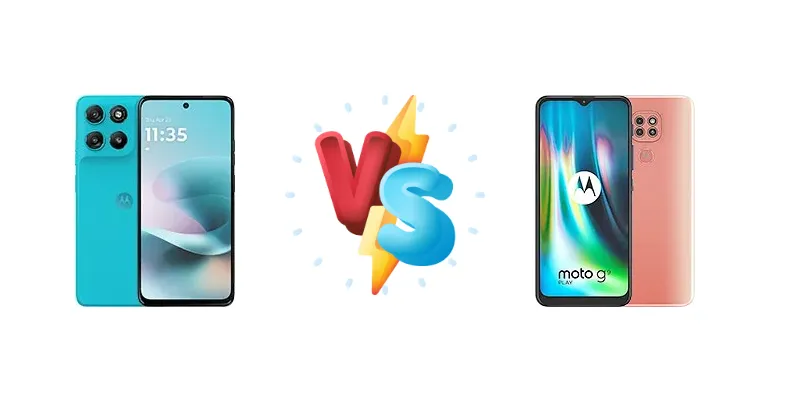
Choosing a new smartphone can be overwhelming, especially with so many options available. Today, we're pitting two popular Motorola devices against each other: the feature-packed Moto G100 and the budget-friendly Moto G9 Play. Let's dive into a detailed comparison to help you decide which one is right for you.
🏆 Quick Verdict
The Moto G100 is the clear winner for performance and display quality, thanks to its Snapdragon 7s Gen 2 chipset and impressive contrast ratio. However, the Moto G9 Play offers excellent value for budget-conscious buyers, providing a solid experience at a lower price point.
| Network |
|---|
| 2G bands | GSM 850 / 900 / 1800 / 1900 | GSM 850 / 900 / 1800 / 1900 |
| 3G bands | HSDPA 850 / 900 / 1900 / 2100 | HSDPA 850 / 900 / 1900 / 2100 |
| 4G bands | LTE | 1, 2, 3, 5, 7, 8, 18, 19, 20, 26, 28, 38, 40, 41 |
| 5G bands | SA/NSA | - |
| EDGE | - | Class 10 |
| GPRS | - | Class 10 |
| Speed | HSPA, LTE, 5G | HSPA 42.2/5.76 Mbps, LTE Cat4 150/50 Mbps |
| Technology | GSM / HSPA / LTE / 5G | GSM / HSPA / LTE |
| Launch |
|---|
| Announced | 2025, October 14 | 2020, August 24. Released 2020, August 28 |
| Status | Available. Released 2025, October 20 | Discontinued |
| Body |
|---|
| Build | Glass front, plastic frame, silicone polymer (eco leather) back | Glass front, plastic back, plastic frame |
| Dimensions | 166.2 x 76.5 x 8.6 mm (6.54 x 3.01 x 0.34 in) | 165.2 x 75.7 x 9.2 mm (6.50 x 2.98 x 0.36 in) |
| Keyboard | - | QWERTY |
| SIM | Nano-SIM + Nano-SIM | · Nano-SIM· Nano-SIM + Nano-SIM |
| Weight | 210 g (7.41 oz) | 200 g (7.05 oz) |
| | Water repellent design | Water-repellent coating |
| Display |
|---|
| Resolution | 1080 x 2400 pixels, 20:9 ratio (~392 ppi density) | 720 x 1600 pixels, 20:9 ratio (~269 ppi density) |
| Size | 6.72 inches, 109.0 cm2 (~85.8% screen-to-body ratio) | 6.5 inches, 102.8 cm2 (~82.2% screen-to-body ratio) |
| Type | IPS LCD, 120Hz, 1050 nits (peak) | IPS LCD |
| Platform |
|---|
| CPU | Octa-core (4x2.40 GHz Cortex-A78 & 4x1.95 GHz Cortex-A55) | Octa-core (4x2.0 GHz Kryo 260 Gold & 4x1.8 GHz Kryo 260 Silver) |
| Chipset | Qualcomm SM7435-AB Snapdragon 7s Gen 2 (4 nm) | Qualcomm SM6115 Snapdragon 662 (11 nm) |
| GPU | Adreno 710 | Adreno 610 |
| OS | Android 15 | Android 10, upgradable to Android 11 |
| Memory |
|---|
| Card slot | No | microSDXC (uses shared SIM slot) |
| Internal | 256GB 8GB RAM, 256GB 12GB RAM, 512GB 12GB RAM | 64GB 4GB RAM, 128GB 4GB RAM |
| | UFS 3.1 | - |
| Main Camera |
|---|
| Dual | 50 MP, f/1.9 (wide), 1/1.95", 0.8µm, PDAF
8 MP, f/2.2, 118˚ (ultrawide), 1/4.0", 1.12µm | - |
| Features | Dual-LED flash, HDR, panorama | LED flash, HDR, panorama |
| Single | - | 1.3 MP |
| Triple | 64 MP, f/1.7, (wide), 1/2.0", 0.7µm, PDAF, Laser AF
16 MP, f/2.2, 117˚ (ultrawide), 1.0µm, PDAF
2 MP, f/2.4, (depth)
TOF 3D | 48 MP, f/1.7, (wide), 1/2.0", 0.8µm, PDAF
2 MP (macro)
Auxiliary lens |
| Video | 4K@30fps, 1080p@30fps | 1080p@30/60fps |
| Selfie camera |
|---|
| Dual | 16 MP, f/2.2, (wide), 1.0µm
8 MP, f/2.4, 118˚ (ultrawide), 1.12µm | - |
| Features | HDR | HDR |
| Single | 32 MP, f/2.2, (wide), 0.7µm | 8 MP, f/2.2, 1.12µm |
| Video | 4K@30fps, 1080p@30/60fps | 1080p@30fps |
| Sound |
|---|
| 3.5mm jack | Yes | Yes |
| 35mm jack | Yes | Yes |
| Loudspeaker | Yes, with stereo speakers | Yes |
| Comms |
|---|
| Bluetooth | 5.1, A2DP, LE | 5.0, A2DP, LE |
| Infrared port | - | Yes |
| NFC | Yes | Yes |
| Positioning | GPS, GALILEO, GLONASS, BDS, QZSS | GPS, GLONASS, GALILEO |
| Radio | No | FM radio |
| USB | USB Type-C 2.0, OTG | USB Type-C 2.0 |
| WLAN | Wi-Fi 802.11 a/b/g/n/ac, dual-band | Wi-Fi 802.11 a/b/g/n/ac, dual-band, Wi-Fi Direct |
| Features |
|---|
| Browser | - | WAP 2.0/xHTML, HTML (PocketIE) |
| Sensors | Fingerprint (side-mounted), accelerometer, gyro, proximity, compass | Fingerprint (rear-mounted), accelerometer, gyro, proximity |
| | Ready For support | - |
| Battery |
|---|
| Charging | 30W wired | 20W wired |
| Type | Si/C Li-Ion 7000 mAh | Li-Po 5000 mAh |
| Misc |
|---|
| Colors | Black, Blue, Green | Forest Green, Sapphire Blue, Spring Pink |
| Models | XT2533-4 | XT2083, XT2083-1 |
| Price | About 170 EUR | About 430 EUR |
| Tests |
|---|
| Battery life |
Endurance rating 100h
| - |
| Camera |
Photo / Video |
Photo / Video |
| Display |
Contrast ratio: 1427:1 (nominal) |
Contrast ratio: 1944:1 |
| Loudspeaker |
-29.4 LUFS (Average)
|
-27.6 LUFS (Good)
|
| Performance |
AnTuTu: 556137 (v8)
GeekBench: 2860 (v5.1)
GFXBench: 47fps (ES 3.1 onscreen) |
AnTuTu: 170064 (v8)
GeekBench: 1402 (v5.1)
GFXBench: 13fps (ES 3.1 onscreen) |
Motorola Moto G100
- Superior Performance
- Vibrant Display
- Potentially Better Camera
- Long Battery Life
- Higher Price
- Potentially Bulky Design
Motorola Moto G9 Play
- Excellent Value
- Bright Display
- Good Battery Life
- Compact Design
- Slower Performance
- Less Advanced Camera
- Older Chipset
Display Comparison
The Moto G100 boasts a nominal contrast ratio of 1427:1, while the G9 Play shines with a measured contrast ratio of 1944:1 and a brighter 465 nits max brightness. The G9 Play's display is noticeably brighter and offers slightly better contrast, making it more enjoyable to use outdoors. The G100's display is still good, but the G9 Play has a slight edge here.
Camera Comparison
Both phones offer 'Photo / Video' capabilities, but the G100 likely has a more advanced camera system given its higher-end chipset. While specific camera specs are missing, the G100's processor should enable better image processing and potentially higher resolution video recording. The G9 Play's camera is decent for casual photography.
Performance
Here's where the G100 truly pulls ahead. Its Snapdragon 7s Gen 2 chipset is significantly faster and more efficient than the G9 Play's Snapdragon 662. Expect smoother multitasking, faster app loading times, and a better gaming experience on the G100. The G9 Play is adequate for basic tasks, but struggles with more demanding applications.
Battery Life
The Moto G100 claims an endurance rating of 100h, suggesting exceptional battery life. The G9 Play, while not explicitly stated, typically offers good battery life thanks to its efficient processor and larger battery capacity (likely around 5000mAh). Both phones should easily last a full day on a single charge.
Buying Guide
The Motorola Moto G100 is ideal for users who prioritize performance, a vibrant display, and a more premium experience. It's great for gaming, multitasking, and content creation. The Moto G9 Play is perfect for those on a tight budget who need a reliable smartphone for everyday tasks like calls, texts, and social media.
Frequently Asked Questions
❓ Is the Moto G100 worth the extra money?
If you prioritize performance and a better display, the Moto G100 is worth the investment. However, if you're on a budget, the G9 Play offers excellent value.
❓ Which phone has better battery life?
Based on the endurance rating, the Moto G100 appears to have slightly better battery life, although both phones should provide all-day usage.