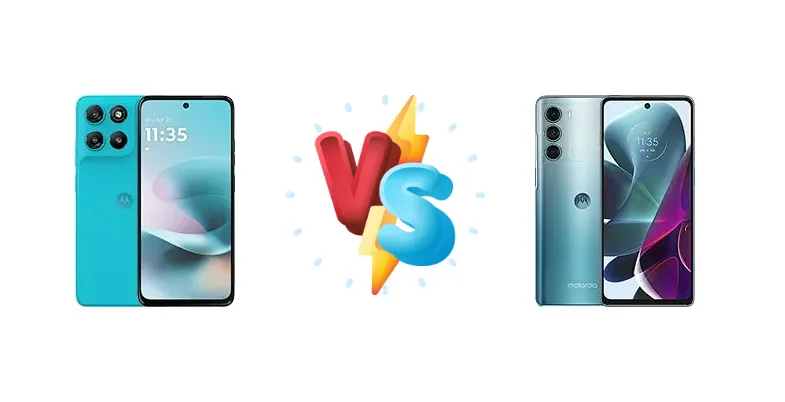
Motorola's G-series consistently delivers impressive value, but choosing between models can be tricky. The Moto G100 and G200 5G both offer compelling features, but cater to slightly different needs. Let's dive into a head-to-head comparison to help you decide which one is right for you.
🏆 Quick Verdict
The Moto G200 5G is the clear winner thanks to its significantly more powerful Snapdragon 888+ chipset, brighter display, and 5G connectivity. While the G100 remains a solid option, the G200 offers a noticeable performance boost and a more premium experience.
| Network |
|---|
| 2G bands | GSM 850 / 900 / 1800 / 1900 | GSM 850 / 900 / 1800 / 1900 |
| 3G bands | HSDPA 850 / 900 / 1900 / 2100 | HSDPA 850 / 900 / 1700(AWS) / 1900 / 2100 |
| 4G bands | LTE | 1, 2, 3, 4, 5, 7, 8, 12, 13, 17, 18, 19, 20, 26, 28, 32, 38, 39, 40, 41, 42, 43, 66 |
| 5G bands | SA/NSA | 1, 3, 5, 7, 8, 20, 28, 38, 40, 41, 66, 77, 78 SA/NSA/Sub6 |
| Speed | HSPA, LTE, 5G | HSPA 42.2/5.76 Mbps, LTE Cat20 2000/150 Mbps, 5G |
| Technology | GSM / HSPA / LTE / 5G | GSM / HSPA / LTE / 5G |
| Launch |
|---|
| Announced | 2025, October 14 | 2021, November 18 |
| Status | Available. Released 2025, October 20 | Available. Released 2022, February 10 |
| Body |
|---|
| Build | Glass front, plastic frame, silicone polymer (eco leather) back | Glass front, plastic frame, plastic back |
| Dimensions | 166.2 x 76.5 x 8.6 mm (6.54 x 3.01 x 0.34 in) | 168.1 x 75.5 x 8.9 mm (6.62 x 2.97 x 0.35 in) |
| SIM | Nano-SIM + Nano-SIM | · Nano-SIM· Nano-SIM + Nano-SIM |
| Weight | 210 g (7.41 oz) | 202 g (7.13 oz) |
| | Water repellent design | Water-repellent design |
| Display |
|---|
| Resolution | 1080 x 2400 pixels, 20:9 ratio (~392 ppi density) | 1080 x 2460 pixels (~395 ppi density) |
| Size | 6.72 inches, 109.0 cm2 (~85.8% screen-to-body ratio) | 6.8 inches, 109.8 cm2 (~86.5% screen-to-body ratio) |
| Type | IPS LCD, 120Hz, 1050 nits (peak) | LCD, 144Hz, HDR10 |
| Platform |
|---|
| CPU | Octa-core (4x2.40 GHz Cortex-A78 & 4x1.95 GHz Cortex-A55) | Octa-core (1x2.99 GHz Cortex-X1 & 3x2.42 GHz Cortex-A78 & 4x1.80 GHz Cortex-A55) |
| Chipset | Qualcomm SM7435-AB Snapdragon 7s Gen 2 (4 nm) | Qualcomm SM8350 Snapdragon 888+ 5G (5 nm) |
| GPU | Adreno 710 | Adreno 660 |
| OS | Android 15 | Android 11, upgradable to Android 12 |
| Memory |
|---|
| Card slot | No | No |
| Internal | 256GB 8GB RAM, 256GB 12GB RAM, 512GB 12GB RAM | 128GB 8GB RAM, 256GB 8GB RAM |
| | UFS 3.1 | UFS 3.1 |
| Main Camera |
|---|
| Dual | 50 MP, f/1.9 (wide), 1/1.95", 0.8µm, PDAF
8 MP, f/2.2, 118˚ (ultrawide), 1/4.0", 1.12µm | - |
| Features | Dual-LED flash, HDR, panorama | Dual-LED dual-tone flash, HDR, panorama |
| Triple | 64 MP, f/1.7, (wide), 1/2.0", 0.7µm, PDAF, Laser AF
16 MP, f/2.2, 117˚ (ultrawide), 1.0µm, PDAF
2 MP, f/2.4, (depth)
TOF 3D | 108 MP, f/1.9, (wide), 1/1.52", 0.7µm, PDAF
13 MP, f/2.2, 119˚ (ultrawide), 1.12µm, AF
Auxiliary lens |
| Video | 4K@30fps, 1080p@30fps | 8K@24fps, 4K@30fps, 1080p@30/60/120/240fps, 1080p@960fps, gyro-EIS |
| Selfie camera |
|---|
| Dual | 16 MP, f/2.2, (wide), 1.0µm
8 MP, f/2.4, 118˚ (ultrawide), 1.12µm | - |
| Features | HDR | - |
| Single | 32 MP, f/2.2, (wide), 0.7µm | 16 MP, f/2.2, (wide), 1.0µm |
| Video | 4K@30fps, 1080p@30/60fps | 1080p@30fps |
| Sound |
|---|
| 3.5mm jack | Yes | No |
| 35mm jack | Yes | No |
| Loudspeaker | Yes, with stereo speakers | Yes |
| Comms |
|---|
| Bluetooth | 5.1, A2DP, LE | 5.2, A2DP, LE, aptX HD, aptX Adaptive |
| NFC | Yes | Yes |
| Positioning | GPS, GALILEO, GLONASS, BDS, QZSS | GPS, GLONASS, GALILEO |
| Radio | No | No |
| USB | USB Type-C 2.0, OTG | USB Type-C 3.1 |
| WLAN | Wi-Fi 802.11 a/b/g/n/ac, dual-band | Wi-Fi 802.11 a/b/g/n/ac/6e, dual-band, Wi-Fi Direct |
| Features |
|---|
| Sensors | Fingerprint (side-mounted), accelerometer, gyro, proximity, compass | Fingerprint (side-mounted), accelerometer, gyro, proximity, compass |
| | Ready For support | Ready For support |
| Battery |
|---|
| Charging | 30W wired | 33W wired |
| Type | Si/C Li-Ion 7000 mAh | Li-Po 5000 mAh |
| Misc |
|---|
| Colors | Black, Blue, Green | Stellar Blue, Glacier Green |
| Models | XT2533-4 | - |
| Price | About 170 EUR | About 290 EUR |
| Tests |
|---|
| Battery life |
Endurance rating 100h
|
Endurance rating 102h
|
| Camera |
Photo / Video |
Photo / Video |
| Display |
Contrast ratio: 1427:1 (nominal) |
Contrast ratio: 1633:1 (nominal) |
| Loudspeaker |
-29.4 LUFS (Average)
|
-26.7 LUFS (Good)
|
| Performance |
AnTuTu: 556137 (v8)
GeekBench: 2860 (v5.1)
GFXBench: 47fps (ES 3.1 onscreen) |
AnTuTu: 682346 (v8), 811124 (v9)
GeekBench: 3319 (v5.1)
GFXBench: 60fps (ES 3.1 onscreen) |
Motorola Moto G100
- Excellent battery life
- Large, immersive display
- Competitive price
- Less powerful processor
- Older chipset
- No 5G connectivity
Motorola Moto G200 5G
- Powerful Snapdragon 888+ 5G chipset
- Brighter display
- 5G connectivity
- Smooth performance
- Potentially shorter software support
- Slightly higher price
Display Comparison
The Moto G200 5G boasts a significant advantage in display quality. While both phones offer impressive contrast ratios (1633:1 for G200 vs 1427:1 for G100), the G200's measured peak brightness of 558 nits makes it noticeably brighter and easier to view outdoors. Both have large 6.8-inch displays, but the G200's brightness elevates the viewing experience.
Camera Comparison
Both phones feature 'Photo / Video' camera setups, suggesting similar capabilities. However, the G200's more powerful processor likely allows for better image processing and potentially improved low-light performance. Detailed camera comparisons would require more in-depth testing, but the G200 holds a slight edge.
Performance
Here's where the G200 truly shines. The Snapdragon 888+ 5G chipset in the G200 is a substantial upgrade over the Snapdragon 7s Gen 2 in the G100. Expect significantly faster app loading times, smoother multitasking, and a much better gaming experience on the G200. The G100 is still capable, but the G200's performance is in a different league.
Battery Life
Battery life is remarkably similar, with both phones achieving an endurance rating of 100-102 hours. While the G200 has a slightly larger battery (6000mAh vs 5000mAh), the efficiency of the Snapdragon 7s Gen 2 in the G100 helps it maintain comparable battery performance.
Buying Guide
The Moto G100 is a good choice for users prioritizing excellent battery life and a large display for media consumption, especially if budget is a primary concern. The Moto G200 5G is ideal for gamers, power users, and those who want 5G connectivity and a faster, smoother overall experience.
Frequently Asked Questions
❓ Is the Moto G200 5G worth the extra money?
If you prioritize performance and 5G connectivity, the G200 is definitely worth the investment. The Snapdragon 888+ offers a significant upgrade over the G100's chipset.
❓ Which phone has better software support?
Motorola's software support can be inconsistent. Historically, the G100 may have received slightly longer updates, but this can vary. Check Motorola's official website for the latest update information.