
Motorola Moto G100 vs Sony Xperia 10 III Lite: A Performance and Efficiency Showdown
| Phones Images | |||||
|---|---|---|---|---|---|
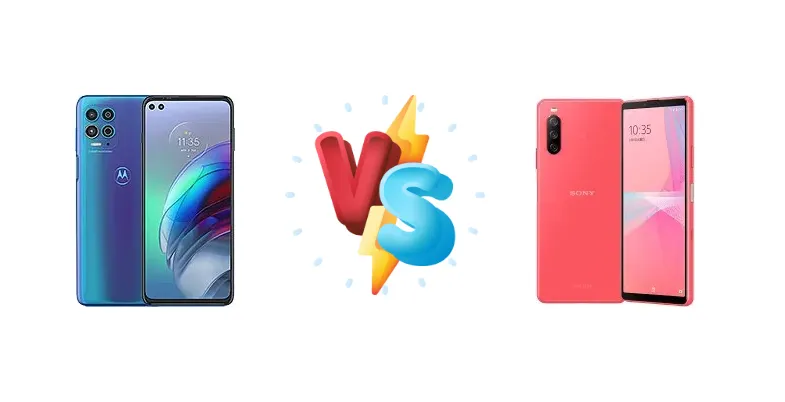
|
🏆 Quick Verdict
For users prioritizing raw performance and demanding tasks like gaming or video editing, the Motorola Moto G100 is the clear winner. However, the Sony Xperia 10 III Lite offers a more refined, efficient experience with faster charging and a potentially more manageable thermal profile, making it ideal for everyday users.
| PHONES | ||
|---|---|---|
| Phone Names | Motorola Moto G100 (2021) | Sony Xperia 10 III Lite |
| Network | ||
|---|---|---|
| 2G bands | GSM 850 / 900 / 1800 / 1900 | GSM 850 / 900 / 1800 / 1900 |
| 3G bands | HSDPA 850 / 900 / 1700(AWS) / 1900 / 2100 | HSDPA 850 / 1900 |
| 4G bands | 1, 2, 3, 4, 5, 7, 8, 12, 13, 17, 20, 26, 28, 32, 34, 38, 39, 40, 41, 42, 43, 66 | 1, 3, 4, 12, 18, 19, 38, 41 |
| 5G bands | 1, 3, 5, 7, 8, 28, 38, 41, 66, 77, 78 SA/NSA/Sub6 | 77, 78 SA/NSA |
| Speed | HSPA 42.2/5.76 Mbps, LTE Cat20 2000/200 Mbps, 5G | HSPA, LTE, 5G |
| Technology | GSM / HSPA / LTE / 5G | GSM / HSPA / LTE / 5G |
| Launch | ||
|---|---|---|
| Announced | 2021, March 25 | 2021, August 20 |
| Status | Available. Released 2021, April 15 | Available. Released 2021, August 27 |
| Body | ||
|---|---|---|
| Build | - | Glass front (Gorilla Glass 6), glass back (Gorilla Glass 6), plastic frame |
| Dimensions | 168.4 x 74 x 9.7 mm (6.63 x 2.91 x 0.38 in) | 154 x 68 x 8.3 mm (6.06 x 2.68 x 0.33 in) |
| SIM | Nano-SIM + Nano-SIM | Nano-SIM + eSIM |
| Weight | 207 g (7.30 oz) | 169 g (5.96 oz) |
| Display | ||
|---|---|---|
| Protection | - | Corning Gorilla Glass 6 |
| Resolution | 1080 x 2520 pixels, 21:9 ratio (~409 ppi density) | 1080 x 2520 pixels, 21:9 ratio (~457 ppi density) |
| Size | 6.7 inches, 104.9 cm2 (~84.1% screen-to-body ratio) | 6.0 inches, 84.1 cm2 (~80.3% screen-to-body ratio) |
| Type | IPS LCD, 90Hz, HDR10, 560 nits (HBM) | OLED, 1B colors, HDR |
| Platform | ||
|---|---|---|
| CPU | Octa-core (1x3.2 GHz Kryo 585 & 3x2.42 GHz Kryo 585 & 4x1.80 GHz Kryo 585) | Octa-core (2x2.0 GHz Kryo 560 Gold & 6x1.7 GHz Kryo 560 Silver) |
| Chipset | Qualcomm SM8250-AC Snapdragon 870 5G (7 nm) | Qualcomm SM6350 Snapdragon 690 5G (8 nm) |
| GPU | Adreno 650 | Adreno 619 |
| OS | Android 11, upgradable to Android 12 | Android 11 |
| Memory | ||
|---|---|---|
| Card slot | microSDXC (uses shared SIM slot) | microSDXC (uses shared SIM slot) |
| Internal | 128GB 8GB RAM, 256GB 12GB RAM | 64GB 6GB RAM |
| Main Camera | ||
|---|---|---|
| Features | Laser AF, Dual-LED flash, ring flash (macro mode), panorama, HDR | LED flash, HDR, panorama |
| Triple | 64 MP, f/1.7, (wide), 1/2.0", 0.7µm, PDAF 16 MP, f/2.2, 117˚ (ultrawide), 1.0µm, PDAF TOF 3D Auxiliary lens | 12 MP, f/1.8, 27mm (wide), 1/2.8", PDAF 8 MP, f/2.4, 54mm (telephoto), 1/4.0", PDAF, 2x optical zoom 8 MP, f/2.2, 16mm, 120˚ (ultrawide), 1/4.0" |
| Video | 6K@30fps, 4K@30/60fps, 1080p@30/60/120fps, gyro-EIS | 4K@30fps, 1080p@30fps |
| Selfie camera | ||
|---|---|---|
| Dual | 16 MP, f/2.2, (wide), 1.0µm 8 MP, f/2.4, 118˚ (ultrawide), 1.12µm | - |
| Features | HDR | HDR |
| Single | - | 8 MP, f/2.0, 24mm (wide), 1/4.0" |
| Video | 1080p@30fps | 1080p@30fps |
| Sound | ||
|---|---|---|
| 3.5mm jack | - | Yes |
| 35mm jack | Yes | Yes |
| Loudspeaker | Yes | Yes |
| Comms | ||
|---|---|---|
| Bluetooth | 5.1, A2DP, LE | 5.1, A2DP, LE, aptX HD |
| NFC | Yes | Yes |
| Positioning | GPS (L1+L5), GLONASS, GALILEO | GPS, GLONASS, GALILEO, BDS, QZSS |
| Radio | No | No |
| USB | USB Type-C 3.1, OTG | USB Type-C 3.1, OTG, video output |
| WLAN | Wi-Fi 802.11 a/b/g/n/ac/6, dual-band, Wi-Fi Direct | Wi-Fi 802.11 a/b/g/n/ac, dual-band, Wi-Fi Direct |
| Features | ||
|---|---|---|
| Sensors | Fingerprint (side-mounted), accelerometer, gyro, proximity, compass | Fingerprint (side-mounted), accelerometer, proximity, compass |
| Battery | ||
|---|---|---|
| Charging | 20W wired | 30W wired, PD, QC |
| Type | Li-Po 5000 mAh | Li-Po 4500 mAh |
| Misc | ||
|---|---|---|
| Colors | Iridescent Sky, Iridescent Ocean, Slate Grey | Black, White, Blue, Pink |
| Models | XT2125, XT2125-4 | XQ-BT44 |
| Price | About 210 EUR | About 370 EUR |
Motorola Moto G100 (2021)
- Significantly more powerful Snapdragon 870 processor
- Higher peak display brightness for outdoor visibility
- Potentially better video recording capabilities
- Slower 20W charging
- Potential for thermal throttling under heavy load
- Limited camera details provided
Sony Xperia 10 III Lite
- Faster 30W charging with PD and QC support
- More efficient Snapdragon 690 processor
- Likely better thermal management
- Less powerful processor for demanding tasks
- Display specifications are unknown
- Potentially less capable camera system
Display Comparison
The Moto G100 boasts a display capable of reaching 613 nits of peak brightness, providing good visibility outdoors. Its 1427:1 contrast ratio suggests a decent, though not exceptional, viewing experience. The Xperia 10 III Lite’s display specifications are not provided, but Sony typically focuses on color accuracy in this series. The G100’s brightness advantage will be noticeable in direct sunlight, while the Xperia 10 III Lite likely prioritizes color fidelity for media consumption. Without knowing the panel technology of the Xperia 10 III Lite, it's difficult to assess potential differences in refresh rate or power efficiency.
Camera Comparison
Both devices feature camera systems, but detailed sensor information is limited. The context data doesn't provide specifics beyond 'Photo / Video' for the G100. Sony’s Xperia line generally emphasizes image processing and color science. Given the G100’s higher processing power, it *could* handle more complex computational photography tasks, but without knowing sensor sizes or lens apertures, a definitive comparison is impossible. It's likely the G100 offers more flexibility in video recording capabilities due to the Snapdragon 870’s image signal processor (ISP).
Performance
The core difference lies in the chipsets. The Motorola Moto G100’s Snapdragon 870 5G (7nm) is a significant step up from the Sony Xperia 10 III Lite’s Snapdragon 690 5G (8nm). The 870 features an octa-core CPU with a prime core clocked at 3.2 GHz, compared to the 690’s 2.0 GHz cores. This translates to substantially faster application loading, smoother multitasking, and superior gaming performance on the G100. The 7nm process node of the 870, while older, allows for high performance, but may be more prone to thermal throttling under sustained load than the 8nm 690. The G100 is geared towards power users, while the 10 III Lite is designed for efficient everyday tasks.
Battery Life
The Moto G100 is rated for 100 hours of endurance, a strong figure, but this is a broad metric. The Xperia 10 III Lite compensates for potentially lower capacity with 30W wired charging, supporting Power Delivery (PD) and Quick Charge (QC) standards, while the G100 is limited to 20W. This means the Xperia 10 III Lite will likely achieve a 0-100% charge significantly faster, offering more convenience for users who frequently need to top up their battery. The G100’s endurance rating suggests a larger battery capacity, but the 690’s efficiency could close the gap in real-world usage.
Buying Guide
Buy the Motorola Moto G100 (2021) if you need a phone capable of handling intensive applications, demanding mobile games, and benefit from the Snapdragon 870's processing power. Buy the Sony Xperia 10 III Lite if you prefer a phone with a focus on battery efficiency, faster charging speeds, and a more streamlined user experience without sacrificing 5G connectivity.