
Motorola Moto G100 vs Samsung Galaxy S21 FE 5G: Which Flagship Fighter Reigns Supreme?
| Phones Images | |||||
|---|---|---|---|---|---|
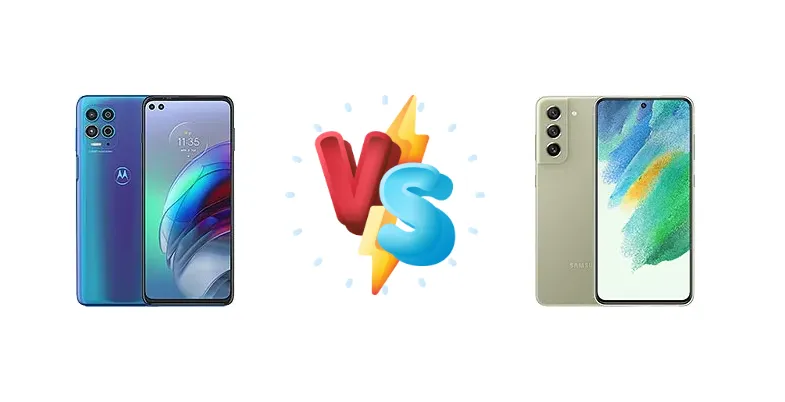
|
🏆 Quick Verdict
For the average user prioritizing a polished experience, refined camera performance, and wireless charging, the Samsung Galaxy S21 FE 5G is the better choice. However, the Motorola Moto G100 offers a significant performance advantage with its Snapdragon 870, making it ideal for power users and gamers who prioritize raw speed over all else.
| PHONES | ||
|---|---|---|
| Phone Names | Motorola Moto G100 (2021) | Samsung Galaxy S21 FE 5G |
| Network | ||
|---|---|---|
| 2G bands | GSM 850 / 900 / 1800 / 1900 | GSM 850 / 900 / 1800 / 1900 |
| 3G bands | HSDPA 850 / 900 / 1700(AWS) / 1900 / 2100 | HSDPA 850 / 900 / 1700(AWS) / 1900 / 2100 |
| 4G bands | 1, 2, 3, 4, 5, 7, 8, 12, 13, 17, 20, 26, 28, 32, 34, 38, 39, 40, 41, 42, 43, 66 | 1, 2, 3, 4, 5, 7, 8, 12, 17, 20, 26, 28, 32, 38, 40, 41, 66 - International |
| 5G bands | 1, 3, 5, 7, 8, 28, 38, 41, 66, 77, 78 SA/NSA/Sub6 | 1, 3, 5, 8, 20, 28, 38, 40, 41, 66, 78 SA/NSA/Sub6 - International |
| Speed | HSPA 42.2/5.76 Mbps, LTE Cat20 2000/200 Mbps, 5G | HSPA 42.2/5.76 Mbps, LTE (5CA) Cat19 1600/200 Mbps, 5G |
| Technology | GSM / HSPA / LTE / 5G | GSM / CDMA / HSPA / EVDO / LTE / 5G |
| - | 41, 66, 71, 260, 261 SA/NSA/Sub6/mmWave - USA | |
| Launch | ||
|---|---|---|
| Announced | 2021, March 25 | 2022, January 04 |
| Status | Available. Released 2021, April 15 | Available. Released 2022, January 07 |
| Body | ||
|---|---|---|
| Build | - | Glass front (Gorilla Glass Victus), plastic back, aluminum frame |
| Dimensions | 168.4 x 74 x 9.7 mm (6.63 x 2.91 x 0.38 in) | 155.7 x 74.5 x 7.9 mm (6.13 x 2.93 x 0.31 in) |
| SIM | Nano-SIM + Nano-SIM | · Nano-SIM· Nano-SIM + Nano-SIM |
| Weight | 207 g (7.30 oz) | 177 g (6.24 oz) |
| - | IP68 dust/water resistant (up to 1.5m for 30 min) | |
| Display | ||
|---|---|---|
| Protection | - | Corning Gorilla Glass Victus |
| Resolution | 1080 x 2520 pixels, 21:9 ratio (~409 ppi density) | 1080 x 2340 pixels, 19.5:9 ratio (~403 ppi density) |
| Size | 6.7 inches, 104.9 cm2 (~84.1% screen-to-body ratio) | 6.4 inches, 100.5 cm2 (~86.7% screen-to-body ratio) |
| Type | IPS LCD, 90Hz, HDR10, 560 nits (HBM) | Dynamic AMOLED 2X, 120Hz, HDR10+ |
| - | Always-on display | |
| Platform | ||
|---|---|---|
| CPU | Octa-core (1x3.2 GHz Kryo 585 & 3x2.42 GHz Kryo 585 & 4x1.80 GHz Kryo 585) | Octa-core (1x2.84 GHz Cortex-X1 & 3x2.42 GHz Cortex-A78 & 4x1.80 GHz Cortex-A55) - Version 1Octa-core (1x2.9 GHz Cortex-X1 & 3x2.80 GHz Cortex-A78 & 4x2.2 GHz Cortex-A55) - Version 2 |
| Chipset | Qualcomm SM8250-AC Snapdragon 870 5G (7 nm) | Qualcomm SM8350 Snapdragon 888 5G (5 nm) - Version 1Exynos 2100 (5 nm) - Version 2 |
| GPU | Adreno 650 | Adreno 660 - Version 1Mali-G78 MP14 - Version 2 |
| OS | Android 11, upgradable to Android 12 | Android 12, up to 4 major Android upgrades, One UI 8 |
| Memory | ||
|---|---|---|
| Card slot | microSDXC (uses shared SIM slot) | No |
| Internal | 128GB 8GB RAM, 256GB 12GB RAM | 128GB 6GB RAM, 128GB 8GB RAM, 256GB 6GB RAM, 256GB 8GB RAM |
| Main Camera | ||
|---|---|---|
| Features | Laser AF, Dual-LED flash, ring flash (macro mode), panorama, HDR | LED flash, auto-HDR, panorama |
| Single | - | 32 MP, f/2.2, 26mm (wide), 1/2.74", 0.8µm |
| Triple | 64 MP, f/1.7, (wide), 1/2.0", 0.7µm, PDAF 16 MP, f/2.2, 117˚ (ultrawide), 1.0µm, PDAF TOF 3D Auxiliary lens | 12 MP, f/1.8, 26mm (wide), 1/1.76", 1.8µm, dual pixel PDAF, OIS 8 MP, f/2.4, 76mm (telephoto), 1/4.5", 1.0µm, PDAF, OIS, 3x optical zoom 12 MP, f/2.2, 13mm, 123˚ (ultrawide), 1/3.0", 1.12µm |
| Video | 6K@30fps, 4K@30/60fps, 1080p@30/60/120fps, gyro-EIS | 4K@30/60fps, 1080p@30/60/120/240fps, HDR10+, gyro-EIS |
| Selfie camera | ||
|---|---|---|
| Dual | 16 MP, f/2.2, (wide), 1.0µm 8 MP, f/2.4, 118˚ (ultrawide), 1.12µm | - |
| Features | HDR | HDR |
| Single | - | 32 MP, f/2.2, 26mm (wide), 1/2.74", 0.8µm |
| Video | 1080p@30fps | 4K@30/60fps, 1080p@30/60fps, gyro-EIS |
| Sound | ||
|---|---|---|
| 3.5mm jack | - | No |
| 35mm jack | Yes | No |
| Loudspeaker | Yes | Yes, with stereo speakers |
| - | 32-bit/384kHz audio | |
| Comms | ||
|---|---|---|
| Bluetooth | 5.1, A2DP, LE | 5.0, A2DP, LE |
| NFC | Yes | Yes |
| Positioning | GPS (L1+L5), GLONASS, GALILEO | GPS, GLONASS, BDS, GALILEO |
| Radio | No | Unspecified |
| USB | USB Type-C 3.1, OTG | USB Type-C, OTG |
| WLAN | Wi-Fi 802.11 a/b/g/n/ac/6, dual-band, Wi-Fi Direct | Wi-Fi 802.11 a/b/g/n/ac/6, dual-band, Wi-Fi Direct |
| Features | ||
|---|---|---|
| Sensors | Fingerprint (side-mounted), accelerometer, gyro, proximity, compass | Fingerprint (under display, optical), accelerometer, gyro, proximity, compass |
| - | Bixby natural language commands and dictation Samsung Pay (Visa, MasterCard certified) Samsung DeX (desktop experience support) | |
| Battery | ||
|---|---|---|
| Charging | 20W wired | 25W wired, PD3.0, 50% in 30 min 15W wireless Reverse wireless |
| Type | Li-Po 5000 mAh | Li-Ion 4500 mAh |
| Misc | ||
|---|---|---|
| Colors | Iridescent Sky, Iridescent Ocean, Slate Grey | White, Graphite, Lavender, Olive |
| Models | XT2125, XT2125-4 | SM-G990B, SM-G990B/DS, SM-G990U, SM-G990U1, SM-G990W, SM-G990E, SM-G9900, SM-G990B2, SM-G990U2, SM-G990W2, SM-G990U3 |
| Price | About 210 EUR | € 199.00 / $ 143.95 / £ 154.99 / ₹ 29,990 |
| SAR | - | 0.77 W/kg (head) 0.90 W/kg (body) |
| SAR EU | - | 0.95 W/kg (head) 1.48 W/kg (body) |
| Tests | ||
|---|---|---|
| Battery life | - | Endurance rating 92h |
| Camera | - | Photo / Video |
| Display | - | Contrast ratio: Infinite (nominal) |
| Loudspeaker | - | -26.9 LUFS (Good) |
| Performance | - | AnTuTu: 566529 (v8), 719696 (v9) GeekBench: 3049 (v5.1) GFXBench: 56fps (ES 3.1 onscreen) |
Motorola Moto G100 (2021)
- Superior raw processing power with Snapdragon 870
- Larger display for immersive media consumption
- Expandable storage via microSD card
- Slower charging speeds (20W)
- Less refined camera image processing
- Bulkier design
Samsung Galaxy S21 FE 5G
- Faster charging with 25W wired, 15W wireless, and reverse wireless
- More polished camera system with better image quality
- More compact and ergonomic design
- Potentially lower sustained performance due to thermal throttling (especially Exynos variant)
- No expandable storage
- Higher price point (typically)
Display Comparison
The Samsung Galaxy S21 FE boasts a higher peak brightness of 792 nits compared to the Moto G100’s 613 nits, resulting in better visibility under direct sunlight. While the Moto G100’s 1427:1 contrast ratio is respectable, Samsung’s ‘Infinite’ contrast ratio (typical of AMOLED panels) delivers deeper blacks and more vibrant colors. Both displays utilize a 120Hz refresh rate, but Samsung’s Dynamic AMOLED 2X panel is likely to offer superior color accuracy and viewing angles. The S21 FE’s smaller size (6.4” vs 6.7”) may appeal to users who prefer a more manageable form factor.
Camera Comparison
Both phones offer versatile camera systems, but Samsung holds an edge in image processing and overall consistency. While both can capture photo and video, the S21 FE’s image processing algorithms are more refined, delivering more natural-looking photos with better dynamic range. The Moto G100’s camera performance is good, but it can sometimes struggle with color accuracy and detail in challenging lighting conditions. The S21 FE’s superior video stabilization and advanced features like Dual Recording provide a more polished video experience. The presence of OIS on the S21 FE’s main sensor further enhances image quality and stability.
Performance
The core difference lies in the chipsets. The Moto G100 features the Qualcomm Snapdragon 870 5G (7nm), while the S21 FE comes in two variants: one with the Snapdragon 888 5G (5nm) and another with the Exynos 2100 (5nm). The Snapdragon 888 and Exynos 2100, built on a smaller 5nm process, generally offer better power efficiency and slightly higher peak performance than the 7nm Snapdragon 870. However, the G100’s larger heat sink and less aggressive thermal throttling may allow it to sustain peak performance for longer periods during intensive tasks. The S21 FE’s CPU, with its Cortex-X1 prime core (versions 1 & 2), provides a noticeable boost in single-core performance, beneficial for everyday tasks and app responsiveness.
Battery Life
The Moto G100 boasts an endurance rating of 100 hours, slightly better than the S21 FE’s 92 hours. However, this doesn’t tell the whole story. The S21 FE’s 25W wired charging, with support for PD3.0 and a 50% charge in 30 minutes, is significantly faster than the G100’s 20W charging. Furthermore, the S21 FE adds the convenience of 15W wireless charging and reverse wireless charging, features absent on the G100. While the G100’s larger battery capacity provides longer overall runtime, the S21 FE’s faster charging and wireless capabilities offer a more convenient user experience.
Buying Guide
Buy the Motorola Moto G100 (2021) if you need uncompromising performance for demanding tasks like video editing or gaming, and prioritize a larger display and expandable storage. Buy the Samsung Galaxy S21 FE 5G if you prefer a more compact and refined design, a superior camera system with consistent image processing, and the convenience of wireless charging and a more established software ecosystem.