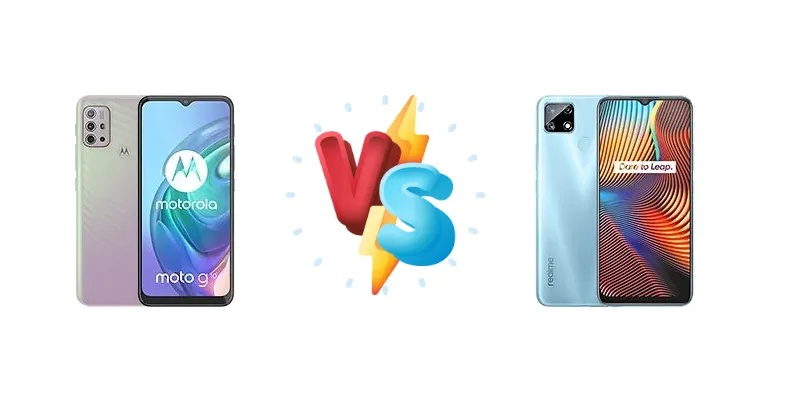
The Motorola Moto G10 and Realme 7i represent compelling options in the ultra-budget smartphone segment. Both aim to deliver essential features at a low price point, but they take different approaches to achieving this. The G10 prioritizes endurance and a high-contrast display, while the 7i focuses on faster charging and a more powerful chipset for gaming and everyday responsiveness.
🏆 Quick Verdict
For the average user prioritizing long battery life and a visually striking display, the Motorola Moto G10 is the better choice. However, if faster charging and slightly improved performance for gaming are crucial, the Realme 7i offers a worthwhile upgrade.
| Network |
|---|
| 2G bands | GSM 850 / 900 / 1800 / 1900 | GSM 850 / 900 / 1800 / 1900 |
| 3G bands | HSDPA 850 / 900 / 1900 / 2100 | HSDPA 850 / 900 / 1700(AWS) / 1900 / 2100 |
| 4G bands | 1, 2, 3, 5, 7, 8, 18, 19, 20, 26, 28, 38, 40, 41 | 1, 2, 3, 4, 5, 7, 8, 20, 28, 38, 40, 41 |
| Speed | HSPA 42.2/5.76 Mbps, LTE Cat4 150/50 Mbps | HSPA, LTE |
| Technology | GSM / HSPA / LTE | GSM / HSPA / LTE |
| Launch |
|---|
| Announced | 2021, February 16 | 2020, December 22. Released 2020, December 23 |
| Status | Available. Released 2021, February 27 | Discontinued |
| Body |
|---|
| Build | Glass front, plastic back, plastic frame | - |
| Dimensions | 165.2 x 75.7 x 9.2 mm (6.50 x 2.98 x 0.36 in) | 164.5 x 75.9 x 9.8 mm (6.48 x 2.99 x 0.39 in) |
| SIM | · Nano-SIM· Nano-SIM + Nano-SIM | Nano-SIM + Nano-SIM |
| Weight | 200 g (7.05 oz) | 208 g (7.34 oz) |
| | Water-repellent design | - |
| Display |
|---|
| Resolution | 720 x 1600 pixels, 20:9 ratio (~269 ppi density) | 720 x 1600 pixels, 20:9 ratio (~270 ppi density) |
| Size | 6.5 inches, 102.8 cm2 (~82.2% screen-to-body ratio) | 6.5 inches, 102.0 cm2 (~81.7% screen-to-body ratio) |
| Type | IPS LCD | IPS LCD, 450 nits (typ), 560 nits (peak) |
| Platform |
|---|
| CPU | Octa-core (4x1.8 GHz Kryo 240 & 4x1.6 GHz Kryo 240) | Octa-core (2x2.0 GHz Cortex-A75 & 6x1.8 GHz Cortex-A55) |
| Chipset | Qualcomm SM4250 Snapdragon 460 (11 nm) | Mediatek MT6769Z Helio G85 (12 nm) |
| GPU | Adreno 610 | Mali-G52 MC2 |
| OS | Android 11 | Android 10, Realme UI |
| Memory |
|---|
| Card slot | microSDXC (uses shared SIM slot) | microSDXC (dedicated slot) |
| Internal | 64GB 4GB RAM, 128GB 4GB RAM | 64GB 4GB RAM |
| | - | eMMC 5.1 |
| Main Camera |
|---|
| Features | LED flash, HDR, panorama | LED flash, HDR, panorama |
| Quad | 48 MP, f/1.7, 26mm (wide), 1/2.0", 0.8µm, PDAF
8 MP, f/2.2, 118˚ (ultrawide), 1/4.0", 1.12µm
2 MP (macro)
Auxiliary lens | - |
| Triple | - | 48 MP, f/1.8, 26mm (wide), 1/2.0", 0.8µm, PDAF
8 MP, f/2.3, 16mm, 119˚ (ultrawide), 1/4.0", 1.12µm
2 MP (macro) |
| Video | 1080p@30/60fps | 1080p@30/60fps |
| Selfie camera |
|---|
| Features | HDR | HDR, panorama |
| Single | 8 MP, f/2.2, (wide), 1/4.0", 1.12µm | 8 MP, f/2.0, 26mm (wide), 1/4.0", 1.12µm |
| Video | 1080p@30fps | 1080p@30fps |
| Sound |
|---|
| 3.5mm jack | Yes | Yes |
| 35mm jack | Yes | Yes |
| Loudspeaker | Yes | Yes |
| Comms |
|---|
| Bluetooth | 5.0, A2DP, LE | 5.0, A2DP, LE, aptX HD |
| NFC | Yes | No |
| Positioning | GPS, GLONASS, GALILEO | GPS, GLONASS, BDS |
| Radio | FM radio | FM radio |
| USB | USB Type-C 2.0 | USB Type-C 2.0, OTG |
| WLAN | Wi-Fi 802.11 a/b/g/n/ac, dual-band, Wi-Fi Direct | Wi-Fi 802.11 a/b/g/n/ac, dual-band, Wi-Fi Direct |
| Features |
|---|
| Sensors | Fingerprint (rear-mounted), accelerometer, gyro, proximity | Fingerprint (rear-mounted), accelerometer, proximity, compass |
| Battery |
|---|
| Charging | 10W wired | 18W wired
5W reverse wired |
| Type | Li-Po 5000 mAh | 6000 mAh |
| Misc |
|---|
| Colors | Aurora Grey, Iridescent Pearl | Glory Silver, Victory Blue |
| Models | XT2127-2 | - |
| Price | About 140 EUR | About 190 EUR |
| Tests |
|---|
| Battery life |
Endurance rating 152h
| - |
| Camera |
Photo / Video | - |
| Display |
Contrast ratio: 11878:1 (nominal) | - |
| Loudspeaker |
-29.2 LUFS (Average)
| - |
| Performance |
AnTuTu: 140230 (v8)
GeekBench: 1139 (v5.1)
GFXBench: 9.2fps (ES 3.1 onscreen) | - |
Motorola Moto G10
- Exceptional battery life (152h endurance)
- High contrast display (11878:1)
- More efficient chipset for light tasks
- Slower charging speed (10W)
- Less powerful chipset for gaming
Realme 7i (Global)
- Faster charging (18W) with reverse charging
- More powerful chipset (Helio G85) for gaming
- More responsive user experience
- Likely shorter battery life
- Potentially lower display contrast
Display Comparison
The Motorola Moto G10 boasts a notably high 11878:1 contrast ratio (nominal), suggesting deep blacks and vibrant colors, while achieving a measured peak brightness of 370 nits. This contrast ratio is significantly higher than what's typically found in this price bracket. The Realme 7i’s display specifications are less detailed, but it likely utilizes a standard IPS LCD panel. While the G10’s contrast ratio is a strong point, the Realme 7i may offer a slightly more color-accurate experience, though this is speculative without detailed testing. The G10’s higher contrast will be particularly noticeable when viewing HDR content or in dimly lit environments.
Camera Comparison
Both phones feature a 'Photo / Video' camera setup, but detailed sensor information is lacking. Without specifics on sensor size or aperture, it’s difficult to make a definitive judgment. However, given the market positioning, it’s likely both phones rely on budget sensors. The Realme 7i’s chipset may offer slightly better image signal processing (ISP) capabilities, potentially leading to improved image quality in certain scenarios. The presence of a dedicated ISP within the Helio G85 could provide advantages in noise reduction and dynamic range. We can assume both phones will struggle in low-light conditions.
Performance
The Realme 7i’s Mediatek Helio G85 (12nm) chipset offers a performance advantage over the Motorola Moto G10’s Qualcomm Snapdragon 460 (11nm). The Helio G85 features a more powerful CPU configuration with 2x2.0 GHz Cortex-A75 cores and 6x1.8 GHz Cortex-A55 cores, compared to the G10’s Octa-core (4x1.8 GHz Kryo 240 & 4x1.6 GHz Kryo 240). The 12nm process node of the Helio G85, while not as efficient as a smaller node, allows for higher clock speeds. This translates to snappier app launches and smoother multitasking on the Realme 7i. The Snapdragon 460 prioritizes efficiency, making the G10 a better choice for sustained light tasks, but will struggle with demanding games.
Battery Life
The Motorola Moto G10 claims an impressive endurance rating of 152 hours, indicating excellent battery life. While the Realme 7i’s battery capacity isn’t specified, its 18W wired charging (versus the G10’s 10W) offers a significant advantage in terms of recharge speed. The 18W charging on the Realme 7i, coupled with 5W reverse wired charging, allows for quicker top-ups and the ability to charge other devices. The G10’s slower charging means longer downtime between uses, despite its longer overall endurance.
Buying Guide
Buy the Motorola Moto G10 if you need exceptional battery life and a high-contrast display for comfortable media consumption, and aren't a demanding mobile gamer. Buy the Realme 7i (Global) if you prefer faster 18W charging, a more responsive experience for everyday tasks, and occasionally play mobile games, even if it means sacrificing some battery endurance.
Frequently Asked Questions
❓ Does the Realme 7i's Helio G85 chipset get noticeably hot during extended gaming sessions?
The Helio G85 is known to generate more heat than the Snapdragon 460. While it offers better performance, prolonged gaming at high settings may lead to thermal throttling, reducing sustained performance. The Moto G10's Snapdragon 460 will likely remain cooler, but at the cost of lower frame rates.
❓ How long does it realistically take to fully charge the Motorola Moto G10 with its 10W charger?
With a 10W charger, the Motorola Moto G10 will likely take over 3 hours to fully charge from 0% to 100%. This is a significant drawback compared to the Realme 7i's 18W charging, which can reduce charging times to around 1.5-2 hours.
❓ Is the difference in CPU performance between the Snapdragon 460 and Helio G85 noticeable in everyday tasks like browsing and social media?
Yes, the Helio G85's more powerful CPU cores will result in snappier app launches and smoother scrolling in everyday tasks. While the Snapdragon 460 is adequate, the Helio G85 provides a more responsive user experience, especially when multitasking.