
Moto G10 vs. Moto G Power (2021): A Deep Dive into Motorola's Budget Lineup
| Phones Images | |||||
|---|---|---|---|---|---|
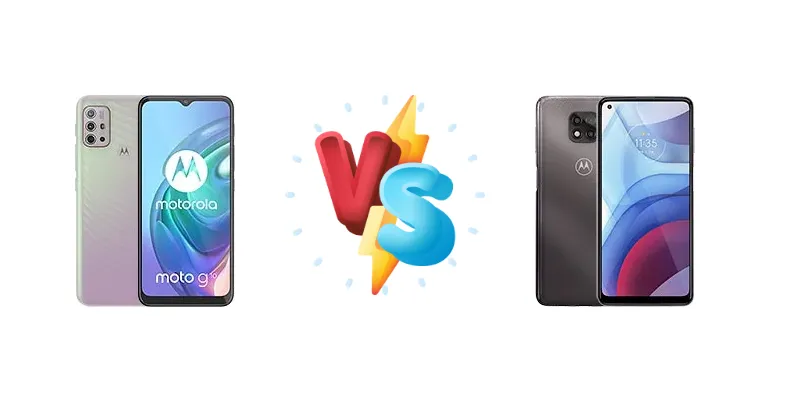
|
🏆 Quick Verdict
For most users, the Motorola Moto G Power (2021) is the better choice. Its Snapdragon 662 chipset provides a noticeable performance boost over the G10’s Snapdragon 460, making everyday tasks and light multitasking smoother. While the G10 boasts a slightly higher contrast ratio, the G Power’s faster charging and improved processing outweigh this difference.
| PHONES | ||
|---|---|---|
| Phone Names | Motorola Moto G10 | Motorola Moto G Power (2021) |
| Network | ||
|---|---|---|
| 2G bands | GSM 850 / 900 / 1800 / 1900 | GSM 850 / 900 / 1800 / 1900 |
| 3G bands | HSDPA 850 / 900 / 1900 / 2100 | HSDPA 850 / 900 / 1700(AWS) / 1900 / 2100 |
| 4G bands | 1, 2, 3, 5, 7, 8, 18, 19, 20, 26, 28, 38, 40, 41 | 1, 2, 3, 4, 5, 7, 8, 12, 13, 14, 17, 25, 26, 29, 30, 38, 41, 66, 71 |
| Speed | HSPA 42.2/5.76 Mbps, LTE Cat4 150/50 Mbps | HSPA, LTE |
| Technology | GSM / HSPA / LTE | GSM / CDMA / HSPA / EVDO / LTE |
| - | CDMA2000 1xEV-DO | |
| Launch | ||
|---|---|---|
| Announced | 2021, February 16 | 2021, January 08 |
| Status | Available. Released 2021, February 27 | Available. Released 2021, January 14 |
| Body | ||
|---|---|---|
| Build | Glass front, plastic back, plastic frame | Glass front, plastic back, plastic frame |
| Dimensions | 165.2 x 75.7 x 9.2 mm (6.50 x 2.98 x 0.36 in) | 165.3 x 75.9 x 9.5 mm (6.51 x 2.99 x 0.37 in) |
| SIM | · Nano-SIM· Nano-SIM + Nano-SIM | Nano-SIM |
| Weight | 200 g (7.05 oz) | 206.5 g (7.30 oz) |
| Water-repellent design | Water-repellent coating | |
| Display | ||
|---|---|---|
| Resolution | 720 x 1600 pixels, 20:9 ratio (~269 ppi density) | 720 x 1600 pixels, 20:9 ratio (~266 ppi density) |
| Size | 6.5 inches, 102.8 cm2 (~82.2% screen-to-body ratio) | 6.6 inches, 105.2 cm2 (~83.8% screen-to-body ratio) |
| Type | IPS LCD | IPS LCD |
| Platform | ||
|---|---|---|
| CPU | Octa-core (4x1.8 GHz Kryo 240 & 4x1.6 GHz Kryo 240) | Octa-core (4x2.0 GHz Kryo 260 Gold & 4x1.8 GHz Kryo 260 Silver) |
| Chipset | Qualcomm SM4250 Snapdragon 460 (11 nm) | Qualcomm SM6115 Snapdragon 662 (11 nm) |
| GPU | Adreno 610 | Adreno 610 |
| OS | Android 11 | Android 10 |
| Memory | ||
|---|---|---|
| Card slot | microSDXC (uses shared SIM slot) | microSDXC (dedicated slot) |
| Internal | 64GB 4GB RAM, 128GB 4GB RAM | 32GB 3GB RAM, 64GB 4GB RAM |
| - | eMMC 5.1 | |
| Main Camera | ||
|---|---|---|
| Features | LED flash, HDR, panorama | LED flash, HDR, panorama |
| Quad | 48 MP, f/1.7, 26mm (wide), 1/2.0", 0.8µm, PDAF 8 MP, f/2.2, 118˚ (ultrawide), 1/4.0", 1.12µm 2 MP (macro) Auxiliary lens | - |
| Triple | - | 48 MP, f/1.7, (wide), 1/2.0", 0.8µm, PDAF 2 MP (macro) Auxiliary lens |
| Video | 1080p@30/60fps | 1080p@30/60fps, gyro-EIS |
| Selfie camera | ||
|---|---|---|
| Features | HDR | HDR |
| Single | 8 MP, f/2.2, (wide), 1/4.0", 1.12µm | 8 MP, f/2.0, 1.12µm |
| Video | 1080p@30fps | 1080p@30fps, gyro-EIS |
| Sound | ||
|---|---|---|
| 3.5mm jack | Yes | Yes |
| 35mm jack | Yes | Yes |
| Loudspeaker | Yes | Yes |
| Comms | ||
|---|---|---|
| Bluetooth | 5.0, A2DP, LE | 5.0, A2DP, LE |
| NFC | Yes | No |
| Positioning | GPS, GLONASS, GALILEO | GPS, GLONASS, GALILEO |
| Radio | FM radio | FM radio |
| USB | USB Type-C 2.0 | USB Type-C 2.0 |
| WLAN | Wi-Fi 802.11 a/b/g/n/ac, dual-band, Wi-Fi Direct | Wi-Fi 802.11 a/b/g/n/ac, dual-band, Wi-Fi Direct |
| Features | ||
|---|---|---|
| Sensors | Fingerprint (rear-mounted), accelerometer, gyro, proximity | Fingerprint (side-mounted), accelerometer, gyro, proximity, compass, barometer |
| Battery | ||
|---|---|---|
| Charging | 10W wired | 15W wired |
| Type | Li-Po 5000 mAh | Li-Po 5000 mAh |
| Misc | ||
|---|---|---|
| Colors | Aurora Grey, Iridescent Pearl | Flash Gray, Polar Silver |
| Models | XT2127-2 | - |
| Price | About 140 EUR | About 60 EUR |
| Tests | ||
|---|---|---|
| Battery life | Endurance rating 152h | - |
| Camera | Photo / Video | - |
| Display | Contrast ratio: 11878:1 (nominal) | - |
| Loudspeaker | -29.2 LUFS (Average) | - |
| Performance | AnTuTu: 140230 (v8) GeekBench: 1139 (v5.1) GFXBench: 9.2fps (ES 3.1 onscreen) | - |
Motorola Moto G10
- Higher contrast ratio for potentially better image quality
- Excellent battery endurance (152h)
- Lower price point (likely)
- Slower processor (Snapdragon 460)
- Slow 10W charging
- Potentially struggles with demanding apps
Motorola Moto G Power (2021)
- Faster processor (Snapdragon 662) for smoother performance
- Faster 15W charging
- More responsive user experience
- Likely lower contrast ratio than the G10
- Potentially slightly shorter battery life (unconfirmed)
- Higher price point
Display Comparison
The Moto G10 features a display with a measured peak brightness of 370 nits and a nominal contrast ratio of 11878:1. This high contrast ratio suggests deeper blacks and a more vibrant image, though the 370 nits may struggle in direct sunlight. The Moto G Power (2021) lacks published display specs, but given its market positioning, it likely prioritizes cost-effectiveness over display fidelity. The G10’s higher contrast ratio will be most noticeable when viewing HDR content, offering a more immersive experience for media consumers.
Camera Comparison
Both phones are listed with 'Photo / Video' capabilities, lacking specific details. Given the budget nature of both devices, expect similar camera performance – adequate for casual snapshots in good lighting conditions. The absence of detailed sensor information suggests neither phone will excel in low-light photography. Focusing on the chipset, the Snapdragon 662 in the G Power (2021) offers a slightly more capable ISP (Image Signal Processor), potentially leading to marginally better image processing and faster capture times.
Performance
The core difference lies in the chipsets: the Moto G10 utilizes the Qualcomm Snapdragon 460 (11nm) with an octa-core CPU configuration (4x1.8 GHz Kryo 240 & 4x1.6 GHz Kryo 240), while the Moto G Power (2021) steps up to the Snapdragon 662 (11nm) with a slightly faster octa-core setup (4x2.0 GHz Kryo 260 Gold & 4x1.8 GHz Kryo 260 Silver). The Snapdragon 662’s Kryo 260 Gold cores offer a performance advantage in single-core tasks, resulting in snappier app launches and smoother scrolling. This translates to a more fluid experience for everyday use, especially for users who frequently switch between applications.
Battery Life
Both phones prioritize battery life, but approach it differently. The Moto G10 boasts an endurance rating of 152 hours, suggesting excellent longevity on a single charge. However, it’s limited to 10W wired charging, meaning a full charge will take a considerable amount of time. The Moto G Power (2021) features 15W wired charging, significantly reducing charge times. While its endurance rating isn’t specified, the faster charging capability is a significant advantage for users who need to quickly top up their battery.
Buying Guide
Buy the Motorola Moto G10 if your primary need is maximizing screen contrast and you operate on a very strict budget, prioritizing endurance over speed. You'll benefit from its 11878:1 contrast ratio for media consumption. Buy the Motorola Moto G Power (2021) if you prefer a more responsive user experience, faster charging, and are willing to spend a little more for improved performance in apps and multitasking.