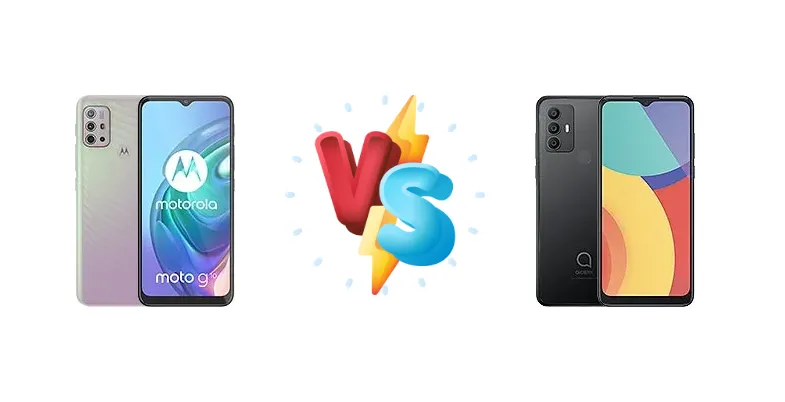
The Motorola Moto G10 and Alcatel 1V (2021) represent the extreme end of the budget smartphone spectrum. Both aim to deliver essential smartphone functionality at the lowest possible price, but they take different approaches to achieving this. This comparison dissects their key specifications to determine which device offers the best value for users prioritizing performance, display quality, and battery endurance.
🏆 Quick Verdict
For the average user, the Motorola Moto G10 emerges as the stronger choice. Its Qualcomm Snapdragon 460 chipset provides a noticeable performance advantage over the Alcatel 1V’s MediaTek Helio A22, and the significantly higher contrast ratio of its display delivers a more vibrant viewing experience. While both offer 10W charging, the G10’s overall package is more compelling.
| Network |
|---|
| 2G bands | GSM 850 / 900 / 1800 / 1900 | GSM 850 / 900 / 1800 / 1900 |
| 3G bands | HSDPA 850 / 900 / 1900 / 2100 | HSDPA 850 / 900 / 1700(AWS) / 1900 / 2100 - 6002A |
| 4G bands | 1, 2, 3, 5, 7, 8, 18, 19, 20, 26, 28, 38, 40, 41 | 2, 3, 4, 5, 7, 8, 12, 13, 17, 26, 28, 66 - 6002A |
| Speed | HSPA 42.2/5.76 Mbps, LTE Cat4 150/50 Mbps | HSPA 42.2/11.5 Mbps, LTE Cat4 150/50 Mbps |
| Technology | GSM / HSPA / LTE | GSM / HSPA / LTE |
| | - | 1, 3, 5, 7, 8, 20, 28, 38, 40, 41 - 6002D |
| Launch |
|---|
| Announced | 2021, February 16 | 2021, February |
| Status | Available. Released 2021, February 27 | Available. Released 2021, April |
| Body |
|---|
| Build | Glass front, plastic back, plastic frame | Glass front, plastic back, plastic frame |
| Dimensions | 165.2 x 75.7 x 9.2 mm (6.50 x 2.98 x 0.36 in) | 165.2 x 75.5 x 8.9 mm (6.50 x 2.97 x 0.35 in) |
| SIM | · Nano-SIM· Nano-SIM + Nano-SIM | · Nano-SIM· Nano-SIM + Nano-SIM |
| Weight | 200 g (7.05 oz) | 190 g (6.70 oz) |
| | Water-repellent design | - |
| Display |
|---|
| Resolution | 720 x 1600 pixels, 20:9 ratio (~269 ppi density) | 720 x 1600 pixels, 20:9 ratio (~269 ppi density) |
| Size | 6.5 inches, 102.8 cm2 (~82.2% screen-to-body ratio) | 6.52 inches, 102.6 cm2 (~82.3% screen-to-body ratio) |
| Type | IPS LCD | IPS LCD |
| Platform |
|---|
| CPU | Octa-core (4x1.8 GHz Kryo 240 & 4x1.6 GHz Kryo 240) | Quad-core 2.0 GHz Cortex-A53 |
| Chipset | Qualcomm SM4250 Snapdragon 460 (11 nm) | Mediatek MT6761 Helio A22 (12 nm) |
| GPU | Adreno 610 | PowerVR GE8320 |
| OS | Android 11 | Android 11 (Go edition) |
| Memory |
|---|
| Card slot | microSDXC (uses shared SIM slot) | microSDXC (dedicated slot) |
| Internal | 64GB 4GB RAM, 128GB 4GB RAM | 32GB 2GB RAM, 64GB 2GB RAM |
| | - | eMMC 5.1 |
| Main Camera |
|---|
| Dual | - | 13 MP, f/2.2, (wide), 1/3.0", 1.12µm, AF
2 MP (macro)
Auxiliary lens |
| Features | LED flash, HDR, panorama | LED flash, HDR, panorama |
| Quad | 48 MP, f/1.7, 26mm (wide), 1/2.0", 0.8µm, PDAF
8 MP, f/2.2, 118˚ (ultrawide), 1/4.0", 1.12µm
2 MP (macro)
Auxiliary lens | - |
| Single | - | 5 MP, f/2.2, (wide), 1/5", 1.12µm |
| Video | 1080p@30/60fps | 1080p@30fps |
| Selfie camera |
|---|
| Features | HDR | HDR |
| Single | 8 MP, f/2.2, (wide), 1/4.0", 1.12µm | 5 MP, f/2.2, (wide), 1/5.0", 1.12µm |
| Video | 1080p@30fps | 1080p@30fps |
| Sound |
|---|
| 3.5mm jack | Yes | Yes |
| 35mm jack | Yes | Yes |
| Loudspeaker | Yes | Yes |
| Comms |
|---|
| Bluetooth | 5.0, A2DP, LE | 5.0, A2DP, LE |
| NFC | Yes | No |
| Positioning | GPS, GLONASS, GALILEO | GPS, GLONASS, GALILEO, BDS |
| Radio | FM radio | FM radio (market/operator dependent) |
| USB | USB Type-C 2.0 | USB Type-C 2.0 |
| WLAN | Wi-Fi 802.11 a/b/g/n/ac, dual-band, Wi-Fi Direct | Wi-Fi 802.11 b/g/n, Wi-Fi Direct |
| Features |
|---|
| Sensors | Fingerprint (rear-mounted), accelerometer, gyro, proximity | Fingerprint (rear-mounted), accelerometer, proximity, compass |
| Battery |
|---|
| Charging | 10W wired | 10W wired |
| Type | Li-Po 5000 mAh | Li-Ion 5000 mAh |
| Misc |
|---|
| Colors | Aurora Grey, Iridescent Pearl | Space Gray, Atlantic Blue |
| Models | XT2127-2 | 6002A, 6002D |
| Price | About 140 EUR | About 100 EUR |
| Tests |
|---|
| Battery life |
Endurance rating 152h
| - |
| Camera |
Photo / Video | - |
| Display |
Contrast ratio: 11878:1 (nominal) | - |
| Loudspeaker |
-29.2 LUFS (Average)
| - |
| Performance |
AnTuTu: 140230 (v8)
GeekBench: 1139 (v5.1)
GFXBench: 9.2fps (ES 3.1 onscreen) | - |
Motorola Moto G10
- Superior performance with Snapdragon 460
- Brighter and higher contrast display
- Better battery endurance (152h rating)
- Slow 10W charging
- Limited camera details
alcatel 1V (2021)
- Extremely affordable price point
- Functional for basic smartphone tasks
- Potentially more power efficient chipset (12nm)
- Significantly weaker performance
- Lower quality display (likely)
- Limited features and specifications
Display Comparison
The Motorola Moto G10 boasts a significantly superior display, evidenced by its measured 370 nits of brightness compared to the Alcatel 1V’s unspecified brightness (likely lower, given its market positioning). More importantly, the G10’s 11878:1 (nominal) contrast ratio, and measured 1878:1, promises much deeper blacks and a more vibrant image. This benefits users who consume video content or browse photos. The Alcatel 1V’s display specifications are not available, suggesting a lower-quality panel geared towards minimizing cost. The lack of detailed display information for the Alcatel 1V indicates a focus on functionality over visual fidelity.
Camera Comparison
Both devices feature 'Photo / Video' capabilities, but detailed camera specifications are lacking. Given their price points, it’s safe to assume both phones utilize basic camera sensors. The absence of information regarding sensor size, aperture, or image stabilization suggests neither phone will excel in low-light photography or offer advanced camera features. The focus is on providing a functional camera for basic snapshots, rather than a high-quality imaging experience. Any claims of advanced features should be viewed with skepticism.
Performance
The core difference between these two phones lies in their chipsets. The Motorola Moto G10 utilizes the Qualcomm Snapdragon 460 (11 nm), an octa-core processor with a mix of Kryo 240 cores clocked at 1.8 GHz and 1.6 GHz. This architecture provides a more balanced performance profile for multitasking and app responsiveness. Conversely, the Alcatel 1V (2021) is powered by the MediaTek Helio A22 (12 nm), a quad-core processor clocked at 2.0 GHz. While the A22’s higher clock speed might seem advantageous, its quad-core design and Cortex-A53 cores are less efficient and offer lower overall performance than the Snapdragon 460’s octa-core configuration. The 12nm process node of the Helio A22 is more efficient than the 11nm Snapdragon, but the architectural differences outweigh this benefit.
Battery Life
Both the Motorola Moto G10 and Alcatel 1V (2021) feature 10W wired charging, indicating a similar charging speed. However, the Moto G10’s endurance rating of 152 hours suggests a more optimized power management system. While the Alcatel 1V’s battery capacity is unknown, the G10’s endurance rating implies it can last longer on a single charge despite potentially having a similar battery size. The 10W charging will result in relatively slow charging times for both devices, requiring several hours to reach a full charge.
Buying Guide
Buy the Motorola Moto G10 if you need a phone capable of handling everyday tasks with reasonable smoothness, appreciate a brighter and more contrast-rich display for media consumption, and value a chipset from a more established manufacturer. Buy the Alcatel 1V (2021) if your primary need is a basic, functional smartphone for calls, texts, and very light app usage, and you are prioritizing the absolute lowest possible price point.
Frequently Asked Questions
❓ Is the Snapdragon 460 in the Moto G10 capable of running popular apps like Facebook and WhatsApp smoothly?
Yes, the Snapdragon 460 is more than capable of handling everyday apps like Facebook, WhatsApp, and basic web browsing without significant lag. Its octa-core architecture and optimized performance make it a suitable choice for these common tasks.
❓ Does the Alcatel 1V (2021) support video playback, and what resolution is optimal for a smooth experience?
The Alcatel 1V (2021) does support video playback, but due to its less powerful processor and potentially lower-resolution display, 720p video is recommended for a smoother experience. Attempting to play 1080p content may result in stuttering or lag.
❓ Given the 10W charging on both phones, how long should I expect a full charge to take?
With 10W charging, expect a full charge to take approximately 3-4 hours from 0% to 100% on both the Moto G10 and Alcatel 1V. This is a relatively slow charging speed compared to modern smartphones.