
Google Pixel 6a vs. Motorola Moto G06: A Deep Dive into Performance and Battery Life
| Phones Images | |||||
|---|---|---|---|---|---|
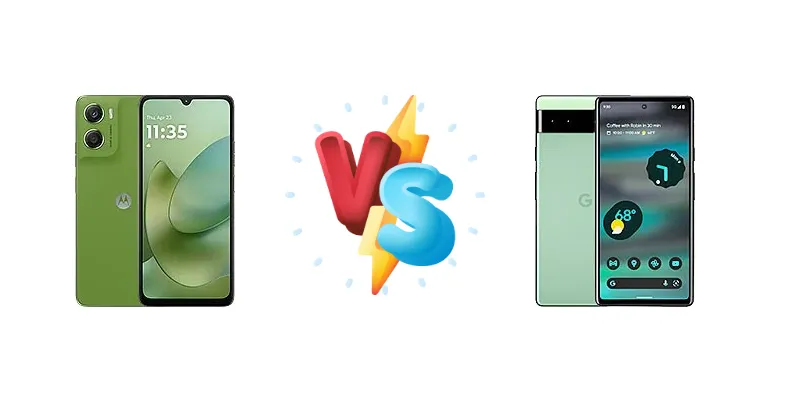
|
🏆 Quick Verdict
For most users, the Google Pixel 6a is the superior choice. Its Google Tensor chipset delivers significantly faster performance and a smoother user experience, complemented by a brighter, higher-quality display. While the Moto G06 excels in battery endurance, the Pixel 6a’s overall package justifies its slightly higher price.
| PHONES | ||
|---|---|---|
| Phone Names | Motorola Moto G06 | Google Pixel 6a |
| Network | ||
|---|---|---|
| 2G bands | GSM 850 / 900 / 1800 / 1900 | GSM 850 / 900 / 1800 / 1900 |
| 3G bands | HSDPA 850 / 900 / 1900 / 2100 | HSDPA 800 / 850 / 900 / 1700(AWS) / 1900 / 2100 |
| 4G bands | 1, 3, 5, 7, 8, 20, 28, 38, 40, 41 - Europe | 1, 2, 3, 4, 5, 7, 8, 12, 13, 14, 17, 18, 19, 20, 25, 26, 28, 29, 30, 38, 39, 40, 41, 42, 48, 66, 71 - GX7AS, GB62Z (USA/Canada) |
| 5G bands | - | 1, 2, 3, 5, 7, 8, 12, 20, 25, 28, 30, 38, 40, 41, 48, 66, 71, 77, 78 SA/NSA/Sub6 - GX7AS (USA/Canada) |
| Speed | HSPA, LTE | HSPA, LTE, 5G |
| Technology | GSM / HSPA / LTE | GSM / HSPA / LTE / 5G |
| - | 1, 2, 3, 5, 7, 8, 12, 20, 25, 28, 30, 40, 48, 66, 71, 77, 78 SA/NSA/Sub6 - G1AZG (International) | |
| Launch | ||
|---|---|---|
| Announced | 2025, September 05 | 2022, May 11 |
| Status | Available. Released 2025, September 23 | Available. Released 2022, July 21 |
| Body | ||
|---|---|---|
| Build | Glass front (Gorilla Glass 3), plastic frame, silicone polymer back (eco leather) | Glass front (Gorilla Glass 3), aluminum frame, plastic back |
| Dimensions | 171.4 x 77.5 x 8.3 mm (6.75 x 3.05 x 0.33 in) | 152.2 x 71.8 x 8.9 mm (5.99 x 2.83 x 0.35 in) |
| SIM | Nano-SIM + Nano-SIM | Nano-SIM + eSIM |
| Weight | 194 g (6.84 oz) | 178 g (6.28 oz) |
| - | IP67 dust/water resistant (up to 1m for 30 min) | |
| Display | ||
|---|---|---|
| Protection | Corning Gorilla Glass 3, Mohs level 4 | Corning Gorilla Glass 3 |
| Resolution | 720 x 1640 pixels (~260 ppi density) | 1080 x 2400 pixels, 20:9 ratio (~429 ppi density) |
| Size | 6.88 inches, 112.4 cm2 (~84.6% screen-to-body ratio) | 6.1 inches, 90.7 cm2 (~83.0% screen-to-body ratio) |
| Type | IPS LCD, 120Hz | OLED, HDR |
| - | Always-on display | |
| Platform | ||
|---|---|---|
| CPU | Octa-core (2x2.0 GHz Cortex-A75 & 6x1.7 GHz Cortex-A55) | Octa-core (2x2.80 GHz Cortex-X1 & 2x2.25 GHz Cortex-A76 & 4x1.80 GHz Cortex-A55) |
| Chipset | Mediatek Helio G81 Ultra (12 nm) | Google Tensor (5 nm) |
| GPU | Mali-G52 MC2 | Mali-G78 MP20 |
| OS | Android 15 | Android 12, upgradable to Android 15, up to 5 major Android upgrades |
| Memory | ||
|---|---|---|
| Card slot | microSDXC (dedicated slot) | No |
| Internal | 64GB 4GB RAM, 128GB 4GB RAM, 256GB 4GB RAM, 256GB 8GB RAM | 128GB 6GB RAM |
| - | UFS 3.1 | |
| Main Camera | ||
|---|---|---|
| Dual | - | 12.2 MP, f/1.7, 27mm, (wide), 1/2.55", 1.4µm, dual pixel PDAF, OIS 12 MP, f/2.2, 17mm, 114˚ (ultrawide), 1.25µm |
| Features | LED flash, HDR | Dual-LED flash, Pixel Shift, Auto-HDR, panorama |
| Single | 50 MP, f/1.8, (wide), PDAF | 8 MP, f/2.0, 24mm (wide), 1.12µm |
| Video | 1080p@30fps | 4K@30/60fps, 1080p@30/60/120/240fps; gyro-EIS, OIS |
| Selfie camera | ||
|---|---|---|
| Features | HDR | HDR, panorama |
| Single | 8 MP, f/2.1, (wide), 1.12µm | 8 MP, f/2.0, 24mm (wide), 1.12µm |
| Video | 1080p@30fps | 1080p@30fps |
| Sound | ||
|---|---|---|
| 3.5mm jack | - | No |
| 35mm jack | Yes | No |
| Loudspeaker | Yes, with stereo speakers | Yes, with stereo speakers |
| Comms | ||
|---|---|---|
| Bluetooth | Yes | 5.2, A2DP, LE |
| NFC | Yes (market/region dependent) | Yes |
| Positioning | GPS, GALILEO, GLONASS | GPS, GLONASS, GALILEO, QZSS |
| Radio | No | No |
| USB | USB Type-C 2.0 | USB Type-C 3.1 |
| WLAN | Wi-Fi 802.11 a/b/g/n/ac, dual-band | Wi-Fi 802.11 a/b/g/n/ac/6e, dual-band, Wi-Fi Direct |
| Features | ||
|---|---|---|
| Sensors | Fingerprint (side-mounted), accelerometer, proximity | Fingerprint (under display, optical), accelerometer, gyro, proximity, compass, barometer |
| Battery | ||
|---|---|---|
| Charging | 10W wired | 18W wired, PD3.0 |
| Type | 5200 mAh | Li-Po 4410 mAh |
| Misc | ||
|---|---|---|
| Colors | Pantone: Laurel Oak, Arabesque, Tapestry, Tendril | Chalk, Charcoal, Sage |
| Models | XT2535-1, XT2535-2, XT2535-3, XT2535-14 | GX7AS, GB62Z, G1AZG, GB17L |
| Price | About 130 EUR | $ 138.99 / C$ 228.74 / ₹ 23,999 |
| Tests | ||
|---|---|---|
| Battery life | - | Endurance rating 94h |
| Display | - | Contrast ratio: Infinite (nominal) |
| EU LABEL | ||
|---|---|---|
| Battery | 55:21h endurance, 1200 cycles | - |
| Energy | Class A | - |
| Free fall | Class A (270 falls) | - |
| Repairability | Class A | - |
Motorola Moto G06
- Superior performance with Google Tensor chipset
- Excellent camera quality and image processing
- Brighter and more vibrant display
- Slower charging than some competitors
- Older model, may receive fewer software updates
Google Pixel 6a
- Exceptional battery endurance and longevity
- Highly affordable price point
- Reliable for basic smartphone tasks
- Significantly slower performance
- Lower display quality
- Less capable camera system
Display Comparison
The Pixel 6a’s display is a clear winner, boasting a measured peak brightness of 876 nits compared to the Moto G06’s unspecified brightness. This translates to significantly better visibility outdoors. While the Moto G06’s panel specs are missing, the Pixel 6a’s ‘Infinite’ (nominal) contrast ratio suggests a superior viewing experience with deeper blacks. The Pixel 6a’s OLED panel also offers better color accuracy and viewing angles, crucial for media consumption.
Camera Comparison
The Pixel 6a’s camera system is a major advantage. While specific sensor details are missing for the Moto G06, the Pixel 6a benefits from Google’s renowned computational photography. The Pixel 6a’s image processing excels in dynamic range, detail, and low-light performance. The absence of a dedicated telephoto lens on either device means digital zoom will be the only option for distant subjects. The Moto G06 likely includes standard budget camera features, but won’t match the Pixel 6a’s consistently high image quality.
Performance
The performance gap between these devices is substantial. The Pixel 6a’s Google Tensor (5nm) chipset, featuring a Cortex-X1 prime core clocked at 2.80 GHz, significantly outperforms the Moto G06’s MediaTek Helio G81 Ultra (12nm). The Tensor’s architecture, including the Cortex-A76 and A55 cores, provides a more balanced and efficient performance profile. The 5nm fabrication process also contributes to better thermal management, reducing the likelihood of throttling during sustained workloads. The Moto G06’s Helio G81, while capable for everyday tasks, will struggle with demanding games and multitasking.
Battery Life
The Moto G06 claims an impressive 55:21h endurance rating and 1200 charge cycles, indicating exceptional longevity and battery life. However, the Pixel 6a, despite a reported 94h endurance rating, offers competitive battery performance thanks to the Tensor chip’s efficiency. The Pixel 6a also supports 18W wired charging with PD3.0, allowing for faster charging speeds than the Moto G06’s 10W charging. While the Moto G06 wins on raw endurance, the Pixel 6a’s faster charging mitigates the difference.
Buying Guide
Buy the Motorola Moto G06 if you prioritize maximizing battery life above all else and need a reliable, affordable device for basic tasks. It’s ideal for users who primarily make calls, text, and browse the web. Buy the Google Pixel 6a if you value performance, camera quality, and a refined software experience. It’s best suited for users who enjoy photography, gaming, and demand a responsive smartphone.