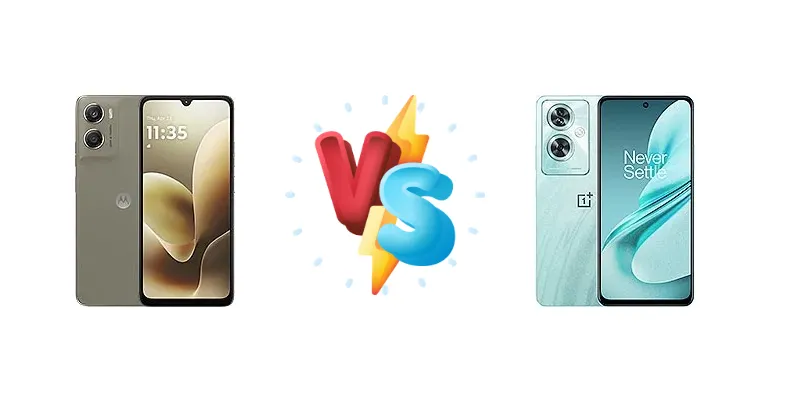
The Motorola Moto G06 Power and OnePlus Nord N30 SE represent compelling options in the crowded budget smartphone market. The G06 Power prioritizes exceptional battery life, while the Nord N30 SE focuses on delivering a more modern chipset and faster charging. This comparison dissects their key differences to help you determine which device best suits your priorities.
🏆 Quick Verdict
For users prioritizing all-day (and then some) battery life, the Motorola Moto G06 Power is the clear winner, boasting a remarkable 74:45h endurance. However, the OnePlus Nord N30 SE edges ahead with its more efficient Dimensity 6020 chipset and significantly faster 33W charging, making it ideal for those who value speed and responsiveness.
| Network |
|---|
| 2G bands | GSM 850 / 900 / 1800 / 1900 | GSM 850 / 900 / 1800 / 1900 |
| 3G bands | HSDPA 850 / 900 / 2100 | HSDPA 850 / 900 / 1700(AWS) / 1900 / 2100 |
| 4G bands | LTE | 1, 2, 3, 4, 5, 7, 8, 12, 13, 17, 18, 19, 20, 26, 28, 38, 39, 40, 41, 66 |
| 5G bands | - | 1, 3, 5, 7, 8, 20, 28, 38, 40, 41, 66, 77, 78 SA/NSA |
| Speed | HSPA, LTE | HSPA, LTE, 5G |
| Technology | GSM / HSPA / LTE | GSM / HSPA / LTE / 5G |
| Launch |
|---|
| Announced | 2025, September 05 | 2024, January 29 |
| Status | Available. Released 2025, October 09 | Available. Released 2024, January 31 |
| Body |
|---|
| Build | Glass front, plastic frame, silicone polymer back (eco leather) | Glass front, plastic frame, plastic back |
| Dimensions | 171.4 x 77.5 x 8.8 mm (6.75 x 3.05 x 0.35 in) | 165.6 x 76 x 8 mm (6.52 x 2.99 x 0.31 in) |
| SIM | Nano-SIM + Nano-SIM | Nano-SIM + Nano-SIM |
| Weight | 220 g (7.76 oz) | 193 g (6.81 oz) |
| Display |
|---|
| Protection | Corning Gorilla Glass 3, Mohs level 4 | - |
| Resolution | 720 x 1640 pixels (~260 ppi density) | 1080 x 2400 pixels, 20:9 ratio (~392 ppi density) |
| Size | 6.88 inches, 112.4 cm2 (~84.6% screen-to-body ratio) | 6.72 inches, 109.0 cm2 (~86.6% screen-to-body ratio) |
| Type | IPS LCD, 120Hz | IPS LCD |
| Platform |
|---|
| CPU | Octa-core (2x2.0 GHz Cortex-A75 & 6x1.7 GHz Cortex-A55) | Octa-core (2x2.2 GHz Cortex-A76 & 6x2.0 GHz Cortex-A55) |
| Chipset | Mediatek Helio G81 Ultra (12 nm) | Mediatek Dimensity 6020 (7 nm) |
| GPU | Mali-G52 MC2 | Mali-G57 MC2 |
| OS | Android 15 | Android 13, OxygenOS 13.1 |
| Memory |
|---|
| Card slot | microSDXC (dedicated slot) | No |
| Internal | 64GB 4GB RAM, 128GB 4GB RAM, 256GB 4GB RAM, 256GB 8GB RAM | 128GB 4GB RAM |
| Main Camera |
|---|
| Dual | - | 50 MP, f/1.8, (wide), 1/2.76", 0.64µm, PDAF
Auxiliary lens |
| Features | LED flash, HDR | LED flash, HDR, panorama |
| Single | 50 MP, f/1.8, (wide), PDAF | - |
| Video | 1080p@30fps | 1080p@30fps |
| Selfie camera |
|---|
| Features | HDR | - |
| Single | 8 MP, f/2.1, (wide), 1.12µm | 8 MP, f/2.0, (wide), 1/4.0", 1.12µm |
| Video | 1080p@30fps | 1080p@30fps |
| Sound |
|---|
| 35mm jack | Yes | Yes |
| Loudspeaker | Yes, with stereo speakers | Yes, with stereo speakers |
| Comms |
|---|
| Bluetooth | Yes | 5.3, A2DP, LE |
| NFC | Yes (market/region dependent) | Yes |
| Positioning | GPS, GALILEO, GLONASS | GPS, GALILEO, GLONASS, BDS |
| Radio | No | No |
| USB | USB Type-C 2.0 | USB Type-C 2.0, OTG |
| WLAN | Wi-Fi 802.11 a/b/g/n/ac, dual-band | Wi-Fi 802.11 a/b/g/n/ac, dual-band |
| Features |
|---|
| Sensors | Fingerprint (side-mounted), accelerometer, proximity | Fingerprint (side-mounted), accelerometer, gyro, proximity, compass |
| Battery |
|---|
| Charging | 18W wired | 33W wired, 51% in 30 min |
| Type | 7000 mAh | 5000 mAh |
| Misc |
|---|
| Colors | Pantone: Laurel Oak, Tapestry, Tendril | Black Satin, Cyan |
| Models | XT2535-13 | CPH2605 |
| Price | ₹ 7,448 | About 510 EUR |
| EU LABEL |
|---|
| Battery | 74:45h endurance, 1200 cycles | - |
| Energy | Class A | - |
| Free fall | Class A (270 falls) | - |
| Repairability | Class A | - |
Motorola Moto G06 Power
- Exceptional battery life (74:45h endurance)
- Potentially more affordable price point
- Proven reliability of the Motorola brand
- Older, less efficient chipset (Helio G81)
- Slower charging speed (18W)
- Likely less responsive user experience
OnePlus Nord N30 SE
- More modern and efficient chipset (Dimensity 6020)
- Faster charging (33W, 51% in 30 min)
- Improved performance for multitasking and gaming
- Likely shorter battery life compared to G06 Power
- Potentially higher price point
- OnePlus software can be polarizing
Display Comparison
Neither device boasts a standout display. While specific display specs are missing, the focus here is on internal performance. Both likely utilize LCD panels common in this price bracket. The real difference lies in how efficiently the chipsets drive them. The Nord N30 SE’s Dimensity 6020, built on a 7nm process, will likely offer smoother scrolling and animations compared to the G06 Power’s 12nm Helio G81, even with similar resolutions.
Camera Comparison
Without detailed camera specifications, a direct comparison is limited. However, it’s reasonable to assume both phones feature budget-oriented camera systems. The focus will likely be on computational photography to enhance image quality. The N30 SE’s more powerful chipset could provide an edge in image processing speed and potentially better low-light performance. The presence of OIS (Optical Image Stabilization) on either device would be a significant advantage, but is not specified in the provided data.
Performance
The OnePlus Nord N30 SE’s Mediatek Dimensity 6020 (7nm) represents a significant architectural leap over the Motorola Moto G06 Power’s Helio G81 Ultra (12nm). The Dimensity 6020 utilizes Cortex-A76 cores clocked at 2.2 GHz, offering a noticeable performance boost over the G06 Power’s 2.0 GHz Cortex-A75 cores. The smaller 7nm node translates to improved power efficiency and reduced thermal throttling during sustained workloads. This means the N30 SE will handle multitasking and gaming more effectively, while the G06 Power may exhibit more slowdown under heavy load.
Battery Life
The Motorola Moto G06 Power’s defining feature is its exceptional 74:45h endurance, a testament to the efficiency of the Helio G81 and likely a large battery capacity (though not specified). While the N30 SE’s battery capacity is unknown, its 33W charging capability is a game-changer. The ability to gain 51% charge in just 30 minutes significantly reduces downtime compared to the G06 Power’s slower 18W charging. The G06 Power prioritizes longevity, while the N30 SE prioritizes convenience.
Buying Guide
Buy the Motorola Moto G06 Power if you need a phone that can reliably last two full days on a single charge, and aren't heavily reliant on demanding applications. Buy the OnePlus Nord N30 SE if you prefer a snappier user experience, faster app loading times, and the convenience of rapid 33W charging, even if it means charging your phone more frequently.
Frequently Asked Questions
❓ Will the Mediatek Dimensity 6020 in the Nord N30 SE struggle with graphically intensive games like Genshin Impact?
While the Dimensity 6020 is a capable chipset, Genshin Impact is a demanding title. Expect to play at medium settings with moderate frame rates. The 7nm process and Cortex-A76 cores will provide a smoother experience than the G06 Power, but don't expect flagship-level performance.
❓ How does the 1200 charge cycle rating of the Moto G06 Power impact its long-term battery health?
The 1200 charge cycle rating indicates Motorola’s confidence in the battery’s longevity. It suggests the battery will retain a significant portion of its capacity even after being fully charged and discharged 1200 times. This is a strong indicator of long-term reliability, especially for users who charge their phones daily.
❓ Is the 18W charging on the Moto G06 Power slow compared to other phones in this price range?
Yes, 18W charging is relatively slow compared to the 33W charging on the Nord N30 SE and other recent budget phones. A full charge will take considerably longer, but the exceptional battery life mitigates this issue for many users.