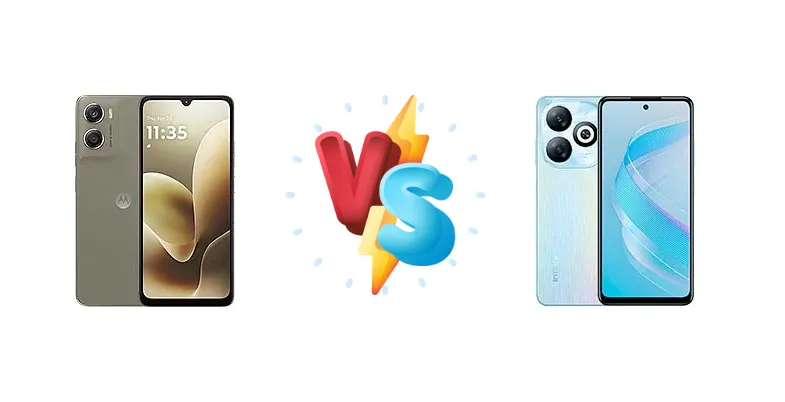
The Motorola Moto G06 Power and the Infinix Smart 8 Pro represent two distinct approaches to the ultra-budget smartphone market. The G06 Power prioritizes exceptional battery life, while the Smart 8 Pro aims for a balance of features at an aggressive price point. This comparison dissects their core components to determine which device best suits your needs.
🏆 Quick Verdict
For users prioritizing longevity and consistent performance, the Motorola Moto G06 Power emerges as the stronger choice. Its Helio G81 chipset and impressive 74:45h endurance rating outweigh the Infinix Smart 8 Pro’s slightly faster CPU clock speeds and reverse charging capability, especially for those who heavily rely on their phone throughout the day.
| Network |
|---|
| 2G bands | GSM 850 / 900 / 1800 / 1900 | GSM 850 / 900 / 1800 / 1900 |
| 3G bands | HSDPA 850 / 900 / 2100 | HSDPA 850 / 900 / 1700(AWS) / 1900 / 2100 |
| 4G bands | LTE | 1, 2, 3, 4, 5, 7, 8, 20, 28, 38, 41, 40 |
| Speed | HSPA, LTE | HSPA, LTE |
| Technology | GSM / HSPA / LTE | GSM / HSPA / LTE |
| Launch |
|---|
| Announced | 2025, September 05 | 2024, January 29 |
| Status | Available. Released 2025, October 09 | Available. Released 2024, February |
| Body |
|---|
| Build | Glass front, plastic frame, silicone polymer back (eco leather) | Glass front, plastic back, plastic frame |
| Dimensions | 171.4 x 77.5 x 8.8 mm (6.75 x 3.05 x 0.35 in) | 163.6 x 75.6 x 8.5 mm (6.44 x 2.98 x 0.33 in) |
| SIM | Nano-SIM + Nano-SIM | Nano-SIM + Nano-SIM |
| Weight | 220 g (7.76 oz) | 189 g (6.67 oz) |
| Display |
|---|
| Protection | Corning Gorilla Glass 3, Mohs level 4 | - |
| Resolution | 720 x 1640 pixels (~260 ppi density) | 720 x 1612 pixels, 20:9 ratio (~267 ppi density) |
| Size | 6.88 inches, 112.4 cm2 (~84.6% screen-to-body ratio) | 6.6 inches, 104.6 cm2 (~84.6% screen-to-body ratio) |
| Type | IPS LCD, 120Hz | IPS LCD, 90Hz, 500 nits (peak) |
| Platform |
|---|
| CPU | Octa-core (2x2.0 GHz Cortex-A75 & 6x1.7 GHz Cortex-A55) | Octa-core (4x2.2 GHz Cortex-A53 & 4x1.6 GHz Cortex-A53) |
| Chipset | Mediatek Helio G81 Ultra (12 nm) | Mediatek Helio G36 (12 nm) |
| GPU | Mali-G52 MC2 | PowerVR GE8320 |
| OS | Android 15 | Android 13 (Go edition), XOS 13 |
| Memory |
|---|
| Card slot | microSDXC (dedicated slot) | microSDXC (dedicated slot) |
| Internal | 64GB 4GB RAM, 128GB 4GB RAM, 256GB 4GB RAM, 256GB 8GB RAM | 64GB 4GB RAM, 128GB 8GB RAM, 256GB 4GB RAM |
| Main Camera |
|---|
| Features | LED flash, HDR | Ring-LED flash, HDR, panorama |
| Single | 50 MP, f/1.8, (wide), PDAF | 50 MP, f/1.9, (wide), AF
Auxiliary lens |
| Video | 1080p@30fps | 1080p@30fps |
| Selfie camera |
|---|
| Features | HDR | - |
| Single | 8 MP, f/2.1, (wide), 1.12µm | 8 MP, f/2.0, (wide) |
| Video | 1080p@30fps | Yes |
| Sound |
|---|
| 35mm jack | Yes | Yes |
| Loudspeaker | Yes, with stereo speakers | Yes |
| Comms |
|---|
| Bluetooth | Yes | 5.0, A2DP, LE |
| NFC | Yes (market/region dependent) | No |
| Positioning | GPS, GALILEO, GLONASS | GPS |
| Radio | No | FM radio |
| USB | USB Type-C 2.0 | USB Type-C 2.0, OTG |
| WLAN | Wi-Fi 802.11 a/b/g/n/ac, dual-band | Wi-Fi 802.11 a/b/g/n/ac, dual-band |
| Features |
|---|
| Sensors | Fingerprint (side-mounted), accelerometer, proximity | Fingerprint (side-mounted), accelerometer, gyro, proximity, compass |
| Battery |
|---|
| Charging | 18W wired | 10W wired
Reverse wired |
| Type | 7000 mAh | 5000 mAh |
| Misc |
|---|
| Colors | Pantone: Laurel Oak, Tapestry, Tendril | Rainbow Blue, Galaxy White, Shiny Gold, Timber Black |
| Models | XT2535-13 | X6525B |
| Price | ₹ 7,448 | About 100 EUR |
| EU LABEL |
|---|
| Battery | 74:45h endurance, 1200 cycles | - |
| Energy | Class A | - |
| Free fall | Class A (270 falls) | - |
| Repairability | Class A | - |
Motorola Moto G06 Power
- Exceptional battery life (74:45h endurance)
- More powerful CPU architecture (Helio G81)
- Faster charging (18W)
- Longer battery lifespan (1200 cycles)
- Display specifications unknown, likely basic
- Camera details unavailable, expected to be average
Infinix Smart 8 Pro
- Slightly higher CPU clock speed
- Reverse wired charging capability
- Aggressive price point (likely)
- Potentially more responsive for basic tasks
- Significantly lower battery endurance
- Slower charging speed (10W)
- Less powerful CPU architecture (Helio G36)
- Likely struggles with demanding applications
Display Comparison
Neither device provides display specifications in the provided data. However, given their price points, both likely utilize LCD panels with 720p+ resolutions. The absence of details like refresh rate or peak brightness suggests a focus on cost reduction. Expect similar viewing experiences, with neither offering exceptional color accuracy or brightness for outdoor visibility. Bezels are likely to be substantial on both devices.
Camera Comparison
The provided data doesn’t detail camera specifications beyond the chipsets. Given the market segment, both phones likely feature a primary camera paired with auxiliary sensors of limited utility. Image processing will be heavily reliant on software optimization, and image quality will likely be adequate for social media sharing but lack detail and dynamic range in challenging lighting conditions. Without sensor size or aperture information, a direct comparison is impossible, but the G81’s ISP (Image Signal Processor) is likely more capable than the G36’s.
Performance
The Motorola Moto G06 Power’s Mediatek Helio G81 Ultra chipset, featuring a dual-core Cortex-A75 configuration alongside six Cortex-A55 cores, offers a more sophisticated CPU architecture than the Infinix Smart 8 Pro’s Helio G36. While the Smart 8 Pro boasts a higher peak clock speed (2.2 GHz vs 2.0 GHz on the G06 Power’s A75 cores), the A75 cores in the G06 Power are significantly more powerful per clock cycle. The G36’s quad-core Cortex-A53 setup is geared towards efficiency but will struggle with demanding multitasking or graphically intensive games compared to the G81. The G06 Power will provide a smoother experience for sustained workloads.
Battery Life
The Motorola Moto G06 Power’s standout feature is its exceptional battery endurance, rated at 74:45 hours. This is significantly longer than what’s typically expected from a budget smartphone. Coupled with a 1200 cycle lifespan, the G06 Power promises long-term reliability. The Infinix Smart 8 Pro, with its 10W charging, will take considerably longer to fully charge than the G06 Power’s 18W charging. The Smart 8 Pro’s reverse wired charging is a niche feature, useful for topping up accessories, but doesn’t compensate for the G06 Power’s superior overall battery performance.
Buying Guide
Buy the Motorola Moto G06 Power if you need a phone that can reliably last through two full days of moderate use, or if you frequently find yourself away from a power outlet. Its focus on battery endurance makes it ideal for travelers, field workers, or anyone who dislikes daily charging. Buy the Infinix Smart 8 Pro if you prioritize a slightly more responsive interface for basic tasks and appreciate the convenience of reverse wired charging to top up accessories, even if it means sacrificing significant battery life.
Frequently Asked Questions
❓ Will the Helio G36 in the Infinix Smart 8 Pro struggle with popular games like PUBG Mobile?
Yes, the Helio G36, while capable of running PUBG Mobile, will likely require significantly reduced graphics settings and may experience frame drops during intense gameplay. The G81 in the Moto G06 Power offers a more stable gaming experience, even if it’s not a high-end gaming chipset.
❓ How long will it take to fully charge the Motorola Moto G06 Power from 0% to 100%?
With 18W charging, the Moto G06 Power should fully charge in approximately 2.5 to 3 hours, depending on usage during charging. This is considerably faster than the Infinix Smart 8 Pro’s 10W charging, which will likely take over 4 hours.
❓ Is the reverse wired charging on the Infinix Smart 8 Pro useful for more than just earbuds?
While primarily useful for accessories like earbuds or smartwatches, the reverse wired charging can provide a small emergency charge to another smartphone, but the transfer rate is slow and it will significantly drain the Smart 8 Pro’s battery.
❓ What does the 1200 cycle lifespan of the Moto G06 Power's battery mean for the average user?
A 1200 cycle lifespan means the battery will retain at least 80% of its original capacity after being fully charged and discharged 1200 times. This translates to roughly 3-4 years of typical use, offering greater long-term reliability compared to phones with lower cycle counts.