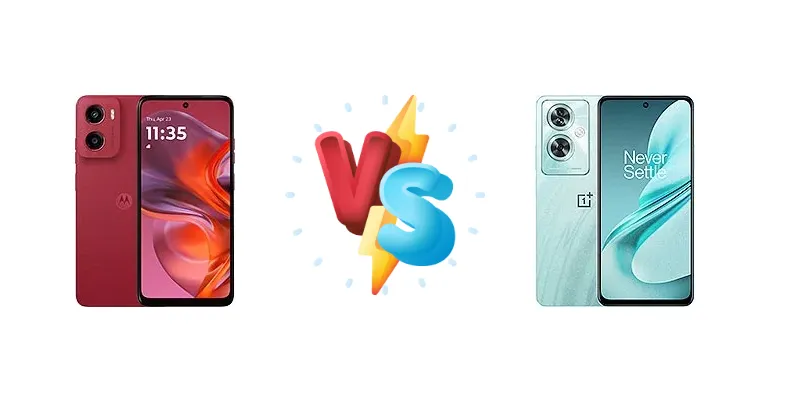
The sub-$200 smartphone market is fiercely competitive. The Motorola Moto G05, known for its impressive battery endurance, faces off against the newer OnePlus Nord N30 SE, which prioritizes faster charging and a more modern chipset. This comparison dives deep into the specs to determine which device offers the best overall experience for budget-conscious consumers.
🏆 Quick Verdict
For most users, the OnePlus Nord N30 SE emerges as the better choice. Its Mediatek Dimensity 6020 chipset, built on a 7nm process, delivers a noticeable performance uplift over the Moto G05’s Helio G81, and the 33W charging significantly reduces downtime. While the Moto G05 boasts exceptional battery endurance, the N30 SE’s efficiency and faster charging make it more practical for daily use.
| Network |
|---|
| 2G bands | GSM 850 / 900 / 1800 / 1900 | GSM 850 / 900 / 1800 / 1900 |
| 3G bands | HSDPA 850 / 900 / 2100 | HSDPA 850 / 900 / 1700(AWS) / 1900 / 2100 |
| 4G bands | 1, 3, 5, 7, 8, 20, 28, 38, 40, 41 | 1, 2, 3, 4, 5, 7, 8, 12, 13, 17, 18, 19, 20, 26, 28, 38, 39, 40, 41, 66 |
| 5G bands | - | 1, 3, 5, 7, 8, 20, 28, 38, 40, 41, 66, 77, 78 SA/NSA |
| Speed | HSPA, LTE | HSPA, LTE, 5G |
| Technology | GSM / HSPA / LTE | GSM / HSPA / LTE / 5G |
| Launch |
|---|
| Announced | 2024, December 17 | 2024, January 29 |
| Status | Available. Released 2025, January 13 | Available. Released 2024, January 31 |
| Body |
|---|
| Build | Glass front (Gorilla Glass 3), plastic frame, silicone polymer back (eco leather) | Glass front, plastic frame, plastic back |
| Dimensions | 165.7 x 76 x 8.2 mm (6.52 x 2.99 x 0.32 in) | 165.6 x 76 x 8 mm (6.52 x 2.99 x 0.31 in) |
| SIM | Nano-SIM + Nano-SIM | Nano-SIM + Nano-SIM |
| Weight | 188.8 g (6.67 oz) | 193 g (6.81 oz) |
| Display |
|---|
| Protection | Corning Gorilla Glass 3, Mohs level 6 | - |
| Resolution | 720 x 1604 pixels, 20:9 ratio (~264 ppi density) | 1080 x 2400 pixels, 20:9 ratio (~392 ppi density) |
| Size | 6.67 inches, 107.2 cm2 (~85.2% screen-to-body ratio) | 6.72 inches, 109.0 cm2 (~86.6% screen-to-body ratio) |
| Type | IPS LCD, 90Hz | IPS LCD |
| Platform |
|---|
| CPU | Octa-core (2x2.0 GHz Cortex-A75 & 6x1.7 GHz Cortex-A55) | Octa-core (2x2.2 GHz Cortex-A76 & 6x2.0 GHz Cortex-A55) |
| Chipset | Mediatek Helio G81 Extreme (12 nm) | Mediatek Dimensity 6020 (7 nm) |
| GPU | Mali-G52 MC2 | Mali-G57 MC2 |
| OS | Android 15 | Android 13, OxygenOS 13.1 |
| Memory |
|---|
| Card slot | microSDXC (dedicated slot) | No |
| Internal | 64GB 4GB RAM, 128GB 4GB RAM, 128GB 8GB RAM, 256GB 4GB RAM, 256GB 8GB RAM | 128GB 4GB RAM |
| Main Camera |
|---|
| Dual | - | 50 MP, f/1.8, (wide), 1/2.76", 0.64µm, PDAF
Auxiliary lens |
| Features | LED flash, HDR | LED flash, HDR, panorama |
| Single | 50 MP, f/1.8, (wide), PDAF | - |
| Video | 1080p@30fps | 1080p@30fps |
| Selfie camera |
|---|
| Features | HDR | - |
| Single | 8 MP, f/2.1, (wide), 1.12µm | 8 MP, f/2.0, (wide), 1/4.0", 1.12µm |
| Video | 1080p@30fps | 1080p@30fps |
| Sound |
|---|
| 35mm jack | Yes | Yes |
| Loudspeaker | Yes, with stereo speakers | Yes, with stereo speakers |
| Comms |
|---|
| Bluetooth | 5.0, A2DP, LE | 5.3, A2DP, LE |
| NFC | Yes (market/region dependent) | Yes |
| Positioning | GPS, GALILEO, GLONASS | GPS, GALILEO, GLONASS, BDS |
| Radio | No | No |
| USB | USB Type-C 2.0 | USB Type-C 2.0, OTG |
| WLAN | Wi-Fi 802.11 a/b/g/n/ac, dual-band | Wi-Fi 802.11 a/b/g/n/ac, dual-band |
| Features |
|---|
| Sensors | Fingerprint (side-mounted), accelerometer, proximity | Fingerprint (side-mounted), accelerometer, gyro, proximity, compass |
| Battery |
|---|
| Charging | 18W wired | 33W wired, 51% in 30 min |
| Type | 5200 mAh | 5000 mAh |
| Misc |
|---|
| Colors | Plum Red, Fresh Lavender, Forest Green, Misty Blue | Black Satin, Cyan |
| Models | XT2523-2, XT2523-3, XT2523-11 | CPH2605 |
| Price | € 82.38 / $ 108.00 / £ 77.00 / ₹ 7,316 | About 510 EUR |
| EU LABEL |
|---|
| Battery | 60:22h endurance, 1000 cycles | - |
| Energy | Class A | - |
| Free fall | Class B (180 falls) | - |
| Repairability | Class B | - |
Motorola Moto G05
- Exceptional battery endurance (60:22h)
- Proven reliability of the Motorola brand
- 1000 charge cycles promise long-term battery health
- Older, less efficient Helio G81 chipset
- Slower 18W charging
- Likely less responsive user experience
OnePlus Nord N30 SE
- More powerful and efficient Mediatek Dimensity 6020 chipset
- Faster 33W charging (51% in 30 min)
- Modern architecture for smoother performance
- Potentially shorter battery life compared to Moto G05
- OnePlus software can be polarizing
- May not match the G05's extreme endurance
Display Comparison
Neither device boasts a standout display. Details on panel technology (IPS, AMOLED) and resolution are missing, but the focus here is on performance. The absence of high refresh rates on both suggests a focus on power efficiency. While specific brightness nits aren't provided, the chipset differences suggest the N30 SE may be able to drive a slightly more vibrant display due to its more capable GPU.
Camera Comparison
Without detailed camera specs beyond the chipsets, a direct comparison is limited. However, the more powerful ISP (Image Signal Processor) within the Dimensity 6020 likely provides superior image processing capabilities, resulting in better dynamic range and noise reduction in photos and videos. The G05 will likely rely more heavily on software processing to compensate for its less advanced chipset. The presence of a 2MP macro lens on either device is largely irrelevant; image quality will be limited.
Performance
The OnePlus Nord N30 SE’s Mediatek Dimensity 6020 (7nm) represents a significant architectural leap over the Motorola Moto G05’s Helio G81 (12nm). The Dimensity 6020 utilizes Cortex-A76 cores clocked at 2.2 GHz, compared to the G05’s Cortex-A75 cores at 2.0 GHz. This translates to faster single-core and multi-core performance, making the N30 SE more responsive for everyday tasks and gaming. The 7nm process also contributes to better thermal efficiency, potentially reducing throttling during sustained workloads. The G05's G81 is still capable, but will show its age in demanding applications.
Battery Life
The Motorola Moto G05 claims an impressive 60:22h endurance, suggesting exceptional battery life. However, the OnePlus Nord N30 SE compensates for potentially slightly lower endurance with its 33W wired charging, capable of delivering 51% charge in just 30 minutes. The G05’s 18W charging is considerably slower. While the G05 excels in longevity, the N30 SE’s faster charging mitigates the impact of a potentially smaller battery capacity, offering a more convenient user experience.
Buying Guide
Buy the Motorola Moto G05 if you absolutely prioritize maximum battery life and are willing to sacrifice processing power and charging speed. This phone is ideal for users who frequently find themselves away from power outlets for extended periods. Buy the OnePlus Nord N30 SE if you value a smoother user experience, faster app loading times, and quicker charging, even if it means slightly less overall battery endurance. This is the better option for everyday users and light gamers.
Frequently Asked Questions
❓ Does the Mediatek Dimensity 6020 in the Nord N30 SE get hot during extended gaming sessions?
The Dimensity 6020's 7nm process is more efficient than the Helio G81's 12nm process, meaning it generates less heat under load. While some warming is expected during prolonged gaming, the N30 SE is less likely to experience significant throttling compared to the Moto G05.
❓ How does the 33W charging on the Nord N30 SE compare to using a power bank with the Moto G05?
The 33W charging on the N30 SE is significantly faster than charging via a power bank, even a high-capacity one. While a power bank offers convenience, it typically delivers a lower wattage, resulting in much slower charging times. The N30 SE's 33W charging gets you back to a usable charge much quicker.
❓ Is the difference in CPU performance between the Helio G81 and Dimensity 6020 noticeable in everyday tasks like browsing and social media?
Yes, the difference is noticeable. The Dimensity 6020's Cortex-A76 cores and more efficient architecture result in snappier app launches, smoother scrolling, and a more responsive overall user experience, even in everyday tasks. The G81 is adequate, but the N30 SE feels more fluid.