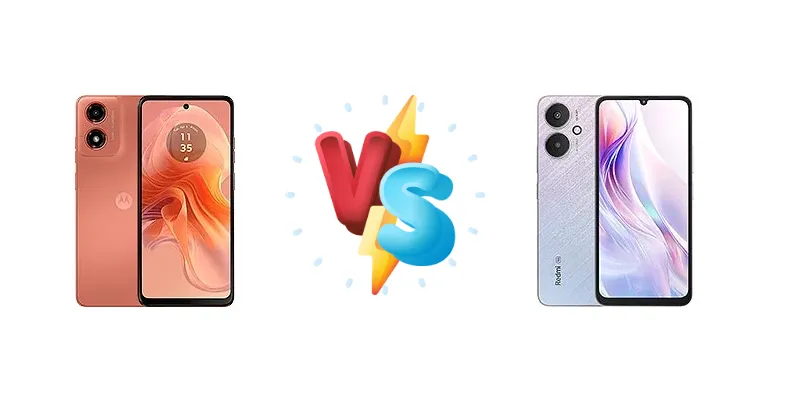
The sub-$200 5G smartphone market is fiercely competitive. The Motorola Moto G04 and Xiaomi Redmi 13C 5G represent two compelling options, but cater to slightly different priorities. The Moto G04 focuses on a clean software experience and affordability, while the Redmi 13C 5G aims for a more powerful chipset and faster charging, making this a crucial comparison for budget-conscious buyers.
🏆 Quick Verdict
For most users, the Xiaomi Redmi 13C 5G is the better choice. Its Mediatek Dimensity 6100+ chipset, built on a more efficient 6nm process, delivers noticeably improved performance compared to the Motorola Moto G04’s Unisoc T606. While the Moto G04 offers a simpler software experience, the Redmi 13C 5G’s performance advantage justifies the slight price difference.
| Network |
|---|
| 2G bands | GSM 850 / 900 / 1800 / 1900 | GSM 850 / 900 / 1800 / 1900 |
| 3G bands | HSDPA 850 / 900 / 2100 | HSDPA 800 / 850 / 900 / 1700(AWS) / 1900 / 2100 - International |
| 4G bands | 1, 3, 5, 7, 8, 20, 28, 38, 40, 41 | 1, 2, 3, 4, 5, 7, 8, 12, 13, 17, 18, 19, 20, 26, 28, 32, 38, 40, 41, 66 - International |
| 5G bands | - | 1, 3, 5, 7, 8, 20, 28, 38, 40, 41, 66, 77, 78 SA/NSA - International |
| Speed | HSPA, LTE | HSPA, LTE, 5G |
| Technology | GSM / HSPA / LTE | GSM / HSPA / LTE / 5G |
| Launch |
|---|
| Announced | 2024, January 18 | 2023, December 06 |
| Status | Available. Released 2024, February 07 | Available. Released 2023, December 16 |
| Body |
|---|
| Build | Glass front, plastic frame, plastic back | Glass front (Gorilla Glass 3), plastic frame, plastic back |
| Dimensions | 163.5 x 74.5 x 8 mm (6.44 x 2.93 x 0.31 in) | 168.1 x 77.9 x 8.2 mm (6.62 x 3.07 x 0.32 in) |
| SIM | · Nano-SIM· Nano-SIM + Nano-SIM | Nano-SIM + Nano-SIM |
| Weight | 178.8 g (6.31 oz) | 192 g or 195 g (6.77 oz) |
| Display |
|---|
| Protection | - | Corning Gorilla Glass 3 |
| Resolution | 720 x 1612 pixels, 20:9 ratio (~269 ppi density) | 720 x 1600 pixels, 20:9 ratio (~260 ppi density) |
| Size | 6.56 inches, 103.4 cm2 (~84.9% screen-to-body ratio) | 6.74 inches, 109.7 cm2 (~83.8% screen-to-body ratio) |
| Type | IPS LCD, 90Hz | IPS LCD, 90Hz, 450 nits (typ), 600 nits (HBM) |
| Platform |
|---|
| CPU | Octa-core (2x1.6 GHz Cortex-A75 & 6x1.6 GHz Cortex-A55) | Octa-core (2x2.2 GHz Cortex-A76 & 6x2.0 GHz Cortex-A55) |
| Chipset | Unisoc T606 (12 nm) | Mediatek Dimensity 6100+ (6 nm) |
| GPU | Mali-G57 MP1 | Mali-G57 MC2 |
| OS | Android 14, no major Android upgrades planned | Android 13, MIUI 14 |
| Memory |
|---|
| Card slot | microSDXC (dedicated slot) | microSDXC (dedicated slot) |
| Internal | 64GB 4GB RAM, 128GB 4GB RAM, 128GB 8GB RAM | 64GB 4GB RAM, 128GB 4GB RAM, 128GB 6GB RAM, 256GB 8GB RAM |
| Main Camera |
|---|
| Features | LED flash, HDR | LED flash, HDR |
| Single | 16 MP, f/2.2, (wide), 1.0µm, PDAF | 50 MP, f/1.8, 28mm (wide), 1/2.76", 1.12µm, PDAF
Auxiliary lens |
| Video | 1080p@30fps | 1080p@30fps |
| Selfie camera |
|---|
| Features | HDR | HDR |
| Single | 5 MP, f/2.2, (wide) | 5 MP, f/2.2, (wide) |
| Video | 1080p@30fps | 1080p@30fps |
| Sound |
|---|
| 35mm jack | Yes | Yes |
| Loudspeaker | Yes | Yes |
| Comms |
|---|
| Bluetooth | 5.0, A2DP, LE | 5.3, A2DP, LE |
| NFC | Yes (market/region dependent) | Yes (market/region dependent) |
| Positioning | GPS, GALILEO, GLONASS | GPS, GLONASS, GALILEO, BDS |
| Radio | No | FM radio |
| USB | USB Type-C 2.0 | USB Type-C 2.0, OTG |
| WLAN | Wi-Fi 802.11 a/b/g/n/ac, dual-band | Wi-Fi 802.11 a/b/g/n/ac, dual-band |
| Features |
|---|
| Sensors | Fingerprint (side-mounted), accelerometer, proximity | Fingerprint (side-mounted), accelerometer, compass |
| Battery |
|---|
| Charging | 15W wired | 18W wired, PD |
| Type | 5000 mAh | 5000 mAh |
| Misc |
|---|
| Colors | Concord Black, Sea Green, Satin Blue, Sunrise Orange | Starry Black, Twilight Blue, Starry Silver, Starlight Black, Startrail Green, Startrail Silver |
| Models | XT2421-2, XT2421-3 | 23124RN87G, 23124RN87I, 23124RN87C |
| Price | € 94.99 / $ 222.00 / £ 93.73 | $ 198.99 / £ 119.00 / € 116.99 / ₹ 10,895 |
| SAR | - | 1.09 W/kg (head) 1.09 W/kg (body) |
| SAR EU | - | 0.98 W/kg (head) 0.98 W/kg (body) |
Motorola Moto G04
- Clean Android software experience
- Affordable price point
- Potentially longer software support (Motorola's recent commitment)
- Less powerful Unisoc T606 chipset
- Slower 15W charging
- Likely lower performance in demanding tasks
Xiaomi Redmi 13C 5G
- More powerful Mediatek Dimensity 6100+ chipset
- Faster 18W charging with PD
- Larger display for media consumption
- Xiaomi’s MIUI software can be bloated
- Potentially shorter software support compared to Motorola
- May be slightly more expensive
Display Comparison
Neither device boasts a standout display. Both likely utilize LCD panels, a common cost-saving measure in this segment. However, details like peak brightness and color gamut coverage are missing. The Redmi 13C 5G’s larger screen size (typically 6.74 inches vs. the Moto G04’s 6.5 inches) may appeal to media consumers, but this comes at the cost of potentially lower pixel density. Without specific display specs, it’s difficult to declare a clear winner, but the larger screen of the Redmi 13C 5G offers a more immersive viewing experience.
Camera Comparison
Both phones likely feature a primary camera paired with depth and macro sensors. However, specific sensor sizes and apertures are unavailable. Given the price point, image quality will be adequate for casual photography in good lighting conditions. The Redmi 13C 5G may benefit from Mediatek’s image signal processor (ISP) offering slightly better noise reduction and dynamic range. The inclusion of a 2MP macro camera on both devices is largely a marketing tactic, offering limited practical value due to the low resolution and lack of optical image stabilization (OIS).
Performance
The performance gap is the most significant differentiator. The Xiaomi Redmi 13C 5G’s Mediatek Dimensity 6100+ (6nm) is a substantial upgrade over the Motorola Moto G04’s Unisoc T606 (12nm). The 6nm process node inherently offers better power efficiency and thermal characteristics, translating to sustained performance under load. Furthermore, the Dimensity 6100+ features faster Cortex-A76 cores (2.2 GHz) compared to the Moto G04’s Cortex-A75 cores (1.6 GHz), resulting in a more responsive user experience and improved app launch times. This benefits users who engage in mobile gaming or frequently switch between applications.
Battery Life
The Redmi 13C 5G’s 18W charging with Power Delivery (PD) support is a clear advantage over the Moto G04’s 15W charging. PD allows for more efficient charging and compatibility with a wider range of chargers. While battery capacity isn’t specified, the faster charging speed of the Redmi 13C 5G means less time tethered to an outlet. The more efficient Dimensity 6100+ chipset also contributes to potentially longer battery life, offsetting any potential capacity differences.
Buying Guide
Buy the Motorola Moto G04 if you prioritize a streamlined Android experience with minimal bloatware and are primarily focused on basic smartphone tasks like calling, texting, and light social media use. Buy the Xiaomi Redmi 13C 5G if you value performance for gaming, multitasking, and demanding applications, and appreciate faster charging speeds for extended usability throughout the day.
Frequently Asked Questions
❓ Will the Dimensity 6100+ in the Redmi 13C 5G overheat during prolonged gaming sessions?
The Dimensity 6100+ is built on a 6nm process, which is more efficient than the 12nm Unisoc T606. This means it generates less heat under load. While it won't match the thermal performance of flagship chips, it should handle moderate gaming sessions without significant throttling, especially given the phone's likely plastic construction which aids in heat dissipation.
❓ Is Xiaomi's MIUI software heavily laden with bloatware, and can it be removed?
MIUI is known for including pre-installed apps (bloatware). However, many of these can be uninstalled or disabled. Xiaomi has been improving MIUI in recent versions, reducing the amount of bloatware and offering more customization options. It's worth noting that the software experience is a subjective preference, and some users may prefer Motorola's cleaner Android implementation.
❓ Does the Moto G04 support VoLTE and VoWiFi for improved call quality?
While not explicitly stated, Motorola typically includes VoLTE (Voice over LTE) and VoWiFi (Voice over Wi-Fi) support in its smartphones, even at the budget level. However, compatibility depends on your carrier, so it's best to check with your mobile provider to confirm support in your region.