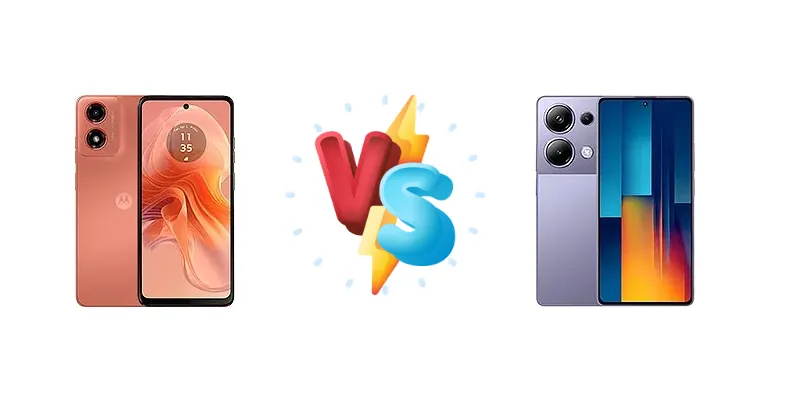
The sub-$200 smartphone market is fiercely competitive. The Motorola Moto G04 aims for affordability and efficiency, while the Xiaomi Poco M6 Pro 4G prioritizes performance and rapid charging. This comparison dissects their key differences to determine which device delivers the best value for your money.
🏆 Quick Verdict
For most users, the Xiaomi Poco M6 Pro 4G is the superior choice. Its significantly faster 67W charging, brighter display, and more powerful Mediatek Helio G99 Ultra chipset offer a noticeably smoother and more versatile experience, justifying the potential slight price premium.
| Network |
|---|
| 2G bands | GSM 850 / 900 / 1800 / 1900 | GSM 850 / 900 / 1800 / 1900 |
| 3G bands | HSDPA 850 / 900 / 2100 | HSDPA 800 / 850 / 900 / 1700(AWS) / 1900 / 2100 |
| 4G bands | 1, 3, 5, 7, 8, 20, 28, 38, 40, 41 | 1, 2, 3, 4, 5, 7, 8, 12, 13, 17, 18, 19, 20, 26, 28, 38, 40, 41, 66 |
| Speed | HSPA, LTE | HSPA, LTE |
| Technology | GSM / HSPA / LTE | GSM / HSPA / LTE |
| Launch |
|---|
| Announced | 2024, January 18 | 2024, January 11 |
| Status | Available. Released 2024, February 07 | Available. Released 2024, January 12 |
| Body |
|---|
| Build | Glass front, plastic frame, plastic back | Glass front (Gorilla Glass 5), plastic frame |
| Dimensions | 163.5 x 74.5 x 8 mm (6.44 x 2.93 x 0.31 in) | 161.1 x 75 x 8 mm (6.34 x 2.95 x 0.31 in) |
| SIM | · Nano-SIM· Nano-SIM + Nano-SIM | Nano-SIM + Nano-SIM |
| Weight | 178.8 g (6.31 oz) | 179 g (6.31 oz) |
| Display |
|---|
| Protection | - | Corning Gorilla Glass 5 |
| Resolution | 720 x 1612 pixels, 20:9 ratio (~269 ppi density) | 1080 x 2400 pixels, 20:9 ratio (~395 ppi density) |
| Size | 6.56 inches, 103.4 cm2 (~84.9% screen-to-body ratio) | 6.67 inches, 107.4 cm2 (~88.9% screen-to-body ratio) |
| Type | IPS LCD, 90Hz | AMOLED, 120Hz, 1000 nits (HBM), 1300 nits (peak) |
| Platform |
|---|
| CPU | Octa-core (2x1.6 GHz Cortex-A75 & 6x1.6 GHz Cortex-A55) | Octa-core (2x2.2 GHz Cortex-A76 & 6x2.0 GHz Cortex-A55) |
| Chipset | Unisoc T606 (12 nm) | Mediatek Helio G99 Ultra |
| GPU | Mali-G57 MP1 | Mali-G57 MC2 |
| OS | Android 14, no major Android upgrades planned | Android 13, MIUI 14, planned upgrade to Android 14, HyperOS |
| Memory |
|---|
| Card slot | microSDXC (dedicated slot) | microSDXC (uses shared SIM slot) |
| Internal | 64GB 4GB RAM, 128GB 4GB RAM, 128GB 8GB RAM | 256GB 8GB RAM, 512GB 12GB RAM |
| Main Camera |
|---|
| Features | LED flash, HDR | LED flash, HDR, panorama |
| Single | 16 MP, f/2.2, (wide), 1.0µm, PDAF | - |
| Triple | - | 64 MP, f/1.8, 25mm (wide), 1/2.0", 0.7µm, PDAF, OIS
8 MP, f/2.2, (ultrawide)
2 MP (macro) |
| Video | 1080p@30fps | 1080p@30/60fps, gyro-EIS |
| Selfie camera |
|---|
| Features | HDR | - |
| Single | 5 MP, f/2.2, (wide) | 16 MP, f/2.5, (wide) |
| Video | 1080p@30fps | 1080p@30/60fps |
| Sound |
|---|
| 35mm jack | Yes | Yes |
| Loudspeaker | Yes | Yes, with dual speakers |
| Comms |
|---|
| Bluetooth | 5.0, A2DP, LE | 5.2, A2DP, LE |
| Infrared port | - | Yes |
| NFC | Yes (market/region dependent) | Yes (market/region dependent) |
| Positioning | GPS, GALILEO, GLONASS | GPS, GALILEO, GLONASS, BDS |
| Radio | No | FM radio |
| USB | USB Type-C 2.0 | USB Type-C 2.0, OTG |
| WLAN | Wi-Fi 802.11 a/b/g/n/ac, dual-band | Wi-Fi 802.11 a/b/g/n/ac, dual-band |
| Features |
|---|
| Sensors | Fingerprint (side-mounted), accelerometer, proximity | Fingerprint (under display, optical), accelerometer, gyro, compass |
| Battery |
|---|
| Charging | 15W wired | 67W wired, 100% in 44 min |
| Type | 5000 mAh | 5000 mAh |
| Misc |
|---|
| Colors | Concord Black, Sea Green, Satin Blue, Sunrise Orange | Black, Blue, Purple |
| Models | XT2421-2, XT2421-3 | 2312FPCA6G |
| Price | € 94.99 / $ 222.00 / £ 93.73 | $ 170.00 |
| SAR | - | 1.09 W/kg (head) 1.09 W/kg (body) |
| SAR EU | - | 0.99 W/kg (head) 0.99 W/kg (body) |
Motorola Moto G04
- Potentially longer battery life (depending on capacity)
- Simple and user-friendly software experience
- Motorola's reputation for software updates
- Significantly slower charging speed
- Less powerful processor for demanding tasks
- Likely dimmer display
Xiaomi Poco M6 Pro 4G
- Extremely fast 67W charging
- More powerful Mediatek Helio G99 Ultra processor
- Brighter and more vibrant display
- Excellent active use battery score
- Xiaomi's MIUI software can be polarizing
- Potential for more bloatware
Display Comparison
The Poco M6 Pro 4G boasts a significantly brighter display, reaching a measured 1053 nits. This is a substantial advantage over what we’d expect from the Moto G04, making it far more usable outdoors in direct sunlight. While the Moto G04’s panel specifics are unknown, the brightness difference alone positions the Poco as the winner for visual clarity. The Poco’s higher brightness also suggests a more vibrant and engaging viewing experience for videos and photos. We can assume both use IPS LCD panels given the price point, but the Poco’s brightness is the key differentiator.
Camera Comparison
Both phones likely feature a multi-camera setup, but the context data only mentions 'Photo / Video' for the Poco M6 Pro 4G. Without specific sensor details for the Moto G04, it’s difficult to make a direct comparison. However, given the Poco M6 Pro 4G’s positioning, it’s reasonable to expect a more capable main sensor and potentially better image processing algorithms. The absence of details regarding OIS or large sensor sizes on either phone suggests a focus on affordability over premium camera features. Users should manage expectations regarding low-light performance on both devices.
Performance
The core difference lies in the chipsets. The Poco M6 Pro 4G’s Mediatek Helio G99 Ultra, with its 2x2.2 GHz Cortex-A76 cores and 6x2.0 GHz Cortex-A55 cores, offers a considerable performance uplift compared to the Moto G04’s Unisoc T606 (2x1.6 GHz Cortex-A75 & 6x1.6 GHz Cortex-A55). The G99 Ultra’s higher clock speeds and more efficient core architecture translate to faster app loading times, smoother multitasking, and improved gaming performance. While both are octa-core CPUs, the architectural advantage of the G99 Ultra is significant. The Moto G04 will handle basic tasks adequately, but the Poco M6 Pro 4G is the clear winner for demanding users.
Battery Life
The Poco M6 Pro 4G truly shines with its 67W wired charging, achieving a full charge in just 44 minutes. This is a game-changer compared to the Moto G04’s slow 15W charging. While the Moto G04 may have a larger battery capacity (unspecified), the Poco’s rapid charging minimizes downtime. The Poco M6 Pro 4G also boasts an impressive 11:46h active use score, indicating excellent battery life despite the faster charging. The convenience of quickly topping up the battery outweighs any potential capacity advantage the Moto G04 might have.
Buying Guide
Buy the Motorola Moto G04 if you prioritize a simple, reliable experience and are less concerned with demanding tasks or quick charging. It’s ideal for basic communication, light social media, and users who value long-term software support from Motorola. Buy the Xiaomi Poco M6 Pro 4G if you want a phone capable of handling gaming, streaming, and multitasking with ease, and if minimizing downtime due to charging is a priority. It’s the better option for power users and those who demand more from their smartphone.
Frequently Asked Questions
❓ Is the Mediatek Helio G99 Ultra in the Poco M6 Pro 4G capable of running demanding games like PUBG or Call of Duty Mobile?
Yes, the Helio G99 Ultra is a capable gaming chipset for its price range. While it won't deliver flagship-level performance, it can comfortably run PUBG and Call of Duty Mobile at medium to high settings with playable frame rates. The Poco M6 Pro 4G’s thermal management will be a factor during extended gaming sessions, but it’s generally well-suited for mobile gaming.
❓ How long will it realistically take to fully charge the Motorola Moto G04 from 0%?
With its 15W charging, fully charging the Moto G04 from 0% will likely take around 2.5 to 3.5 hours. This is a significant drawback compared to the Poco M6 Pro 4G’s 44-minute charge time. Users who frequently need to top up their phone will find the Moto G04’s charging speed frustratingly slow.
❓ Does the Poco M6 Pro 4G's MIUI software come with a lot of pre-installed bloatware?
Xiaomi's MIUI is known for including pre-installed apps, often referred to as bloatware. While the amount has decreased in recent versions, users can expect to find several apps pre-loaded on the Poco M6 Pro 4G. Fortunately, many of these apps can be uninstalled or disabled, allowing you to customize the software to your preferences.
❓ What type of USB port do both phones use?
Both the Motorola Moto G04 and the Xiaomi Poco M6 Pro 4G utilize a USB-C port for charging and data transfer. This is the current standard for most smartphones, offering faster data transfer speeds and reversible connectivity.