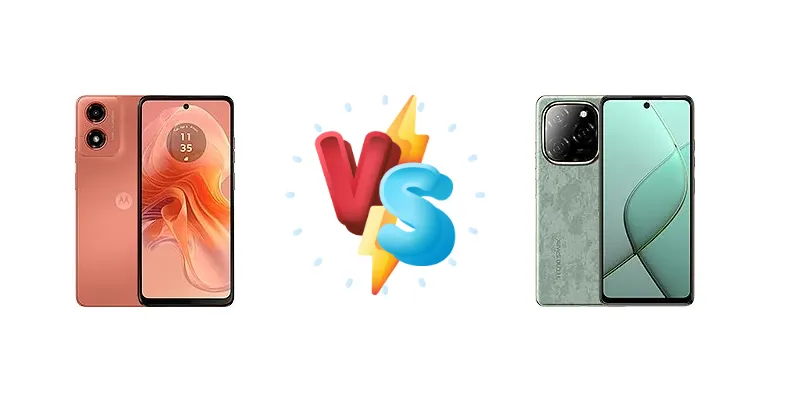
The sub-$200 5G smartphone market is fiercely competitive. The Motorola Moto G04 and Tecno Spark 20 Pro 5G represent compelling options, but cater to slightly different priorities. The Moto G04 focuses on providing a reliable, basic 5G experience, while the Tecno Spark 20 Pro 5G aims for a more performance-driven approach, leveraging a more modern chipset and faster charging.
🏆 Quick Verdict
For the average user prioritizing responsiveness and future-proofing, the Tecno Spark 20 Pro 5G is the better choice. Its Mediatek Dimensity 6080 chipset delivers significantly improved CPU and GPU performance compared to the Moto G04’s Unisoc T606, and the 33W charging drastically reduces downtime. While the Moto G04 offers a functional experience, the Spark 20 Pro 5G provides a more compelling value proposition.
| Network |
|---|
| 2G bands | GSM 850 / 900 / 1800 / 1900 | GSM 850 / 900 / 1800 / 1900 |
| 3G bands | HSDPA 850 / 900 / 2100 | HSDPA 850 / 900 / 1700(AWS) / 1900 / 2100 |
| 4G bands | 1, 3, 5, 7, 8, 20, 28, 38, 40, 41 | LTE |
| 5G bands | - | SA/NSA |
| Speed | HSPA, LTE | HSPA, LTE, 5G |
| Technology | GSM / HSPA / LTE | GSM / HSPA / LTE / 5G |
| Launch |
|---|
| Announced | 2024, January 18 | 2024, June 17 |
| Status | Available. Released 2024, February 07 | Available. Released 2024, June 20 |
| Body |
|---|
| Build | Glass front, plastic frame, plastic back | - |
| Dimensions | 163.5 x 74.5 x 8 mm (6.44 x 2.93 x 0.31 in) | 168.5 x 76.2 x 8.3 mm or 8.5 mm |
| SIM | · Nano-SIM· Nano-SIM + Nano-SIM | Nano-SIM + Nano-SIM |
| Weight | 178.8 g (6.31 oz) | 200 g or 201.5 g (7.05 oz) |
| Display |
|---|
| Resolution | 720 x 1612 pixels, 20:9 ratio (~269 ppi density) | 1080 x 2460 pixels (~396 ppi density) |
| Size | 6.56 inches, 103.4 cm2 (~84.9% screen-to-body ratio) | 6.78 inches, 109.2 cm2 (~85.0% screen-to-body ratio) |
| Type | IPS LCD, 90Hz | IPS LCD, 120Hz |
| Platform |
|---|
| CPU | Octa-core (2x1.6 GHz Cortex-A75 & 6x1.6 GHz Cortex-A55) | Octa-core (2x2.4 GHz Cortex-A76 & 6x2.0 GHz Cortex-A55) |
| Chipset | Unisoc T606 (12 nm) | Mediatek Dimensity 6080 (6 nm) |
| GPU | Mali-G57 MP1 | Mali-G57 MC2 |
| OS | Android 14, no major Android upgrades planned | Android 14 |
| Memory |
|---|
| Card slot | microSDXC (dedicated slot) | microSDXC (dedicated slot) |
| Internal | 64GB 4GB RAM, 128GB 4GB RAM, 128GB 8GB RAM | 128GB 8GB RAM, 256GB 8GB RAM |
| Main Camera |
|---|
| Dual | - | 108 MP, f/1.8, (wide), 1/1.67", 0.64µm, PDAF
2 MP (macro) |
| Features | LED flash, HDR | Quad-LED flash |
| Single | 16 MP, f/2.2, (wide), 1.0µm, PDAF | - |
| Video | 1080p@30fps | 1440p@30fps, 1080p@30fps |
| Selfie camera |
|---|
| Features | HDR | Dual-LED dual-tone flash |
| Single | 5 MP, f/2.2, (wide) | 8 MP, (wide) |
| Video | 1080p@30fps | 1440p@30fps, 1080p@30fps |
| Sound |
|---|
| 35mm jack | Yes | No |
| Loudspeaker | Yes | Yes, with stereo speakers |
| Comms |
|---|
| Bluetooth | 5.0, A2DP, LE | 5.3, A2DP, LE |
| NFC | Yes (market/region dependent) | Yes |
| Positioning | GPS, GALILEO, GLONASS | GPS, GLONASS |
| Radio | No | FM radio |
| USB | USB Type-C 2.0 | USB Type-C |
| WLAN | Wi-Fi 802.11 a/b/g/n/ac, dual-band | Wi-Fi 802.11 a/b/g/n/ac, dual-band |
| Features |
|---|
| Sensors | Fingerprint (side-mounted), accelerometer, proximity | Fingerprint (side-mounted), accelerometer, proximity, compass |
| Battery |
|---|
| Charging | 15W wired | 33W wired |
| Type | 5000 mAh | 5000 mAh |
| Misc |
|---|
| Colors | Concord Black, Sea Green, Satin Blue, Sunrise Orange | Startrail Black, Glossy White, Neon Green |
| Models | XT2421-2, XT2421-3 | KJ8 |
| Price | € 94.99 / $ 222.00 / £ 93.73 | About 180 EUR |
Motorola Moto G04
- Potentially longer battery life due to less demanding chipset.
- Simple and straightforward user experience.
- Reliable brand reputation for software updates (Motorola).
- Significantly slower charging speed (15W).
- Less powerful processor for demanding tasks.
- Older chipset architecture (Unisoc T606).
Tecno Spark 20 Pro 5G
- Faster and more efficient processor (Dimensity 6080).
- Significantly faster charging (33W).
- More responsive user experience.
- Potentially shorter battery life due to more powerful processor.
- Tecno’s software experience can be inconsistent.
- May run slightly warmer under heavy load.
Display Comparison
Neither device boasts a standout display. Both likely utilize LCD panels, common in this price bracket. However, the core difference lies beneath the surface. Without specific display specs, we can infer that the Tecno Spark 20 Pro 5G, given its more modern chipset, may benefit from a slightly more efficient display driver, potentially leading to marginally better color reproduction. Bezels are likely comparable, and both will likely target 60Hz refresh rates to conserve power.
Camera Comparison
Without detailed camera specifications, a direct comparison is challenging. However, the chipset’s image signal processor (ISP) plays a crucial role. The Dimensity 6080 in the Tecno Spark 20 Pro 5G features a more advanced ISP, enabling better image processing, noise reduction, and dynamic range. While both phones likely feature a primary camera, the Spark 20 Pro 5G’s ISP will likely extract more detail and produce more visually appealing images, especially in challenging lighting conditions. The presence of a 2MP macro camera on either device is largely a marketing tactic and offers limited practical benefit.
Performance
The performance gap is the most significant differentiator. The Tecno Spark 20 Pro 5G’s Mediatek Dimensity 6080, fabricated on a 6nm process, is a substantial upgrade over the Motorola Moto G04’s Unisoc T606 (12nm). The Dimensity 6080’s Cortex-A76 cores, clocked at 2.4 GHz, offer a noticeable performance boost over the G04’s Cortex-A75 cores at 1.6 GHz. This translates to faster app loading times, smoother multitasking, and improved gaming performance. The 6nm process also contributes to better thermal efficiency, reducing the likelihood of throttling under sustained load. The G04 will handle basic tasks adequately, but the Spark 20 Pro 5G is the clear winner for demanding users.
Battery Life
The Moto G04’s 15W charging is a significant drawback compared to the Tecno Spark 20 Pro 5G’s 33W charging. While battery capacity isn’t specified, the faster charging speed of the Spark 20 Pro 5G dramatically reduces downtime. A full charge on the G04 will take considerably longer. The Unisoc T606’s 12nm process is less efficient than the Dimensity 6080’s 6nm process, meaning the G04 may consume more power for similar tasks, potentially offsetting any battery capacity advantage.
Buying Guide
Buy the Motorola Moto G04 if you need a dependable, no-frills 5G smartphone with a focus on simplicity and extended battery life for basic tasks. Buy the Tecno Spark 20 Pro 5G if you prefer a smoother, more responsive experience for multitasking, gaming, and content creation, and value the convenience of significantly faster charging speeds.
Frequently Asked Questions
❓ Will the Dimensity 6080 in the Tecno Spark 20 Pro 5G overheat during prolonged gaming sessions?
The Dimensity 6080’s 6nm process and improved thermal management capabilities make overheating less likely than with the Unisoc T606. While some throttling may occur during extended, graphically intensive gaming, the Spark 20 Pro 5G is better equipped to handle sustained loads without significant performance degradation.
❓ Is the 15W charging on the Motorola Moto G04 slow enough to be a major inconvenience?
Yes, 15W charging is considerably slower than the 33W charging on the Tecno Spark 20 Pro 5G. Expect a significantly longer time to reach a full charge, potentially taking over two hours. This can be a major inconvenience for users who frequently need to top up their battery quickly.
❓ How does the Unisoc T606 chipset perform with multitasking compared to the Dimensity 6080?
The Unisoc T606 will struggle with heavy multitasking. The Dimensity 6080, with its more powerful cores and efficient architecture, handles multiple apps and background processes much more smoothly, resulting in a more responsive user experience.
❓ Are software updates guaranteed for both devices, and for how long?
Motorola generally provides more consistent software updates, including security patches, for a longer period than Tecno. While Tecno has improved its software support, Motorola remains the more reliable option in terms of long-term software maintenance.