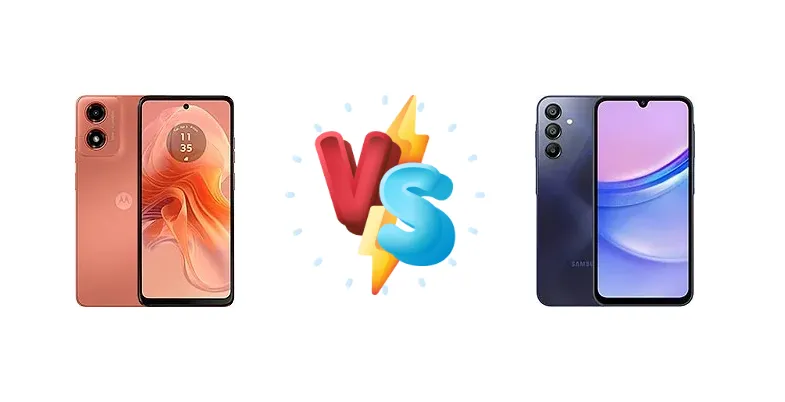
The Motorola Moto G04 and Samsung Galaxy A15 represent compelling options in the ultra-budget smartphone segment. While both aim to deliver essential smartphone functionality at an accessible price, they take different approaches to achieving this. The G04 prioritizes affordability, while the A15 attempts to balance cost with improved display quality and processing power. This comparison will dissect their key differences to determine which device best suits your needs.
🏆 Quick Verdict
For most users, the Samsung Galaxy A15 is the better choice. Its Mediatek Helio G99 chipset provides a noticeable performance uplift over the Moto G04’s Unisoc T606, and the significantly brighter 808 nit display enhances usability in outdoor conditions. The faster 25W charging is also a major advantage, despite a similar battery life.
| Network |
|---|
| 2G bands | GSM 850 / 900 / 1800 / 1900 | GSM 850 / 900 / 1800 / 1900 |
| 3G bands | HSDPA 850 / 900 / 2100 | HSDPA 850 / 900 / 2100 |
| 4G bands | 1, 3, 5, 7, 8, 20, 28, 38, 40, 41 | 1, 3, 5, 7, 8, 20, 28, 38, 40, 41 |
| Speed | HSPA, LTE | HSPA, LTE |
| Technology | GSM / HSPA / LTE | GSM / HSPA / LTE |
| Launch |
|---|
| Announced | 2024, January 18 | 2023, December 11 |
| Status | Available. Released 2024, February 07 | Available. Released 2023, December 16 |
| Body |
|---|
| Build | Glass front, plastic frame, plastic back | Glass front, plastic back, plastic frame |
| Dimensions | 163.5 x 74.5 x 8 mm (6.44 x 2.93 x 0.31 in) | 160.1 x 76.8 x 8.4 mm (6.30 x 3.02 x 0.33 in) |
| SIM | · Nano-SIM· Nano-SIM + Nano-SIM | · Nano-SIM· Nano-SIM + Nano-SIM |
| Weight | 178.8 g (6.31 oz) | 200 g (7.05 oz) |
| Display |
|---|
| Resolution | 720 x 1612 pixels, 20:9 ratio (~269 ppi density) | 1080 x 2340 pixels, 19.5:9 ratio (~396 ppi density) |
| Size | 6.56 inches, 103.4 cm2 (~84.9% screen-to-body ratio) | 6.5 inches, 103.7 cm2 (~84.3% screen-to-body ratio) |
| Type | IPS LCD, 90Hz | Super AMOLED, 90Hz, 800 nits (HBM) |
| Platform |
|---|
| CPU | Octa-core (2x1.6 GHz Cortex-A75 & 6x1.6 GHz Cortex-A55) | Octa-core (2x2.2 GHz Cortex-A76 & 6x2.0 GHz Cortex-A55) |
| Chipset | Unisoc T606 (12 nm) | Mediatek Helio G99 (6 nm) |
| GPU | Mali-G57 MP1 | Mali-G57 MC2 |
| OS | Android 14, no major Android upgrades planned | Android 14, up to 4 major Android upgrades, One UI 7 |
| Memory |
|---|
| Card slot | microSDXC (dedicated slot) | microSDXC (uses shared SIM slot) |
| Internal | 64GB 4GB RAM, 128GB 4GB RAM, 128GB 8GB RAM | 128GB 4GB RAM, 128GB 6GB RAM, 128GB 8GB RAM, 256GB 6GB RAM, 256GB 8GB RAM |
| Main Camera |
|---|
| Features | LED flash, HDR | LED flash, panorama, HDR |
| Single | 16 MP, f/2.2, (wide), 1.0µm, PDAF | - |
| Triple | - | 50 MP, f/1.8, 26mm (wide), 1/2.8", 0.64µm, PDAF
5 MP, f/2.2, 17mm (ultrawide), 1/5.0", 1.12µm
2 MP (macro) |
| Video | 1080p@30fps | 1080p@30fps |
| Selfie camera |
|---|
| Features | HDR | - |
| Single | 5 MP, f/2.2, (wide) | 13 MP, f/2.0, 26mm (wide), 1/3.06", 1.12µm |
| Video | 1080p@30fps | 1080p@30fps |
| Sound |
|---|
| 35mm jack | Yes | Yes |
| Loudspeaker | Yes | Yes |
| Comms |
|---|
| Bluetooth | 5.0, A2DP, LE | 5.3, A2DP, LE |
| NFC | Yes (market/region dependent) | Yes (market/region dependent) |
| Positioning | GPS, GALILEO, GLONASS | GPS, GALILEO, GLONASS, BDS, QZSS |
| Radio | No | FM radio (market/region dependent) |
| USB | USB Type-C 2.0 | USB Type-C 2.0 |
| WLAN | Wi-Fi 802.11 a/b/g/n/ac, dual-band | Wi-Fi 802.11 a/b/g/n/ac, dual-band, Wi-Fi Direct |
| Features |
|---|
| Sensors | Fingerprint (side-mounted), accelerometer, proximity | Fingerprint (side-mounted), accelerometer, compass |
| Battery |
|---|
| Charging | 15W wired | 25W wired |
| Type | 5000 mAh | 5000 mAh |
| Misc |
|---|
| Colors | Concord Black, Sea Green, Satin Blue, Sunrise Orange | Brave Black, Optimistic Blue, Magical Blue, Personality Yellow |
| Models | XT2421-2, XT2421-3 | SM-A155F, SM-A155F/DSN, SM-A155M, SM-A155M/DS, SM-A155P, SM-A155R |
| Price | € 94.99 / $ 222.00 / £ 93.73 | € 168.99 / $ 125.00 / £ 113.00 |
| SAR EU | - | 0.42 W/kg (head) 1.29 W/kg (body) |
Motorola Moto G04
- Potentially lower price point
- Clean, near-stock Android experience
- Simple and straightforward user interface
- Significantly weaker performance
- Less vibrant and dimmer display
- Slower charging speeds
Samsung Galaxy A15
- Brighter and more vibrant display
- Faster and more efficient processor
- Faster 25W charging
- Longer battery life in active use
- May have more pre-installed bloatware
- Slightly higher price
Display Comparison
The Samsung Galaxy A15 boasts a significantly brighter display, reaching a measured 808 nits, compared to the Moto G04’s unspecified brightness. This difference is crucial for outdoor visibility, where the A15 will remain readable in direct sunlight while the G04 may struggle. While both likely utilize LCD panels given their price point, the A15’s higher peak brightness suggests a more advanced backlight system. Bezels are expected to be similar on both devices, reflecting their budget positioning. Color accuracy is also likely to be superior on the A15, benefiting from Samsung’s display expertise.
Camera Comparison
Without detailed camera specifications beyond the presence of cameras, a direct comparison is difficult. However, given Samsung’s generally more sophisticated image processing algorithms, the Galaxy A15 is likely to produce more visually appealing photos, particularly in challenging lighting conditions. The A15 likely benefits from better dynamic range and noise reduction. The Moto G04’s camera system will likely focus on basic functionality, suitable for casual snapshots. It's reasonable to assume both devices will include a standard macro camera, which are often of limited utility.
Performance
The Mediatek Helio G99 in the Galaxy A15 represents a substantial upgrade over the Unisoc T606 found in the Moto G04. The G99, fabricated on a more efficient 6nm process versus the T606’s 12nm, delivers better performance and thermal efficiency. The CPU configuration further highlights this difference: the A15 features 2x2.2 GHz Cortex-A76 cores alongside 6x2.0 GHz Cortex-A55 cores, while the G04 has 2x1.6 GHz Cortex-A75 cores and 6x1.6 GHz Cortex-A55 cores. The A76 cores in the A15 offer a significant architectural advantage, resulting in faster application loading and smoother multitasking. While both phones likely feature similar RAM configurations, the A15’s superior chipset will maximize its effectiveness.
Battery Life
The Samsung Galaxy A15 delivers a strong battery performance, achieving 15 hours and 28 minutes of active use. While the Moto G04’s battery capacity is not specified, the A15’s 25W wired charging significantly outperforms the G04’s 15W charging. This translates to faster top-ups, reducing downtime. The A15’s more efficient chipset also contributes to its impressive battery life, allowing it to extract more usage from its battery capacity. A full charge on the A15 will be considerably quicker than on the G04.
Buying Guide
Buy the Motorola Moto G04 if you absolutely need the lowest possible price and prioritize a clean, near-stock Android experience. It’s suitable for basic communication, light social media use, and minimal multitasking. Buy the Samsung Galaxy A15 if you value a brighter, more vibrant display, smoother performance for everyday tasks and gaming, and faster charging capabilities. It’s ideal for users who consume more media and demand a more responsive user experience.
Frequently Asked Questions
❓ Does the Mediatek Helio G99 in the Galaxy A15 get hot during extended gaming sessions?
The Helio G99 is a relatively efficient chipset, and while it will generate heat during prolonged gaming, its 6nm process helps mitigate thermal throttling. Samsung likely incorporates thermal management solutions to maintain stable performance for extended periods, though it won't match flagship-level cooling.
❓ Is the 15W charging on the Moto G04 slow enough to be a significant inconvenience?
Yes, 15W charging is noticeably slower than the 25W charging on the Galaxy A15. Expect a significantly longer time to fully charge the Moto G04, potentially taking over 3 hours for a complete 0-100% charge, making it less convenient for users who need quick top-ups.
❓ How does the Unisoc T606 perform with multitasking and app switching?
The Unisoc T606 is adequate for basic multitasking, such as switching between messaging apps and web browsing. However, it will struggle with more demanding tasks like running multiple apps simultaneously or switching between resource-intensive applications. Expect noticeable lag and slowdowns.
❓ Will the Galaxy A15 receive software updates and security patches for an extended period?
Samsung generally provides better software support than Motorola in this price segment. The Galaxy A15 is likely to receive at least two major Android updates and several years of security patches, offering a longer lifespan and improved security compared to the Moto G04.